Skip to content
A tractor unit that leaves the carriageway on the A7 towards Hannover is not an ordinary breakdown. Once a vehicle ends up on the embankment or below road level, an ordinary tow truck stops being an option. What’s needed is a mobile crane, a coordinated team, and cooperation with the police that a simple tyre blowout never requires.
On 24 July, during daylight hours, exactly this kind of case came up near Hildesheim: a Scania tractor unit had left the carriageway and come to rest in a position from which rope and winch could not extract it. What follows is a plain account of a heavy-duty crane recovery, the most expensive and technically demanding category of our work.
If you drive an artic yourself or manage a fleet, here is a straightforward breakdown: when a crane is genuinely necessary, how tonnage is actually calculated, what role the police play, and why cutting corners here ends up costing more in the long run.
The situation: when a tow truck is no longer enough
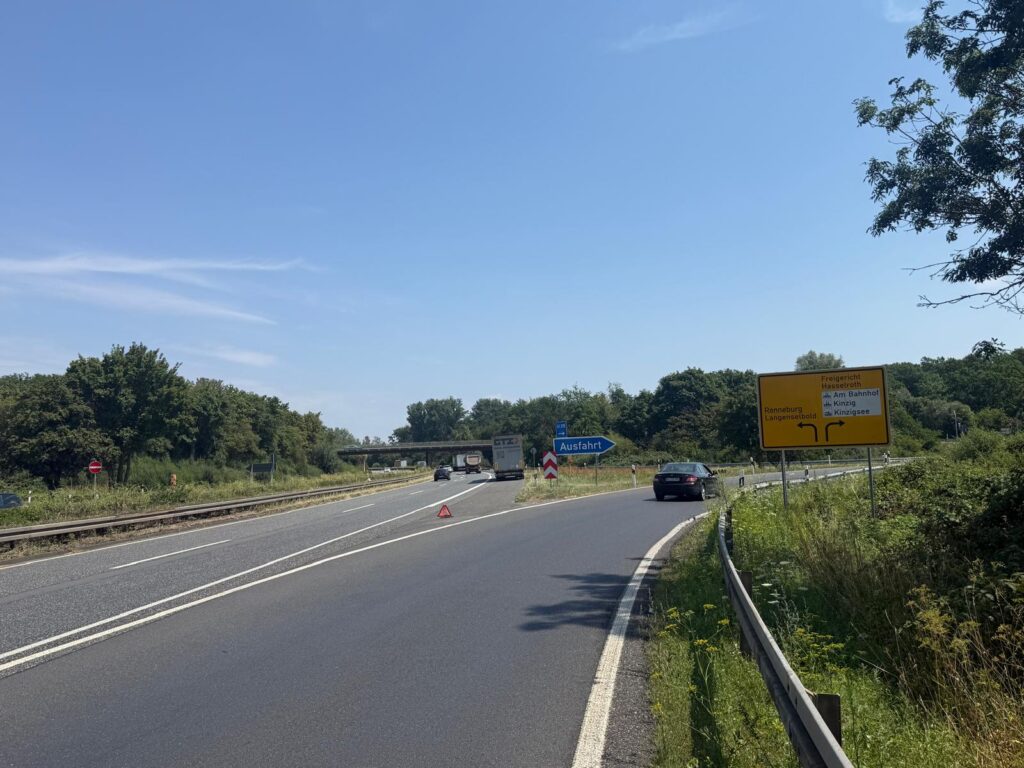
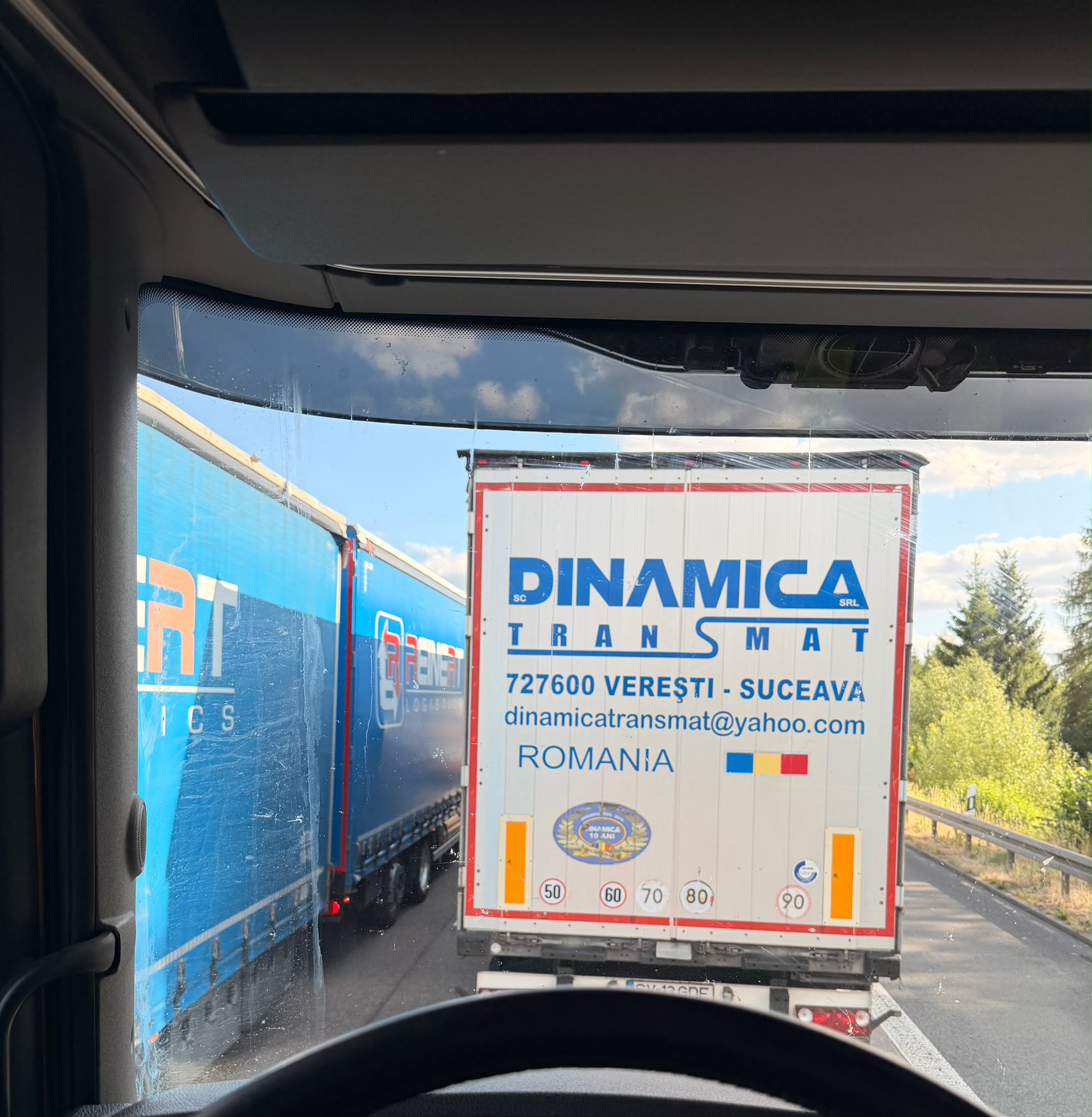
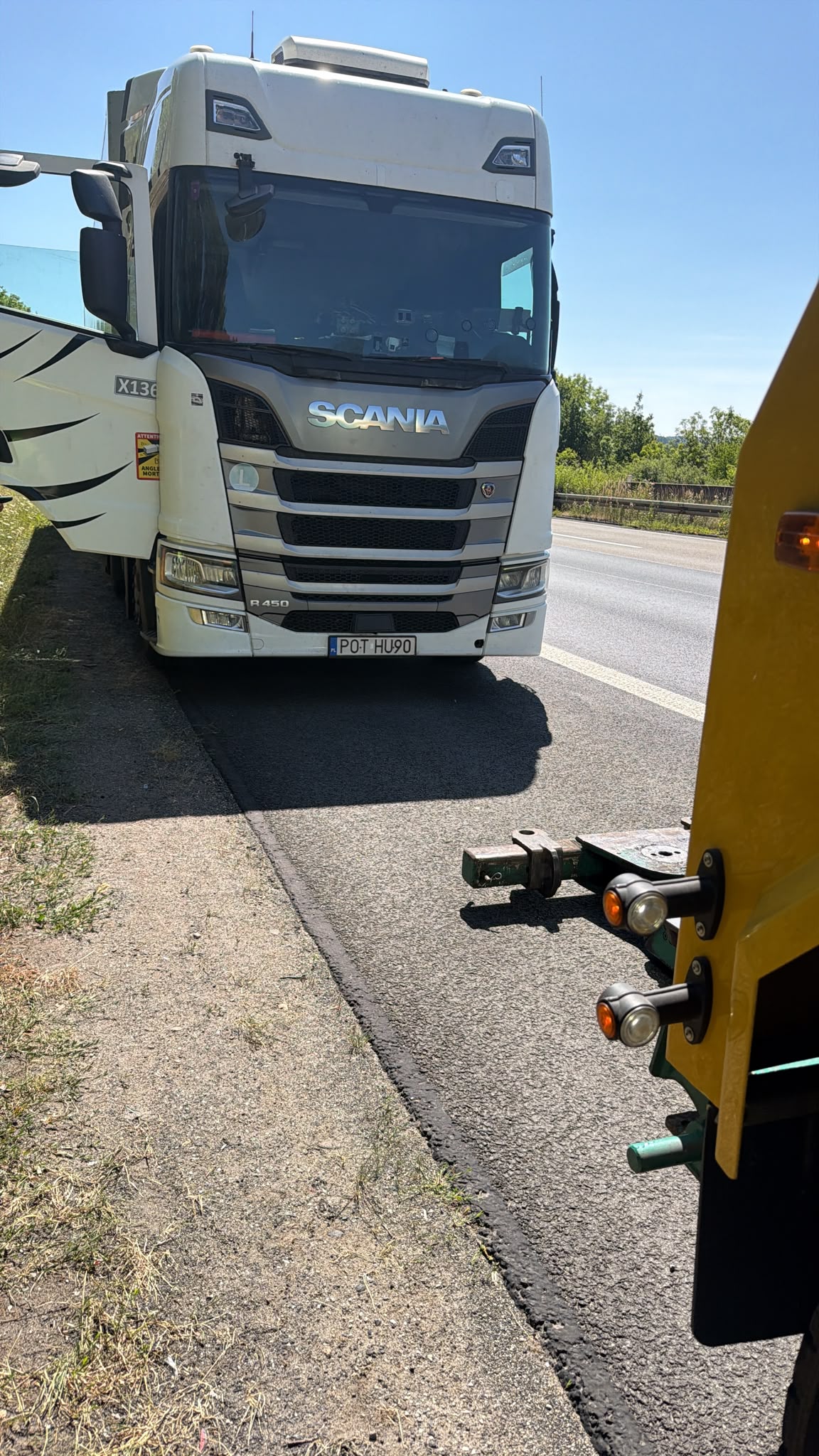
On the A7 heading towards Hannover, an artic had run off the carriageway. The Scania tractor unit ended up in a position that ruled out a straight pull upward or sideways — the transition from the road to the embankment made a simple drag-out impossible without damaging the frame or axles.
That’s precisely where an ordinary tow truck’s job ends. A crane lifts the vehicle vertically or in a controlled arc rather than dragging it across the ground. That’s the key difference: pulling generates lateral and diagonal forces on the frame and steering knuckles that quickly cause lasting damage on a laden 40-tonne artic. A crane, by contrast, applies vertical force at defined lifting points.
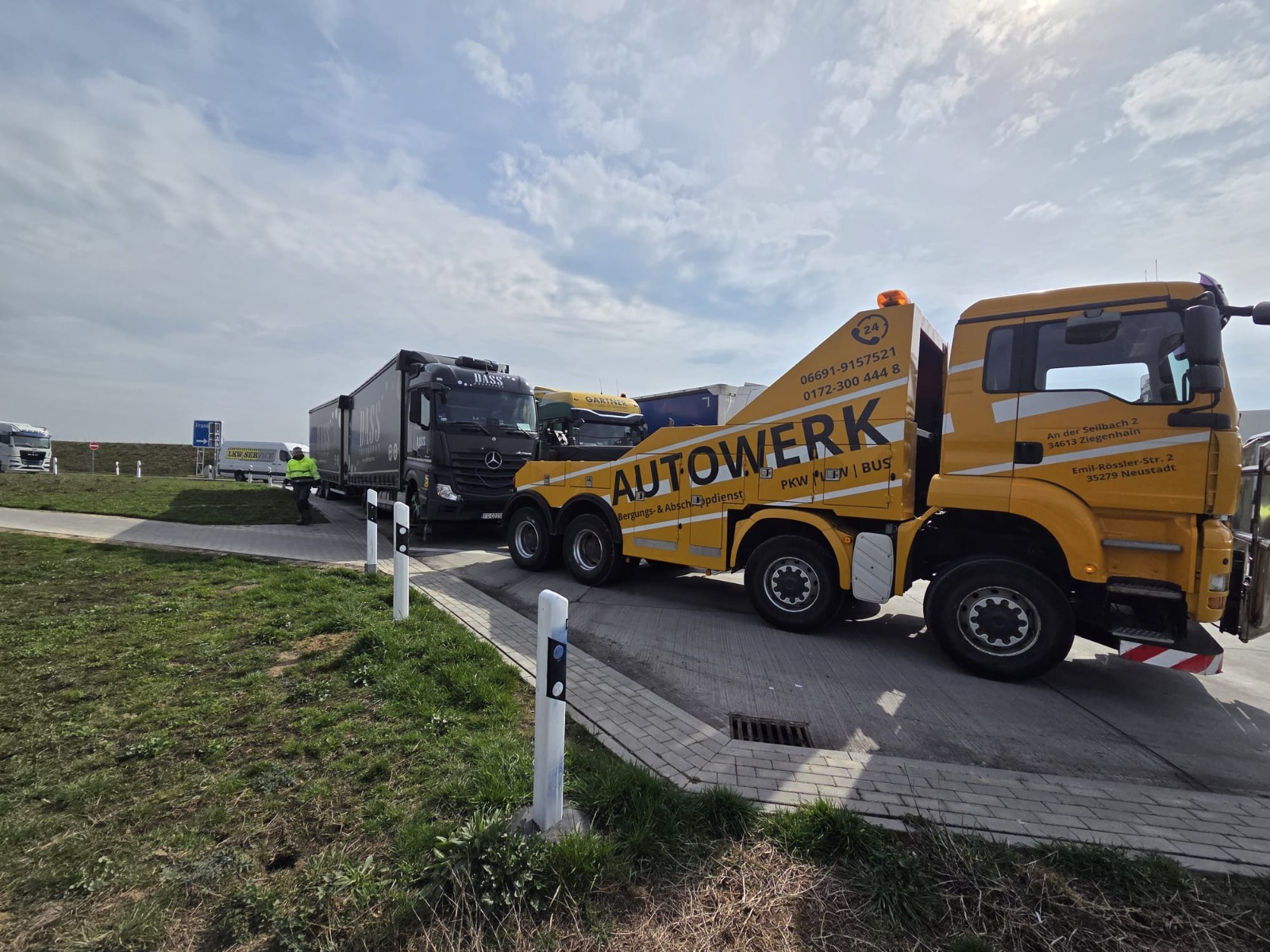
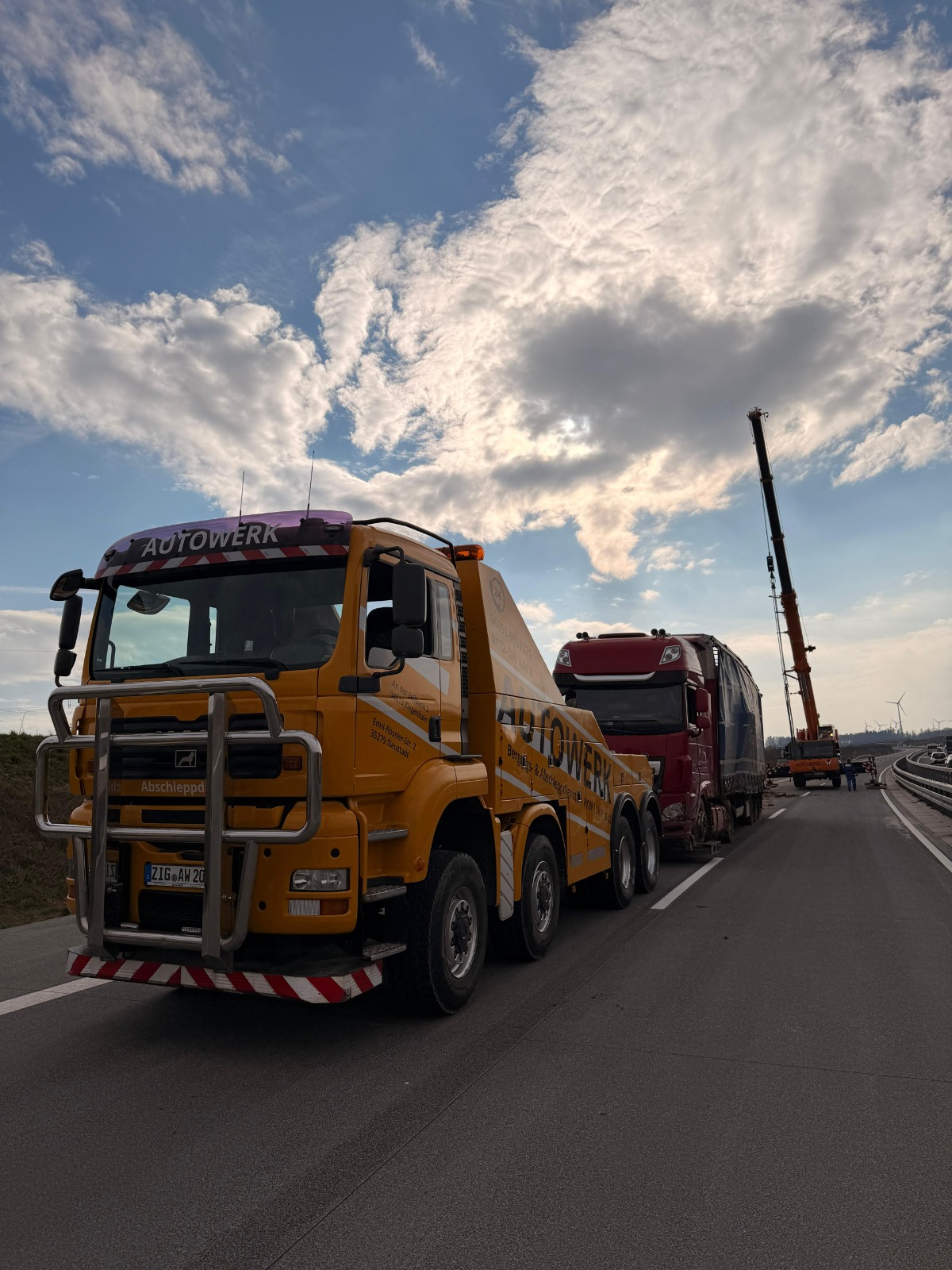
The carriageway had to be partially closed, and a tailback formed, which is practically unavoidable with a crane operation on the motorway. Anyone who has driven past such a scene knows it: blue lights, a jib reaching out over the road, several recovery vehicles, and a queue of waiting lorries.
When nothing but a crane will do
Not every recovery needs heavy lifting gear. In practice the line is clear:
- The vehicle is lying on its side or heavily tilted.
- It has dropped below road level into an embankment or ditch.
- The load has shifted, the centre of gravity is unstable, and pulling would tip the vehicle further.
- The ground is too soft or too steep for the wheels to gain controlled grip.
- The frame or axles are already visibly deformed, so any extra pulling load would make the damage worse.
Several of these applied to the Scania near Hildesheim: a position below road level, an unfavourable embankment angle, no safe point for a straight pull. The mobile crane wasn’t a convenient extra here. It was the only method that could bring the tractor unit back without doing further damage.
How we organised the job
Once the emergency call came in, dispatch at our control centre moved within minutes. A heavy-duty crane recovery is organised quite differently from a tyre blowout or a routine tow:
- Get an initial description of the scene from the driver or the police on site — position, angle, visible damage.
- Based on that description, dispatch the right crane class, not simply the nearest vehicle available.
- Alert the recovery vehicle and team from our partner network in parallel.
- Contact the Autobahnpolizei and the responsible highway maintenance authority, since a closure is almost always required.
- Coordinate arrival times so the crane and recovery team reach the site as close together as possible.
That kind of coordination with the authorities is a minor detail on a tyre blowout, but it’s the core of the organisation on a crane recovery. Without an approved closure, the crane cannot even be set up, since the stability of its outriggers needs space that flowing traffic simply doesn’t allow.
How tonnage is actually calculated
A common misconception: a 40-tonne artic automatically needs a 100-tonne crane. The maths isn’t that simple. What matters isn’t the crane’s nominal rated capacity but its lifting capacity at the actual working radius, and that drops sharply as the jib extends.
A crane rated at 100 tonnes can only lift that figure close to the vehicle, with the jib almost fully retracted. If the crane has to extend further because of an embankment, a ditch, or a required safety distance from the carriageway, the capacity actually available falls to a fraction of what’s printed on the nameplate. At ten metres of reach, a 100-tonne-rated crane may have only a few tonnes of usable capacity left.
That’s why experienced crane operators plan backwards: first they establish the required jib length from the terrain, then choose the crane class that still has enough margin at exactly that reach. For the Scania near Hildesheim, that meant measuring the embankment angle and the distance from the carriageway first, and only then confirming which crane class actually fit — with a clear safety margin, because a dynamic lift generates higher short-term loads than the vehicle’s static weight alone.
For context: the permitted gross weight of an articulated lorry in Germany is up to 40 tonnes, and up to 44 tonnes in certain combined-transport cases. An uncoupled tractor unit alone weighs considerably less, typically 7 to 9 tonnes unladen. Even so, the crane class is always chosen with a substantial safety margin above the calculated load, since wind, ground incline, and uneven weight distribution during the lift add extra forces.
Lane closures, police, and traffic control
A heavy-duty crane recovery can almost never be carried out in flowing traffic. The crane needs outrigger space well beyond the vehicle’s own footprint, and the jib’s swing radius has to stay clear of traffic. That’s why nearly every crane job on the motorway involves:
- Coordination with the Autobahnpolizei on traffic control and securing the work zone.
- Involvement of the responsible highway maintenance authority when barriers or a diversion is needed.
- Closure of at least one lane, often with a further narrowing onto the hard shoulder or an adjacent lane.
- Realistic planning of closure duration — hours, not minutes, for a crane recovery.
Current traffic information and stretch closures on federal motorways can be tracked via autobahn.de, the official service of Germany’s federal motorway authority. Hauliers planning an alternative route, or drivers affected directly, will find up-to-date reports on roadworks and closures there.
The tailback that built up near Hildesheim is the unavoidable flip side of a safe recovery. A rushed job without proper securing would put our own team, the police, and following traffic at real risk. Taking that risk to shave a few minutes off the closure would never be a reasonable trade.
The step-by-step process
A crane recovery follows a fixed sequence that has proven itself in practice, and there’s rarely a good reason to deviate from it.
Step 1 — Site and ground assessment. The site manager assesses the vehicle’s position, the embankment angle, the ground’s load-bearing capacity for the crane’s outriggers, and any hazards such as leaking fluids.
Step 2 — Securing the work zone. Warning triangles, barriers, and coordination with police and the highway authority for the closure. Setup only begins once the zone is secured.
Step 3 — Uncoupling or securing the load. Where a trailer is involved, it’s uncoupled where possible, or otherwise additionally secured, so that no uncontrolled weight shifts while the tractor unit is being lifted.
Step 4 — Rigging at the frame. Lifting points sit exclusively on load-bearing frame sections, never on the cab, bumpers, or bolt-on parts. Only the frame is designed to bear that kind of load; any other attachment point would give way under load or permanently deform the vehicle.
Step 5 — Controlled lift. The crane raises the vehicle slowly, in several controlled stages, with constant monitoring of load distribution and the crane’s own stability.
Step 6 — Setting down on wheels or a low-loader. If the chassis is intact, the vehicle is set back down on its own wheels. If axles or tyres are damaged, it’s loaded onto a low-loader instead.
Step 7 — Transport away and reopening the carriageway. Only once the site is fully cleared is the closure lifted and traffic released.
The complete timeline
| Time | Phase | Action |
|---|---|---|
| 14:40 | Alert | Emergency call reaches control centre, initial situation report |
| 14:40–15:05 | Dispatch | Crane class and recovery team selected and alerted |
| 15:05–15:50 | Travel | Mobile crane and recovery vehicles travel to the A7 near Hildesheim |
| 15:50–16:20 | Securing | Site assessment, barriers, coordination with the Autobahnpolizei |
| 16:20–17:10 | Preparation | Uncoupling the trailer, securing the load |
| 17:10–19:10 | Crane operation | Rigging at the frame, controlled lift, setting down |
| 19:10–20:00 | Removal | Loading and transporting the tractor unit away |
| 20:00–20:55 | Wrap-up | Clearing the carriageway, lifting the closure |
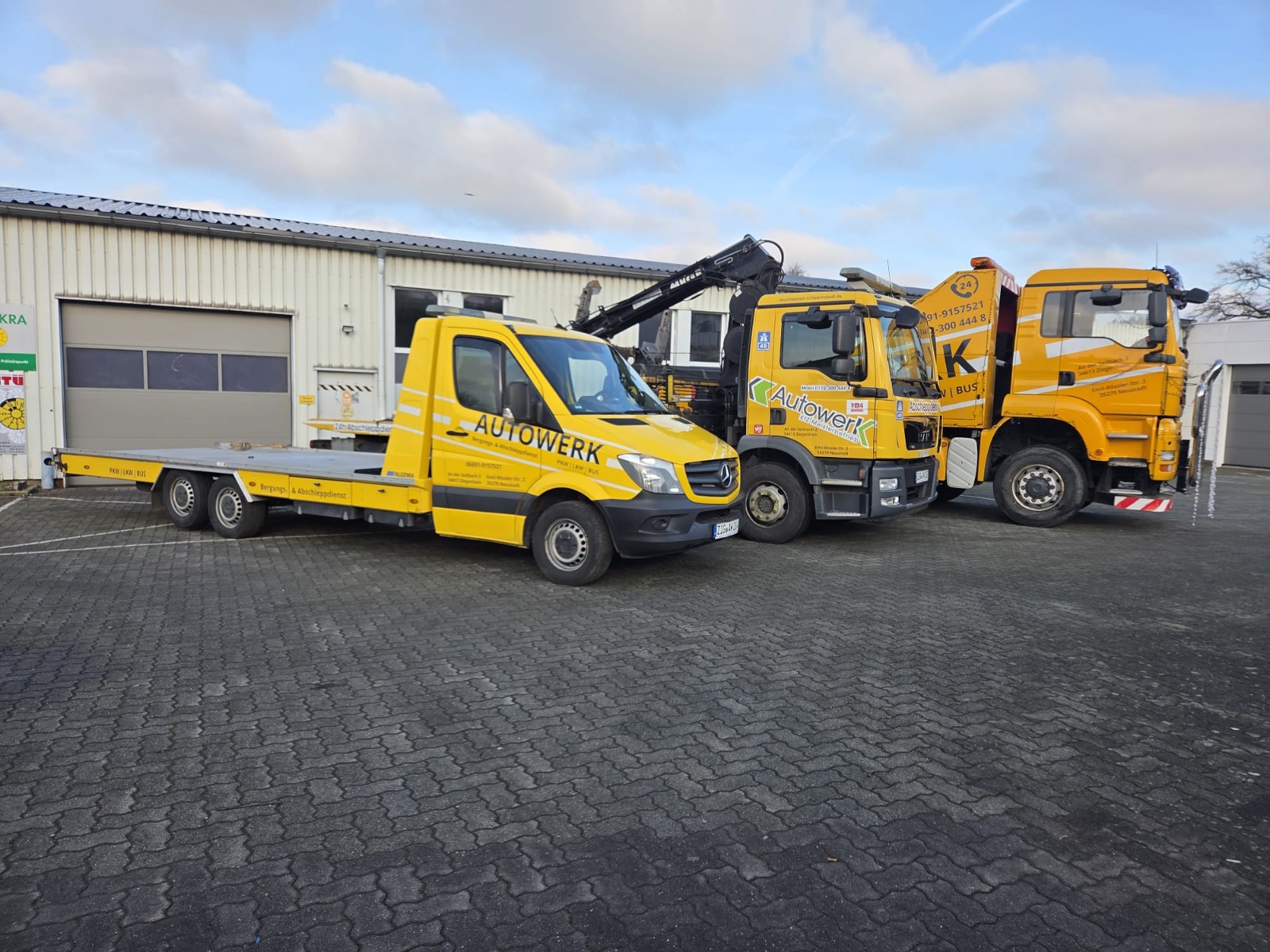
Total duration: 6 hours 15 minutes — a realistic figure for a heavy-duty crane recovery. Five to seven hours is normal for this kind of job, considerably longer than a tyre change or a straightforward tow.
The cost breakdown
A crane recovery is the most expensive category of our work, and for good reason: crane hire, specialist personnel, closure time, and the elevated risk of the job itself all show up in the price.
| Item | Price (EUR, net) |
|---|---|
| Mobile crane callout (100–130 t class) incl. operator | 980 |
| Recovery vehicle/tow truck callout | 360 |
| On-site crane operation (setup, lift, breakdown) | 2,450 |
| Recovery team, two technicians | 890 |
| Traffic safety, barrier equipment, signage | 340 |
| Coordination with highway authority, documentation | 260 |
| Towing to storage yard/workshop | 520 |
| Total | €5,800 |
All prices are net, plus VAT. For comparison, a laid-up artic costs a haulier roughly €800 to €1,200 a day depending on the load and contract, often considerably more on international routes with contractual penalties attached. A crane recovery completed within a single working day keeps that knock-on cost tightly contained.
Factors that shift the price on a given job: the crane class and reach required, time of day and day of the week, how accessible the accident site is, whether a low-loader transport is needed, and the condition of the recovered vehicle.
Why doing it yourself doesn’t pay off
The urge to help things along with a strong tow truck and a winch is understandable — every hour of downtime costs money. Still, in a situation like the one near Hildesheim, improvising is off the table.
- A pull with rope or winch on a tilted or below-grade tractor unit generates lateral forces the frame was never designed to take.
- Bent chassis rails are, in most cases, a write-off — repair costs frequently exceed the tractor’s residual value.
- Without properly securing the carriageway, an improvised recovery attempt puts your own team and following traffic at serious risk.
- A lifting point improperly rigged at the cab or bumper can snap and whip loose under load.
- Without coordination with the police, an unauthorised partial closure of the motorway can bring substantial fines.
Section 15 of the German Road Traffic Regulations (StVO) sets out the duties around broken-down vehicles and securing accident sites; the official text is available at gesetze-im-internet.de. Ignoring those duties risks not just damage to the vehicle but personal liability as well.
Typical situations we bring a crane to
Cases that go beyond a routine breakdown land on our desk regularly:
- Articulated lorries that leave the carriageway and end up below road level.
- Overturned trailers or semi-trailers after an evasive manoeuvre.
- Vehicles that have sunk deep into soft ground alongside the motorway.
- Collisions with crash barriers where the vehicle ends up hanging over the barrier itself.
- Incidents with shifted loads, where pulling would only worsen an already unstable tipping balance.
Across Germany, we draw on a network of regional partners with the right heavy lifting gear, so arrival times stay realistic even when a crane is needed.
The insurance angle: what a driver should do now
On a crane recovery following a road accident, how well things are documented often decides how smoothly the claim goes through. A few practical points for drivers and dispatchers:
- Photograph the accident scene before recovery work begins — the vehicle’s position, visible damage, and the surroundings.
- Secure the police report and case reference; with the motorway closed, the police are on site anyway.
- Request a recovery report with timestamps and the steps carried out — this is often more useful to the insurer than photos alone.
- With a load covered by a consignment note, document the load’s condition separately from the vehicle damage.
- Contact your own vehicle and cargo insurer the same day if possible, with the first photos and the police reference number.
What happens to the load?
If the trailer is damaged in the incident, or can no longer safely continue, the load doesn’t simply sit there. In practice there are a few routes:
- If the trailer is intact but the tractor unit is damaged: a replacement tractor unit takes over the trailer, and the load continues without interruption.
- If the trailer itself is damaged: the load is transferred to a replacement trailer on site, or at the nearest secure yard.
- With perishable or time-critical cargo: the transfer is organised as a priority, to limit standing time and knock-on losses.
- With dangerous goods: separate coordination with the responsible authority takes place before recovery work even starts.
That call is usually made by the haulier in consultation with the insurer, while our recovery team focuses on the vehicle itself.
Frequently asked questions
How much does a heavy-duty crane recovery on the motorway cost?
Realistically between €4,000 and €7,000 net, depending on the crane class, reach, closure duration, and the vehicle’s condition. In the case described here, the total came to €5,800 net.
How long does a crane recovery take compared with a normal tow?
Five to seven hours is normal, against one to two hours for a standard breakdown. Setting up the crane, coordinating with the authorities, and the controlled lift itself all take considerably longer than a straightforward pull with a tow truck.
Who decides whether a crane is needed?
The site manager makes that call on the spot, based on the vehicle’s position, the ground, and the embankment angle, often in consultation with the police. A crane is never brought in without genuine need, since it’s substantially more expensive and time-consuming than a normal tow.
Why does the motorway get closed for this?
The crane needs outrigger space and a clear swing radius that extends well beyond the vehicle’s own footprint. Without a closure, neither the crane’s stability nor the team’s safety could be guaranteed.
Who pays for the recovery?
Usually the vehicle owner’s motor or haulage insurance, provided the incident qualifies as an accident. Thorough on-site documentation makes the claims process considerably smoother.
What happens if the frame is already deformed in the accident?
In that case the vehicle is normally loaded straight onto a low-loader rather than set back on its wheels, to avoid further damage during transport.
Summary
- Vehicle: Scania tractor unit
- Location: A7 near Hildesheim, towards Hannover
- Date: 24 July, daylight hours
- Method: Heavy-duty crane recovery
- Response time to arrival: around 1 hour 10 minutes
- Total duration: 6 hours 15 minutes
- Cost: €5,800 net
- Secondary damage: avoided through a properly executed recovery, no additional frame damage
A heavy-duty crane recovery is the most demanding discipline in the recovery business. The right crane class, careful securing of the site, and a team that rigs the frame rather than the cab decide whether what’s left at the end is a working vehicle or a write-off.
Why LKW Help 24
We’re reachable around the clock, backed by a network of regional partners who can dispatch heavy lifting gear like mobile cranes at short notice. Our dispatch team works across several languages, which noticeably speeds things up for international drivers and hauliers. You’ll always get a transparent cost breakdown before work begins, with no hidden items.
Call us for any breakdown or accident: +49 160 5753826 · www.lkwhelp24.com · Around the clock, across Germany.
Further services: our truck towing service for standard cases, our truck workshop service for repairs after recovery, and our mobile truck service for on-site work.
Keywords: truck crane recovery | heavy-duty recovery motorway | artic recovery Hildesheim | towing service A7 Hannover | HGV accident recovery crane | mobile crane motorway closure
Related articles
- Towing Services: Truck Recovery in Winter
- Trucks Towing Service: How We Rescued a 25t Scania from the Mud in 85 Minutes in Regensburg (93055)
- Trucks Towing Service for Truck Gearbox Failure Frankfurt (Oder): International Heavy Recovery in 3 Hours
- Truck Loses 2 Wheels Near Hannover – Sheared Bolts
- Contact LKW Help 24