Skip to content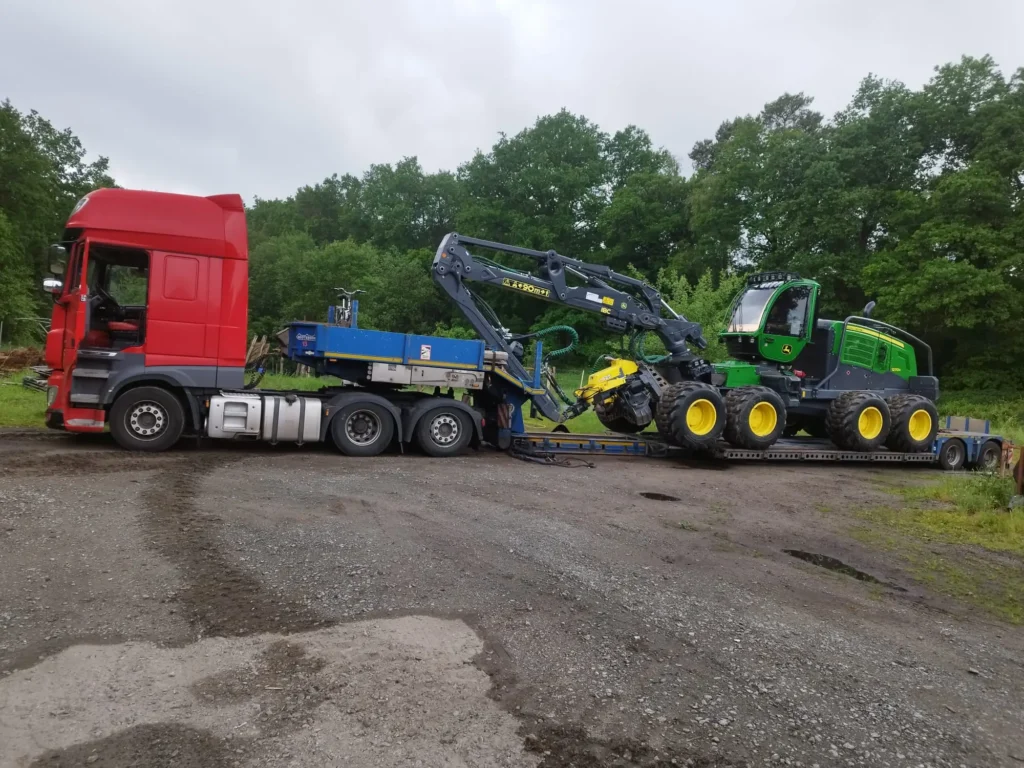
When a forestry harvester the size of a small house stops being fit for the road, you cannot just wave down a passing lorry and ask for a lift. Heavy machinery transport is its own discipline, closer to engineering than to breakdown assistance, and getting it wrong risks the machine, the driver, and anyone nearby. That is exactly the kind of job that landed on our desk on a weekday morning in the forests near Celle, in Lower Saxony’s Lüneburg Heath region.
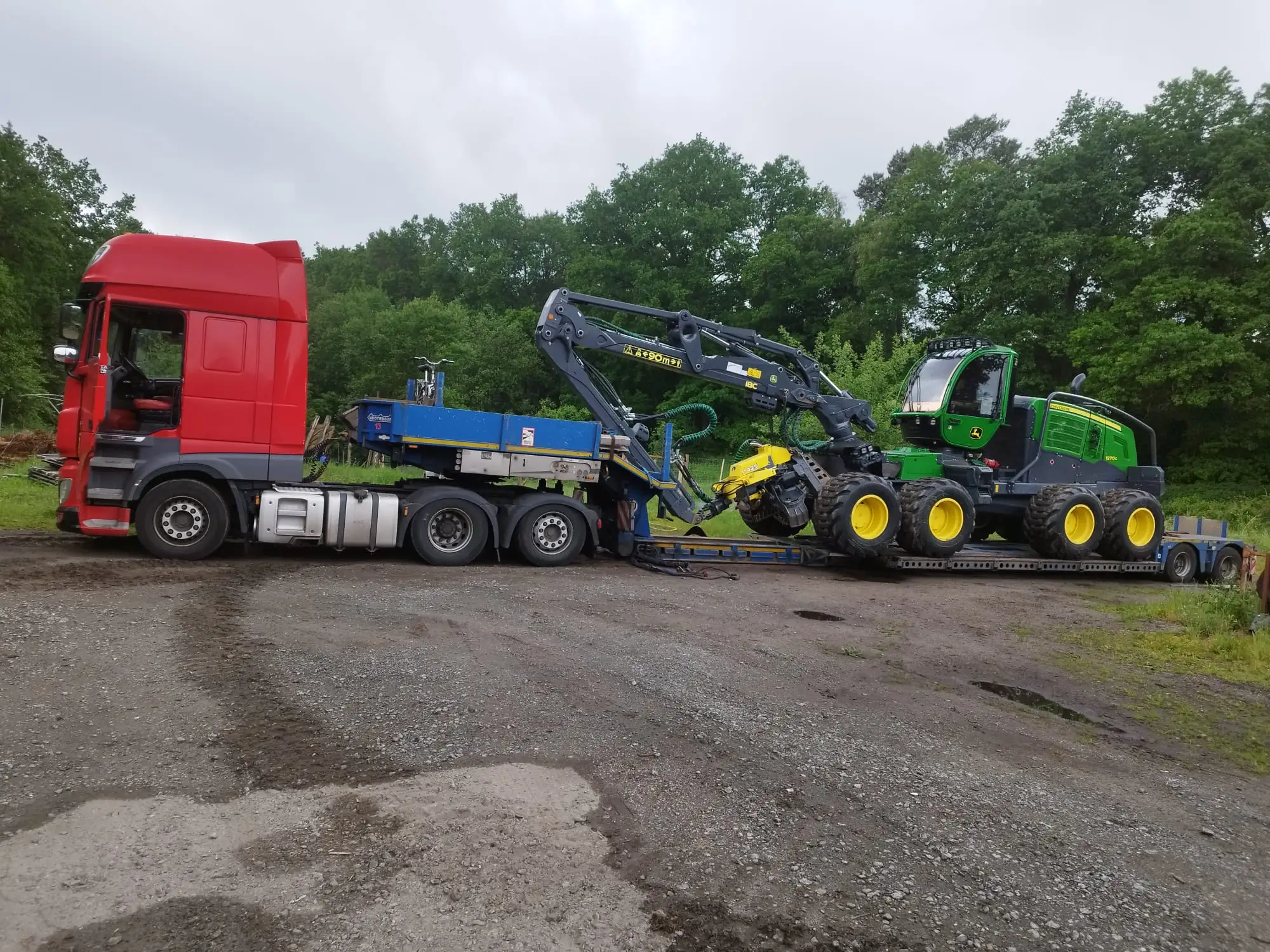
A John Deere 1270G forestry harvester needed to leave the woodland where it had been working and get to a workshop, and it could not do that under its own power on public roads. What followed was a tightly organised low-loader operation: a call at 08:20, a fully loaded and secured machine leaving the forest track by 10:35, and the harvester handed over at its destination by 12:05. Total time from first phone call to signed handover: roughly three hours and forty-five minutes.
This case study walks through how that operation came together, why forestry machine transport demands more planning than a standard breakdown recovery, and what it actually costs to move a several-tonne harvester safely across Lower Saxony’s country roads. If you run a forestry contracting business, manage a fleet of agricultural or construction machinery, or simply want to understand what “professional machine transport” looks like in practice, this is a genuine, recent example rather than a marketing brochure.
The Situation: A Harvester Stranded in the Forest
The John Deere 1270G is not a small machine. It is an eight-wheeled forestry harvester built to fell, delimb, and cut timber to length in a single continuous operation, and it weighs well into double-digit tonnage once fitted out with its harvesting head and boom. Machines like this are designed to work on forest floors, not on tarmac, and they are never simply driven out onto a public road. When one needs to be relocated, whether for a scheduled service, a mechanical fault, or a move to a new felling site some distance away, the only realistic option is a low-loader.
In this case the harvester had finished its work in a stretch of woodland near Celle and needed transferring to a workshop for attention. It was not drivable on the road network, and even if it had been, forestry machines of this size are not permitted to simply trundle along country lanes under their own steam. The task, in short, was a machine transport and relocation job: get a heavy low-loader into the forest, load the harvester safely, secure it properly for the road, and deliver it to its destination without incident.
Jobs like this sit at the more demanding end of what we coordinate at LKWHelp24. There is no tyre to change and no simple part to fit. Instead there is routing, load securing, ground conditions to consider, and a vehicle combination that needs a driver who has done this before, not once, but many times.
How We Organised the Recovery
The call came in at 08:20. Within fifteen minutes, by 08:35, we had a specialist low-loader partner dispatched and the route confirmed. This is not a job you hand to any towing operator with a flatbed. Moving a forestry harvester requires a low-loader combination rated for the weight and dimensions involved, a driver experienced with agricultural and forestry machinery specifically, and a realistic plan for getting a heavy vehicle down forest tracks that were never built with lorries in mind.
Our dispatch process for machine transport jobs works through the same partner network we use for roadside breakdowns, but the vetting is stricter. For this case we called on a heavy-haulage partner with a DAF XF tractor unit paired to a Nooteboom semi low-loader trailer, a combination with the axle capacity and low deck height needed to load and carry a machine of this size and shape.
Between the phone call and the low-loader reaching the site, the driver had to:
- Confirm the harvester’s approximate weight, dimensions, and loading points with the site contact
- Check the route in for width, weight restrictions, and any low bridges or tight bends unsuitable for a low-loader and trailer combination
- Plan the loading approach given that the machine was standing on unpaved forest ground rather than a hard surface
- Prepare ramps, chains, and load-securing equipment appropriate for an eight-wheeled harvester with an articulated boom
The low-loader arrived on site at 09:40, a little over an hour after the initial call. Given that the location was a working forest track rather than a roadside layby, that is a reasonable turnaround, and it reflects the value of having partners who already know the region rather than searching cold for capacity once a job has come in.
On-Site: Loading a Forestry Harvester Is Not a Quick Job
Loading a machine like the John Deere 1270G onto a low-loader is nothing like loading a car or a small trailer. The ground in a working forest is uneven, often soft, and rarely flat, which makes ramp placement critical. Get the ramp angle wrong, or set it on ground that gives way under the harvester’s weight, and you risk the machine sliding, tipping, or damaging the trailer deck.
The crew took their time getting this right. Ramps were positioned and checked for stability before anything moved. The harvester was then driven up onto the low-loader bed slowly and under close supervision, with a second person guiding and watching clearance at every point, since the boom and harvesting head extend well beyond the machine’s main body and can easily catch on trailer rails or overhead branches if nobody is watching.
Once the harvester was in position, the securing work began. This is where a lot of amateur machine transport falls down, sometimes literally. A forestry harvester’s centre of gravity is not straightforward: the weight of the boom and head shifts depending on their position, and the machine’s tracks or wheels need to be chocked and chained at multiple points, not just strapped once and left. The crew used heavy-duty ratchet chains at the axles and frame points, checked tension at each anchor, and confirmed nothing could shift under braking or on the country road bends ahead. This whole loading and securing process took around 25 minutes, and the low-loader pulled away from the forest track at 10:35.
Why the Route Mattered as Much as the Loading
With a fully loaded low-loader carrying several tonnes of forestry machinery, the route out of the forest and onto the public road network is not something you improvise. Forest access tracks can have weight limits that a lightly loaded pickup would never test but a loaded low-loader will. Country lanes in this part of Lower Saxony wind through villages with tight corners, and a trailer carrying an oversized load needs room to swing that a standard lorry does not.
The driver had already scouted the route before the machine was loaded, which meant no surprises once under way: no reversing back out of a lane too narrow for the combination, no unexpected weight-restricted bridge forcing a detour with the load already on board. The journey from the forest to the destination workshop took just over an hour, and the low-loader arrived at 11:45.
Unloading followed the same careful approach as loading, in reverse: chains released in the correct sequence to avoid any sudden shift in weight, ramps checked again, and the harvester driven off slowly under supervision. Handover to the workshop, including a walk-round check and paperwork, was completed by 12:05.
Full Timeline
| Time | Phase | Action |
|---|---|---|
| 08:20 | Call received | Customer contacts LKWHelp24 dispatch about the stranded harvester |
| 08:35 | Partner dispatched | Low-loader partner confirmed, route to the forest site checked |
| 09:40 | On site | Low-loader arrives at the forest track near Celle |
| 10:05 | Loading | Ramps positioned, John Deere 1270G driven onto the trailer |
| 10:35 | Securing complete, departure | Machine chained and secured, low-loader leaves the forest |
| 11:45 | Arrival at destination | Low-loader reaches the workshop |
| 12:05 | Unloading & handover | Harvester unloaded, checked, and handed over |
Total elapsed time: approximately 3 hours 45 minutes, with the loading and securing phase alone taking roughly 30 minutes.
What It Cost
Machine transport pricing depends heavily on the weight and dimensions of the load, the distance covered, and how accessible the loading and unloading points are. A harvester sitting on soft forest ground, reached only by an unpaved track, takes longer and requires more careful handling than the same machine parked on a hard standing next to a public road, and that is reflected in the price.
| Item | Cost |
|---|---|
| Call-out and low-loader dispatch | €220 |
| Loading (positioning, ramps, securing the harvester) | €280 |
| Transport (low-loader, road distance to destination) | €480 |
| Total | €980 |
For context, that figure covers a specialist low-loader combination, an experienced operator, load-securing equipment rated for forestry machinery, and a completed job with no damage to the machine, the trailer, or the surrounding forest track. Compare that with the potential cost of a botched DIY transport attempt, a machine that slips during loading, or a fine for moving an oversized load without proper planning, and the number looks sensible rather than steep. Prices for jobs like this vary case by case based on weight, distance, and site access, so we always confirm the figure with the customer before the low-loader sets off.
Why You Need a Specialist for Machine Transport, Not a Generic Towing Firm
It is tempting to think any lorry with a trailer can move heavy machinery. In practice, several things go wrong when that assumption is tested:
- Underrated equipment. A low-loader without the right axle rating or deck length for the machine’s weight and dimensions can be overloaded or unable to carry the load safely, which is both illegal and dangerous.
- Poor load securing. Machinery with moving parts, such as a harvester’s boom, needs securing at multiple points calculated for its actual weight distribution, not a single strap thrown over the top.
- Route unfamiliarity. Drivers unfamiliar with rural Lower Saxony can end up on roads with bridges, width restrictions, or turns unsuitable for an oversized combination, sometimes discovering this only once the load is already on board.
- Ground assessment. Loading a multi-tonne machine from unpaved or uneven ground requires judgement that comes from experience, not guesswork with a ramp and a hope.
- Insurance and liability. A specialist heavy-haulage partner carries the right insurance for the cargo value and the operation; a generic hauler may not, leaving the machine’s owner exposed if something goes wrong.
Forestry and agricultural machinery represents a serious capital investment. A harvester like the John Deere 1270G is not the kind of asset you want handled by whoever happens to be free that afternoon.
Typical Machine and Heavy Equipment Transport Jobs We Handle
Beyond forestry harvesters, our partner network across Germany regularly coordinates:
- Low-loader transport of agricultural machinery, including combine harvesters, forage harvesters, and tractors moving between fields, farms, or workshops
- Construction equipment relocation, from excavators and wheel loaders to compact site machinery
- Breakdown recovery for heavy trucks, articulated lorries, and coaches on the autobahn and rural roads alike
- Cross-border machine and vehicle transport on low-loaders, including tanker units and specialist trailers
- Emergency transport when a machine becomes non-driveable mid-job and needs relocating before it can hold up a contractor’s schedule
Whatever the machine, the principle is the same: match the load to the right low-loader and driver, plan the route before committing, and secure the cargo properly.
Practical Advice for Contractors and Fleet Operators
If you operate forestry or agricultural machinery, a few habits reduce the chance of a costly surprise:
- Keep weight and dimension documentation for each machine on hand, ideally in the vehicle folder and with your dispatcher’s contact. It speeds up route planning considerably.
- Think about access before a machine gets stuck somewhere awkward. If a forest track or field is only reachable by a narrow lane, know that in advance rather than finding out when a low-loader cannot get in.
- Schedule routine servicing so machines are not forced off-site under time pressure. A planned transport is always cheaper and less stressful than an emergency one.
- Have a single point of contact, like LKWHelp24, who already knows which partners in a region can handle heavy or awkward loads, rather than starting from scratch every time something needs moving.
LKWHelp24: Your Partner for Heavy Machinery and Truck Emergencies Across Germany
We coordinate a nationwide network of vetted low-loader operators, recovery specialists, and breakdown partners, available 24 hours a day, seven days a week, across all of Germany. For a job like this Niedersachsen harvester transport, that network meant a suitable low-loader combination was dispatched within fifteen minutes of the first call, and an experienced operator who understood exactly how to load and secure forestry machinery was on site inside an hour and twenty minutes.
We work in German, English, Polish, and Russian, which matters when a fleet operator, a farm manager, or a construction site foreman needs to explain a problem quickly and get a straight answer about cost and timing. Pricing is agreed before dispatch wherever possible, so there are no surprises once the job is done.
Summary
- Machine: John Deere 1270G forestry harvester, non-driveable on public roads
- Transport vehicle: DAF XF tractor unit with Nooteboom low-loader trailer
- Location: Forest near Celle, Lüneburg Heath region, Lower Saxony
- Response time: Low-loader on site 1 hour 20 minutes after the call
- Total operation time: Approximately 3 hours 45 minutes, call to handover
- Total cost: €980
- Secondary damage: None
Frequently Asked Questions
Can a forestry harvester like the John Deere 1270G be driven on public roads?
No, not without special permits and equipment it does not carry. Machines of this size and weight are transported on a low-loader, which is exactly what happened here.
How quickly can a low-loader reach a forest site?
In this case, around 80 minutes from the initial call. Actual timing depends on location, low-loader availability, and how accessible the site is.
Does the price change if the ground is soft or unpaved?
Yes. Loading from unpaved forest ground, as in this case, takes longer and requires more careful ramp placement than loading from a hard standing, which is reflected in the loading cost.
Do you handle machine transport across Germany, not just Lower Saxony?
Yes. Our partner network covers the whole country, and we coordinate low-loader transport for agricultural, forestry, and construction machinery nationwide, 24/7.
Request Emergency Machine Transport Now
If you need a harvester, tractor, excavator, or any heavy machine moved safely and quickly anywhere in Germany, call +49 160 5753826 or visit lkwhelp24.com. Available 24/7 across all of Germany.
Bergung eines John Deere 1270G Mähdreschers mit Tieflader in Niedersachsen.