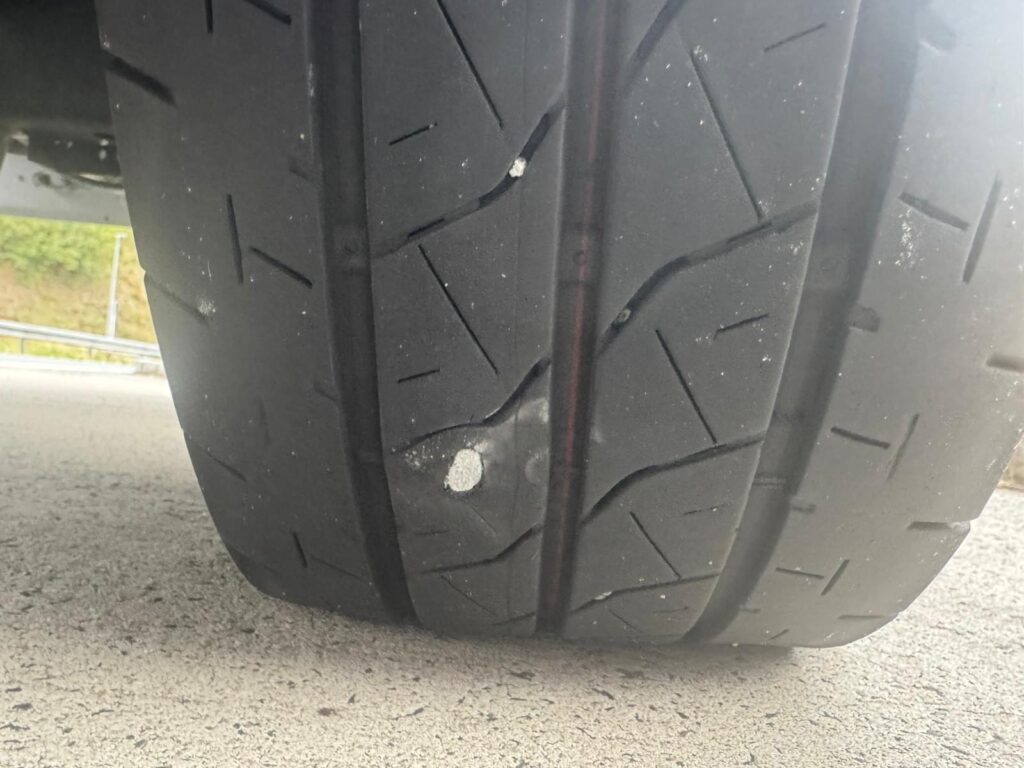
On 19 August 2026 a drive-axle tyre on an artic went flat at a rest area on the A3 near Limburg an der Lahn, heading for Frankfurt. Our truck tyre service took the call at 12:20, the partner crew arrived at 13:15, and the tractor unit rolled out at 14:30: 2 hours 10 minutes from call to departure, 965 EUR net in total, no damage to the rim or hub.
A drive-axle tyre that has lost its pressure is not something you nurse to the next town. The tractor unit carries the weight of the fifth wheel and a large part of the trailer, and a dead tyre on that axle puts the whole load onto its twin. This is exactly the kind of job a mobile truck tyre service exists for, and this write-up walks through it minute by minute, with the full price list, so that fleet managers and drivers can see what a realistic callout looks like.
The emergency: a flat drive-axle tyre at a rest area on the A3
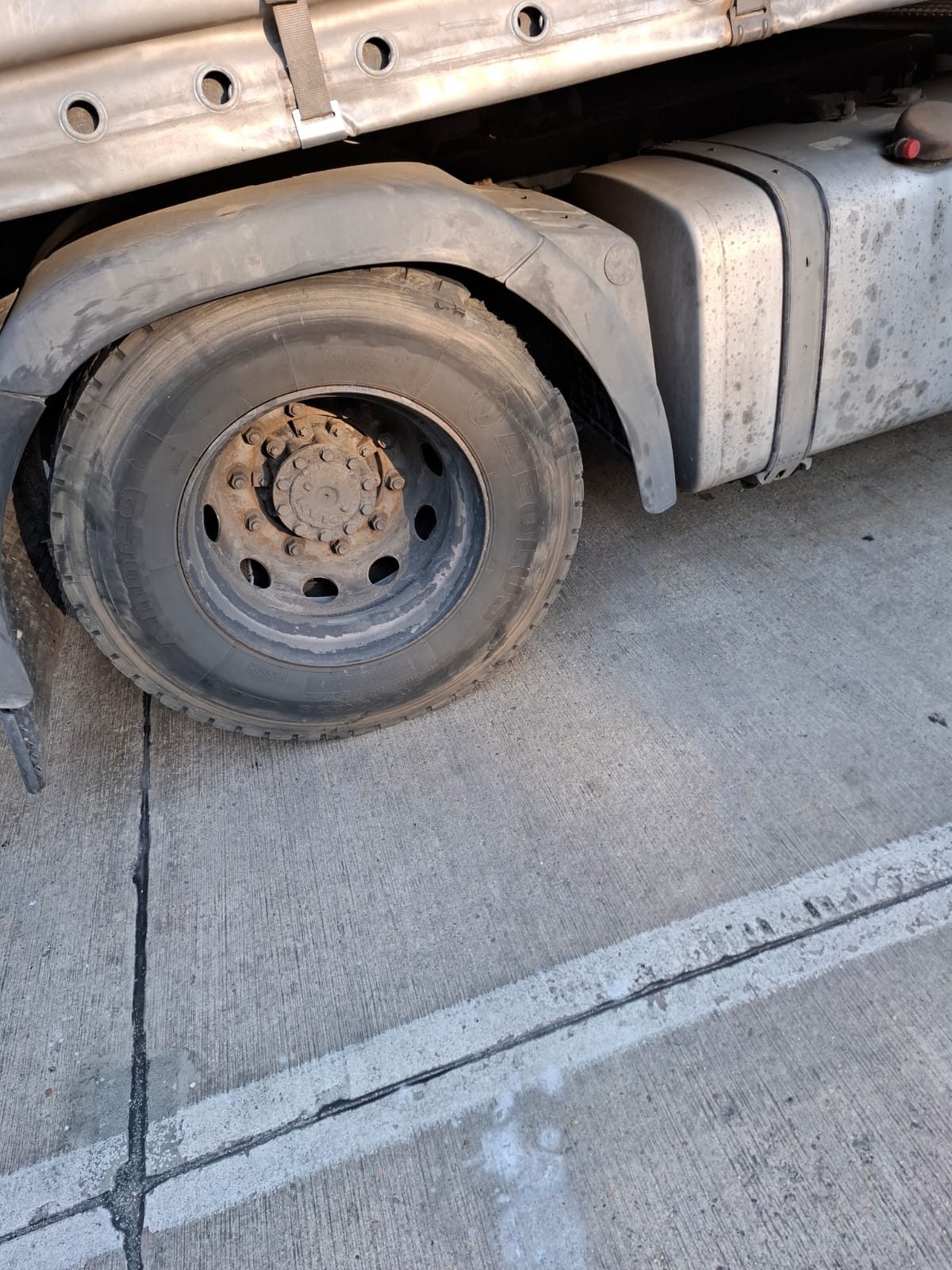
The driver pulled into a rest area on the A3 near Limburg, Hesse, shortly before noon. He had felt the tractor unit pulling slightly and noticed that the rear axle sat lower on one side. A walk around the unit confirmed it: the outer drive tyre was worn, its shoulder was damaged and the pressure had gone. The rusty hub and the wheel nuts were visible behind the sagging sidewall. The sky was clear, the surface was dry, and the car park was almost empty, which made the next hours easier than they could have been.
He had made the right decision by not carrying on. A rolling flat tyre on a loaded artic destroys the casing within a few kilometres, can overheat and ignite, and often takes the rim edge with it. Some drivers try to reach a workshop 20 or 30 kilometres away. On a drive axle that regularly turns a 540 EUR tyre problem into a rim, hub seal and sometimes brake-chamber problem.
The vehicle was a tractor unit with a semi-trailer from a foreign haulier, a typical combination on the Frankfurt corridor. The trailer ran low-profile 435/50 R19.5 tyres, the size used on mega-trailers, while the drive axle ran 315/80 R22.5. The driver rang our number at 12:20 and gave us the location, the tyre size and the state of the wheel. That was enough to start.
Why this call came at a difficult time
Mid-day on a weekday means the A3 is full of long-haul traffic, and the driver’s tachograph clock was already running towards his daily limit. Every hour of standstill costs a haulier real money, because a parked artic earns nothing. As a rule of thumb, a stationary tractor unit costs between 800 and 1,200 EUR per day in lost earnings, depending on the contract and the cargo. Against that figure, a 965 EUR callout that was finished before 14:30 is a modest bill.
How we organised the help
Our dispatch desk works around the clock and speaks several languages, so the driver could describe the problem in his own. The process is the same every time:
- We take the exact location (motorway, direction, rest area name) and confirm that the vehicle is parked safely.
- We note the tyre size, the axle position and the condition of the wheel, plus whether the trailer has any visible tyre issues.
- We pick the closest available crew from our partner network that carries truck tyres in the requested size.
- We confirm the price range and the expected arrival time with the driver before anyone drives off.
- We send updates until the crew has arrived.
The call came in at 12:20. By 12:34 the nearest mobile crew in our partner network was confirmed and the driver had his arrival window. Fourteen minutes for dispatch is on the quick side of what we normally see (10 to 20 minutes), because the driver knew the tyre size and the exact rest area. Good information at the start saves more time than any fast van.
The crew then needed 41 minutes to reach the rest area. Together with dispatch, the driver waited 55 minutes for a technician to stand next to the wheel. That is within the normal 35 to 70 minutes for a motorway callout in Hesse. Details of our mobile approach are on our truck tyre service page, and the wider range of breakdown work sits under mobile truck service.
What we found on site, and why a flat drive tyre cannot be ignored
The crew first checked the tractor unit. The drive tyre was flat and its shoulder was damaged, so it was beyond repair. No amount of plugging or patching would have made it legal or safe. The technician measured the remaining tread on the twin tyre, looked for cuts on the sidewall and checked the wheel nuts for rust trails and cracks around the studs.
Why does this matter? Heavy-truck tyres run at high inflation pressure, normally between 8.5 and 9.5 bar for the 315/80 R22.5 size. A tyre in that class stores a great deal of energy. If it fails while the vehicle is moving, the casing can burst, and loose tread can hit the mudguard, the air lines or the fuel tank. Standing still, the risks are different but real. A tyre with almost no air, jacked up with the wrong tool, can slip. This is why the crew placed the wheel chocks and the warning triangle before touching anything.
Axle load is the second reason. The drive axle of a loaded tractor unit carries roughly 10 to 11.5 tonnes. If one tyre of a twin set is flat, the neighbouring tyre carries almost double its design load. At motorway speed that overheats the casing quickly. Even a short drive can write off two tyres instead of one.
The trailer tyre check
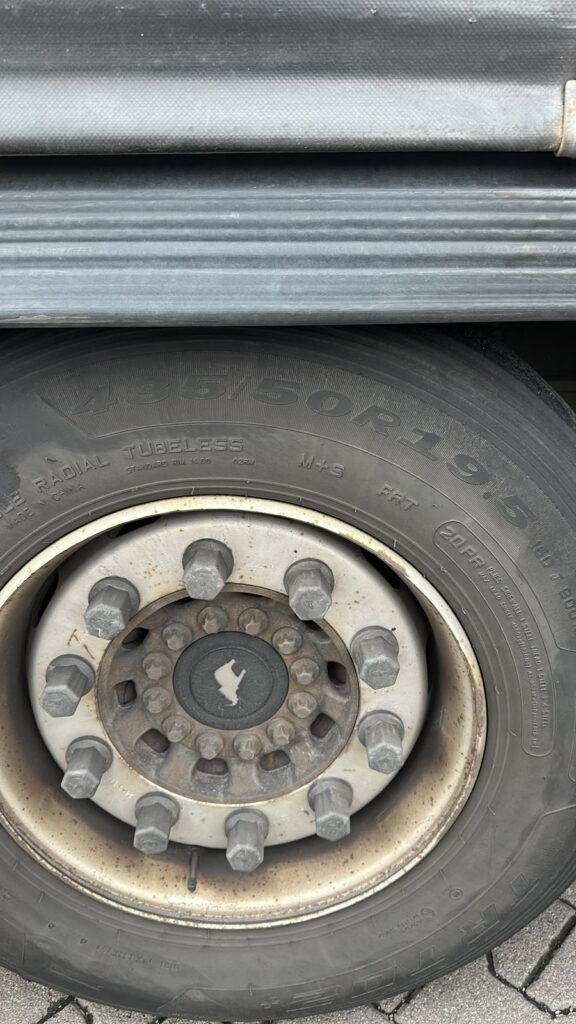
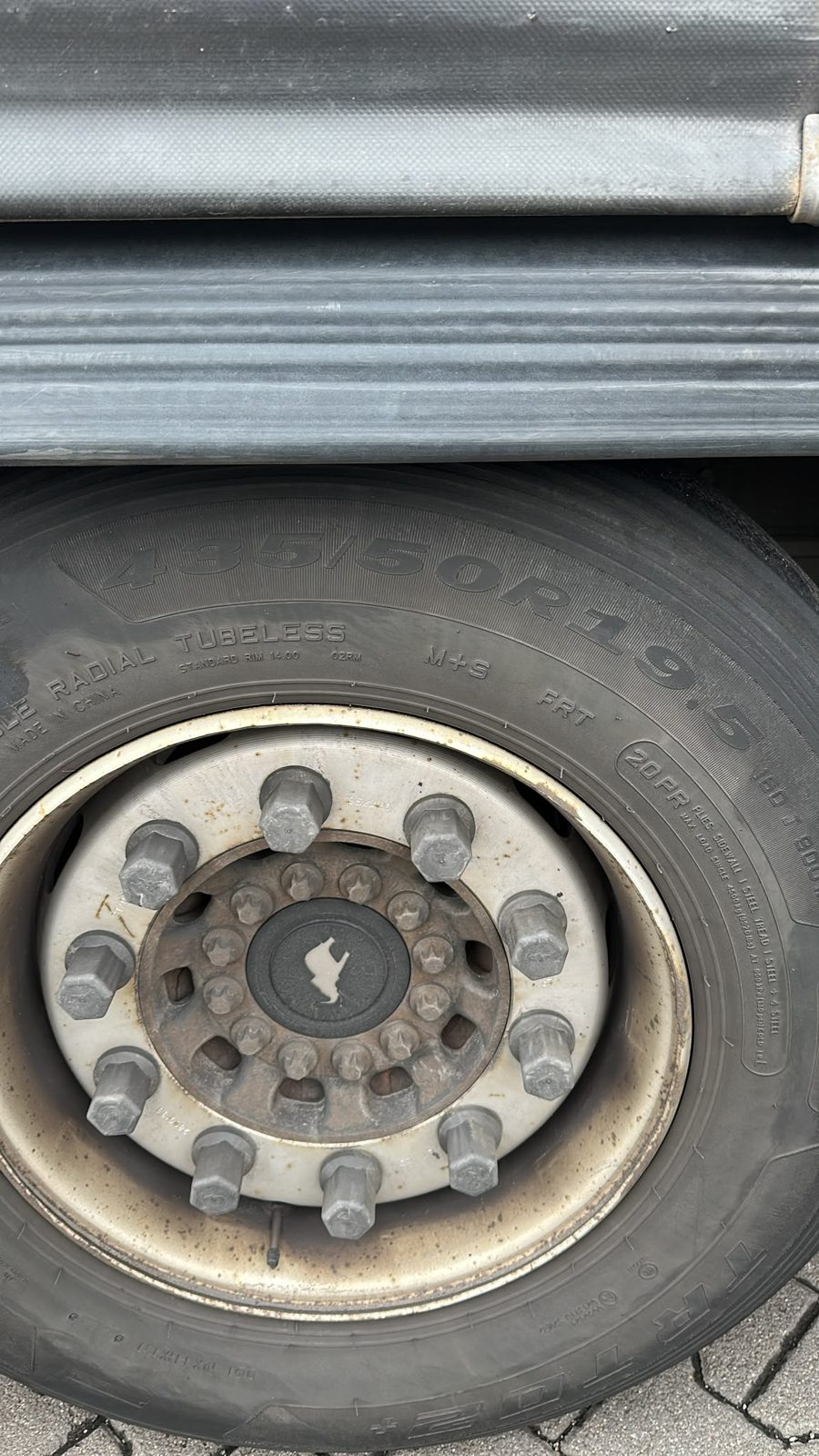
The photograph at the top shows a marking on the sidewall of the trailer tyre: 435/50 R19.5, tubeless, M+S, 20 ply rating, standard rim 14.00. The crew included this tyre in the visit. It had no damage, but it was worth reading the numbers properly. The first group is the section width in millimetres, the second is the aspect ratio (sidewall height as a percentage of the width), and the “R” stands for radial construction. 19.5 is the rim diameter in inches. If you want to read the full code including load index and date of manufacture, our guide to truck tyre markings explains it line by line. The size standards come from ETRTO, the body that defines which tyre fits which rim in Europe.
The crew also checked the trailer pressure, which was in range, and the condition of the ten wheel nuts. The inspection was included in the quote. For a haulier, that is worth having: a driver rarely checks a low-profile trailer tyre properly at a rest area, and a mismatch in pressure between two tyres on one axle is exactly what produces premature wear.
Step-by-step: how the drive tyre was replaced
The work followed the order we use for every roadside truck tyre replacement. It took 75 minutes on site, from arrival to the final check.
Step 1: Inspection and photos (13:15)
The technician parked the service van behind the tractor unit, switched on the amber beacon and walked around the whole combination. He photographed the damaged shoulder and the flat tyre for the report, then checked the twin tyre and the trailer tyre. He also asked the driver how the problem started, which matters: a slow leak points to a nail or a valve, a sudden loss points to a sidewall failure.
Step 2: Securing the place (13:25)
Wheel chocks went under the trailer wheels and the tractor’s front axle. The handbrake was on, the warning triangle stood at the correct distance, and the driver put on his high-visibility vest. A rest area is safer than a hard shoulder, but vehicles still manoeuvre around you. A hydraulic jack was set under the drive axle on the manufacturer’s jacking point, not on the leaf spring or any random bracket.
Step 3: Removal of the wheel (13:40)
The technician loosened the wheel nuts while the wheel was still on the ground, then lifted the axle and removed the nuts one by one. The flat wheel came off the hub. At this point he inspected the hub, the stud threads and the rim. The hub was rusty on the outside but sound, and the rim had no cracks or bends. Had the rim been deformed, the bill would have been higher, and we would have told the driver before ordering any extra parts.
Step 4: Fitting the new tyre (14:05)
The new tubeless 315/80 R22.5 tyre was fitted to the rim with the correct valve. The assembly was balanced on the van’s mobile equipment, then inflated step by step to the working pressure. The technician checked the bead seat all the way round and did a leak test with soapy water around the valve and bead. A drive tyre in this size is a standard premium-brand product in this class, and the same logic applies to the established makers such as Michelin and Continental. What matters on site is that the replacement has the right load index and a matching rolling circumference to its twin.
Step 5: Refitting and final torque (14:20)
The wheel went back onto the hub. The technician tightened the nuts in a star pattern with a calibrated torque wrench, in two or three passes, and then rechecked each one. The exact figure depends on the axle and wheel system, and our wheel nut torque table lists typical values. He also checked the pressure on the trailer tyre one more time and wrote it on the job sheet. The driver asked for a second look at the nuts, and the technician showed him the torque marks. A short retorque after the first 50 to 100 kilometres is standard advice, and we repeated it to the driver.
By 14:30 the tractor unit pulled out of the rest area, the paperwork was signed and the old tyre was loaded for disposal.
Full timeline of the callout
The table below is the real timeline of 19 August 2026. The total from the first ring to the departure was 130 minutes; the actual work on site took 75 minutes.
| Time | Phase | Action |
|---|---|---|
| 12:20 | Call | The driver reports a deflated drive-axle tyre on the tractor unit at the rest area; we take the tyre size and location |
| 12:34 | Dispatch | We confirm the partner crew nearby and send the driver a time estimate |
| 13:15 | Arrival | The crew is on site (41 minutes on the road), inspects the tyre, takes photos and checks the 435/50 R19.5 trailer tyre |
| 13:25 | Preparation | The site is secured, with chocks, warning triangle and a jack under the axle |
| 13:40 | Removal | The wheel is taken off; the rim and hub are inspected |
| 14:05 | Fitting | The new tyre is mounted, balanced and inflated to working pressure |
| 14:20 | Tightening | The wheel is refitted, the nuts are torqued in a star pattern, and the trailer pressure is checked |
| 14:30 | Done | The tractor unit leaves; documents are handed over |
Total: 130 minutes (2 hours 10 minutes) from call to departure.
If it had rained, or if the call had come during the evening rush hour, the arrival would likely have taken longer. We say this honestly to every driver: the 41 minutes in the table is the result of a quiet mid-day, a nearby crew and dry roads.
What it cost: the full price list
A callout of this kind is easiest to judge when every line is visible. Here is the quote that the driver accepted before the crew set off. All amounts are net, plus VAT (zzgl. MwSt.).
| Item | Price (EUR) |
|---|---|
| Callout / Anfahrt | 240 |
| Truck tyre 315/80 R22.5 (drive axle) | 540 |
| Labour, 1.5 hours at 110 EUR | 165 |
| Disposal of the old tyre | 20 |
| TOTAL | 965 |
The inspection of the trailer tyre is included in this price. No evening or weekend surcharge applied, since the job was done on a weekday at midday.
What drives the price of a truck tyre callout
Four factors decide the final number:
- Distance and time of day. The callout fee for a motorway job normally lies between 180 and 320 EUR. At night or on a weekend, expect a surcharge of 25 to 50 per cent.
- Tyre size and brand. A 315/80 R22.5 usually costs between 480 and 620 EUR; a trailer tyre such as 385/65 R22.5 costs 420 to 540 EUR; a smaller 245/70 R19.5 comes in at 320 to 420 EUR.
- Labour time. Hourly rates for roadside work lie between 90 and 140 EUR. A straightforward single-wheel job takes about 1.5 hours, but a seized wheel nut or a corroded hub can add time.
- Condition of rim and hub. A bent rim or damaged stud turns a tyre job into a wheel job. That is the single biggest variable, and the reason we ask drivers to avoid driving on a flat tyre.
For a more detailed breakdown of what tyres cost, see our article on truck tyre change cost.
Comparing the bill with the alternative
A parked artic costs a haulier somewhere between 800 and 1,200 EUR per day in lost revenue, plus the risk of missing a delivery slot. The alternative to a roadside replacement is usually a tow to a workshop, and a recovery of a tractor unit starts at 850 EUR and can reach 1,600 EUR depending on distance. In this case a tow would have cost roughly as much as the entire repair, and the driver would still have been waiting for a tyre at the other end. A mobile truck tyre service wins on both money and time.
Why a professional should do this
Some drivers carry a jack and a wheel brace and are tempted to do it themselves. We understand that, but on a loaded tractor unit it is rarely a good idea. The reasons are practical:
- A standard workshop jack is not rated for a loaded drive axle and can fail or tip.
- Truck wheel nuts need torque far beyond what a hand wrench can deliver, and unequal tightening warps the wheel and loosens the studs.
- A tubeless tyre must seat correctly on the bead. Over-inflation of a poorly seated tyre is dangerous.
- A rest area or hard shoulder is a traffic area. Working on the left side next to moving vehicles is the cause of many accidents in the industry.
- The driver’s rest time is limited by the tachograph rules. Spending 90 minutes on a wheel does not count as rest.
- Insurance and warranty claims are easier to settle if the work is documented by a professional with photos and a job sheet.
Our crew documents every callout. For a fleet, that document is useful: it shows what failed, when, and at what cost.
Typical situations where we are called out in Germany
This job on the A3 was a standard case, but the range of calls is wide. We go out to the following situations across Germany:
- Blowouts on drive, steer and trailer axles, including twin tyres.
- Punctures and slow leaks from nails, screws or stones in the tread.
- Flat tyres after long standstill, for example after a weekend on a car park.
- Damaged valves and loose valve caps that leak air.
- Rim damage after kerb contact or after driving on a flat.
- Seasonal wheel changes at the yard, particularly in November and March.
- Pre-trip checks before long-haul runs to Scandinavia or Eastern Europe.
- Trailer tyres on low-profile mega-trailers, which are harder to source than standard sizes.
Not every tyre can be repaired. The rules for repair of a heavy-truck tyre are strict: a puncture in the tread area may be repairable, a damaged shoulder or sidewall almost never. Our article on truck tyre repair explains where the line is drawn.
Prevention: how to avoid the next callout
Most tyre failures give a warning. The following habits cost a few minutes and prevent most roadside problems:
- Check pressure with a gauge once a week, cold, on every axle. A tyre that has lost 10 per cent of its pressure wears faster and runs hotter. Our guide to truck tyre pressure gives target values and explains how to measure properly.
- Walk around the vehicle at every break. Look at the sidewalls, the tread and the valve caps. A stone stuck in the tread or a bulge on the shoulder is easy to see in daylight.
- Watch the tread depth. The legal minimum for heavy goods vehicles is set in section 36 of the StVZO. Most fleets replace earlier than that, since grip in rain drops well before the limit.
- Match twin tyres. Two tyres on one axle should have a similar tread depth and the same brand and pattern. A difference of a few millimetres creates uneven loading.
- Do not ignore vibration. A new vibration through the steering wheel or the seat is often a tyre issue or a loose wheel.
- Keep a record. Note the date of mounting and the pressure on each wheel. Without a record, nobody can tell which tyre is old.
For fleet managers, a scheduled tyre inspection at the yard is cheaper than a callout. It is also easier to plan around loading times.
More on tyres and fleet maintenance
Heavy-truck tyres divide into three categories: steer, drive and trailer. Steer tyres have ribs along the circumference for directional stability, drive tyres have a block pattern with deeper lugs for traction, and trailer tyres are optimised for low rolling resistance and even wear. Mixing them up on the wrong axle shortens their life and can affect braking.
Retreading is common for drive and trailer positions. A retreaded casing is cheaper than a new tyre and has a good safety record when the casing was inspected properly. For emergencies on the road, though, we usually fit new tyres, since a repaired casing of unknown history is a risk nobody wants on a loaded motorway run.
The big manufacturers, Michelin, Continental, Goodyear and Bridgestone, offer ranges for long-haul, regional and construction use. Long-haul tyres emphasise fuel efficiency and mileage; regional tyres are built for more frequent turns and kerb contact; construction tyres have reinforced sidewalls. If your fleet runs a mix, ask the supplier for a recommendation per axle position rather than buying one pattern for everything.
Low-profile tyres such as the 435/50 R19.5 on the trailer in this case deserve special mention. They are common on mega-trailers because they allow a lower floor and more cargo volume. The downside is that the shorter sidewall absorbs less shock, and the tyres are more sensitive to kerbs and potholes. They are also less common than 385/65 R22.5, so if one fails away from your home depot, finding the right size can take extra time. A good habit is to know the size and load index of every tyre in your combination and to keep them written in the cab.
Seasonal changes matter too. In winter, M+S marking is the minimum for drive axles under German rules, and a three-peak snowflake tyre gives better grip. Our article on emergency tyre service for trucks covers what to do when a tyre fails in cold weather.
Why drivers and fleets choose Lkwhelp24
- Round the clock, every day. Our dispatch is open at 3 a.m. on a Sunday as it is at noon on a Wednesday.
- A checked partner network. The crews that come out carry truck tyres in common sizes, calibrated torque equipment and mobile balancing.
- A price before the work starts. The driver hears the callout fee, the tyre price and the hourly rate before the van moves.
- A multilingual desk. Many drivers on German roads do not speak German or English as a first language. We take the call in the language they are comfortable with.
- Full documentation. Photos, job sheet and an invoice that the fleet office can process.
- The whole country. From the Danish border to the Alps, and from the Dutch border to Poland.
If you manage a fleet and want to set up an arrangement before the next problem occurs, our contact page shows how to reach us.
FAQ: truck tyre service on the motorway
How long does a mobile truck tyre service take to arrive?
On a motorway, expect between 35 and 70 minutes of travel time after dispatch, which takes 10 to 20 minutes. In this case the crew needed 41 minutes. At night, in heavy rain or in a traffic jam, the time is longer.
What does a truck tyre replacement on the motorway cost?
A typical callout for a drive-axle tyre in 315/80 R22.5 ran to 965 EUR net, made up of 240 EUR callout, 540 EUR for the tyre, 165 EUR for 1.5 hours of labour and 20 EUR for disposal. Night and weekend jobs carry a 25 to 50 per cent surcharge.
Can I drive a short distance on a flat truck tyre?
No. Even a few kilometres can destroy the casing, damage the rim and overload the twin tyre. If you must move the vehicle to a safe place, drive at walking pace and only as far as needed.
Can a damaged shoulder be repaired?
Almost never. Repairs are limited to small punctures in the central tread area, by the manufacturer’s rules. Damage to the shoulder or sidewall means replacement.
Who pays for the callout?
The haulier or the vehicle owner pays, normally through the fleet account or the insurance, depending on the policy. We issue a proper invoice with all items listed, so you can submit it to your insurer or leasing company.
Do you also check the trailer tyres?
Yes. In this case the trailer tyre (435/50 R19.5) was inspected at no extra charge, and the pressure was verified. We recommend it whenever a crew is on site anyway.
Summary
- Vehicle: tractor unit with a semi-trailer; drive tyre 315/80 R22.5, trailer tyre 435/50 R19.5.
- Location: rest area on the A3 near Limburg an der Lahn, Hesse, towards Frankfurt.
- Date: 19 August 2026, weekday.
- Response time: 14 minutes to dispatch, 41 minutes on the road, crew on site after 55 minutes.
- Work on site: 75 minutes.
- Total time: 130 minutes (2 hours 10 minutes) from call to departure.
- Cost: 965 EUR net (callout 240, tyre 540, labour 165, disposal 20).
- Secondary damage: none; the rim and hub were intact because the driver stopped at once.
Need a truck tyre service on the road?
Call us at any hour. Tell us where you are, the tyre size and what you see, and we will send the nearest crew and give you a price before they leave.
Phone: +49 160 5753826
Website: www.lkwhelp24.com
Around the clock across Germany
Keywords: truck tyre service | mobile reifenservice | truck tyre replacement | truck tyre change | truck tyre callout | truck tyre roadside assistance | truck tyre repair | trailer tyre service | truck tyre breakdown | truck tyre germany | A3 Limburg | drive axle tyre | 315/80 R22.5 | 435/50 R19.5
Related articles
- Tire Blowout on the Autobahn: The Immediate Action Checklist for Truck Drivers
- Emergency Wheel Change on a Truck: What to Do After a Tyre Blowout on the Motorway
- Mobile Truck Tyre Service on the A19 near Malchin: Scania Artic Back on the Road in 2 Hours 16 Minutes After a Blowout
- Truck Tyre Service on the A28 near Westerstede: Irish DAF Artic Back on the Road in 2 Hours 15 Minutes After a Drive-Axle Blowout