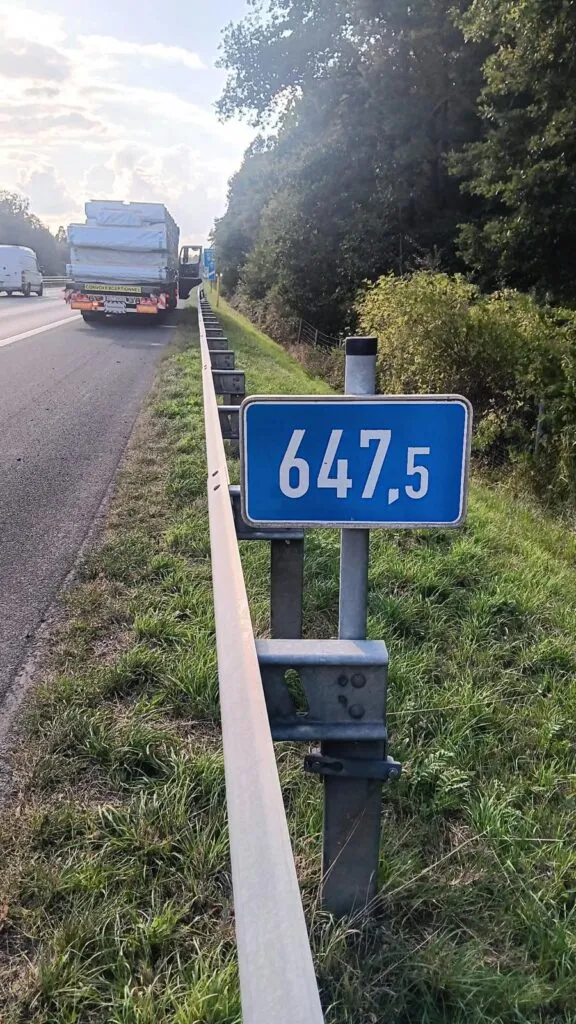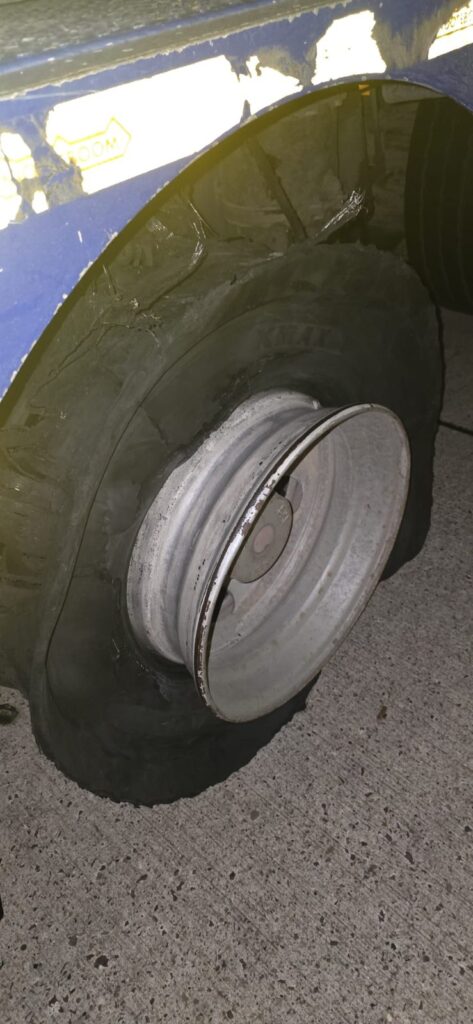
At 23:40 on a dry August night, a driver rang us from a concrete hardstanding beside the A7 near Göttingen. One tyre on the twin wheel of his trailer had burst, torn open down to the steel rim. Our truck tyre service had a night crew on site 35 minutes after dispatch, and the trailer rolled off again at 01:30, exactly 110 minutes after the first call. The total bill came to €977 net.
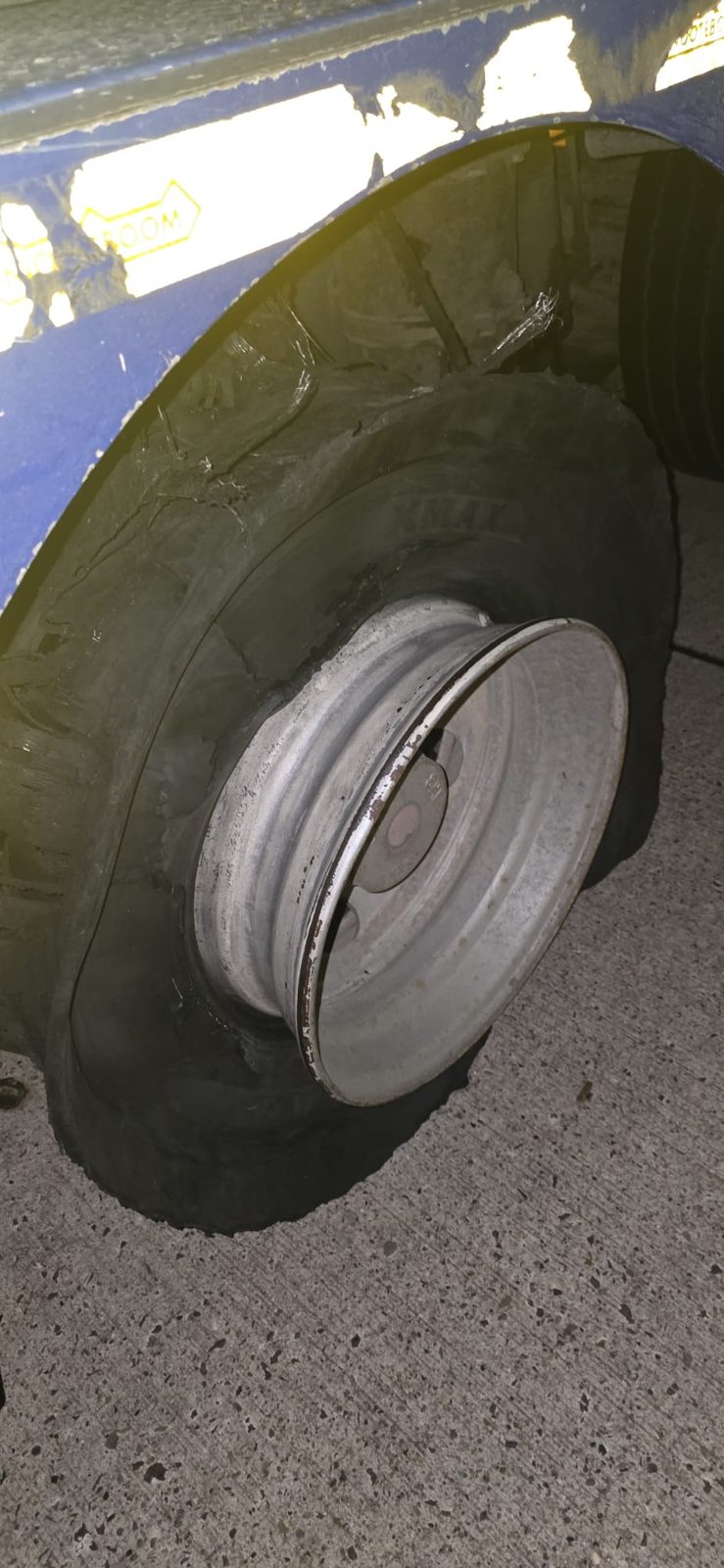
That sounds routine until you look at what a burst trailer tyre does if nobody deals with it properly. Rubber shreds can snag brake hoses, a bare rim digs into the hub and the neighbouring tyre carries a load it was never meant to take alone. A trailer left standing overnight also costs real money, because a stationary rig loses somewhere between €800 and €1,200 per day. This write-up walks through the whole job, minute by minute and euro by euro, so that drivers and fleet managers can see what a proper mobile response looks like.
The emergency: a shredded trailer tyre on the A7
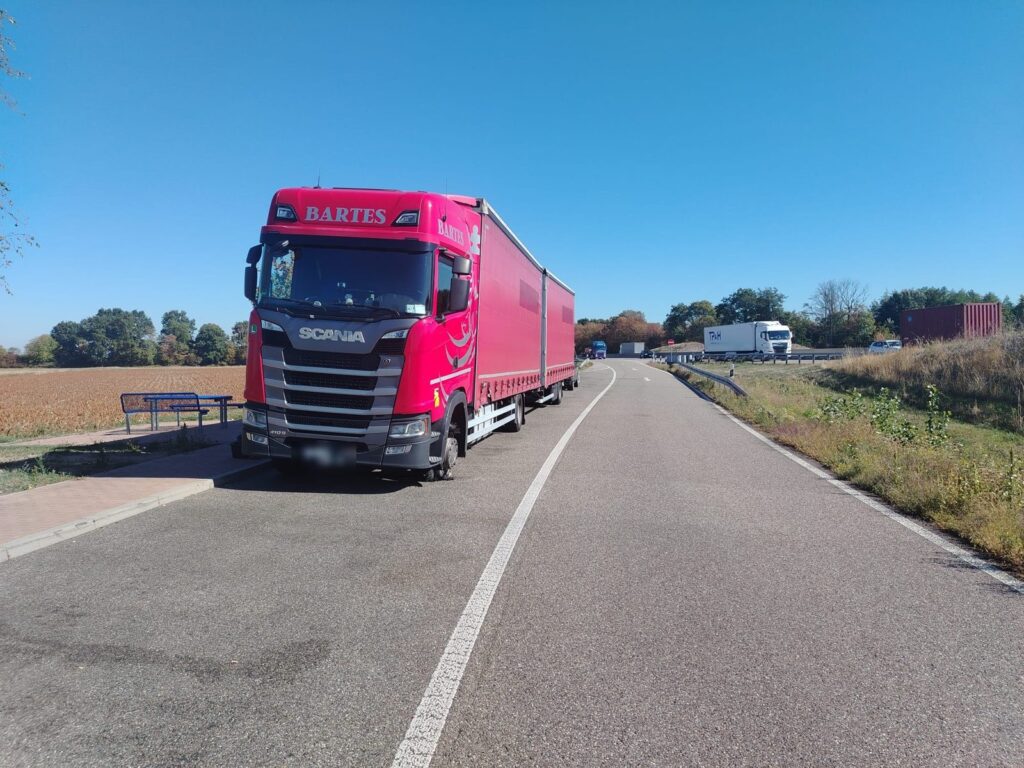
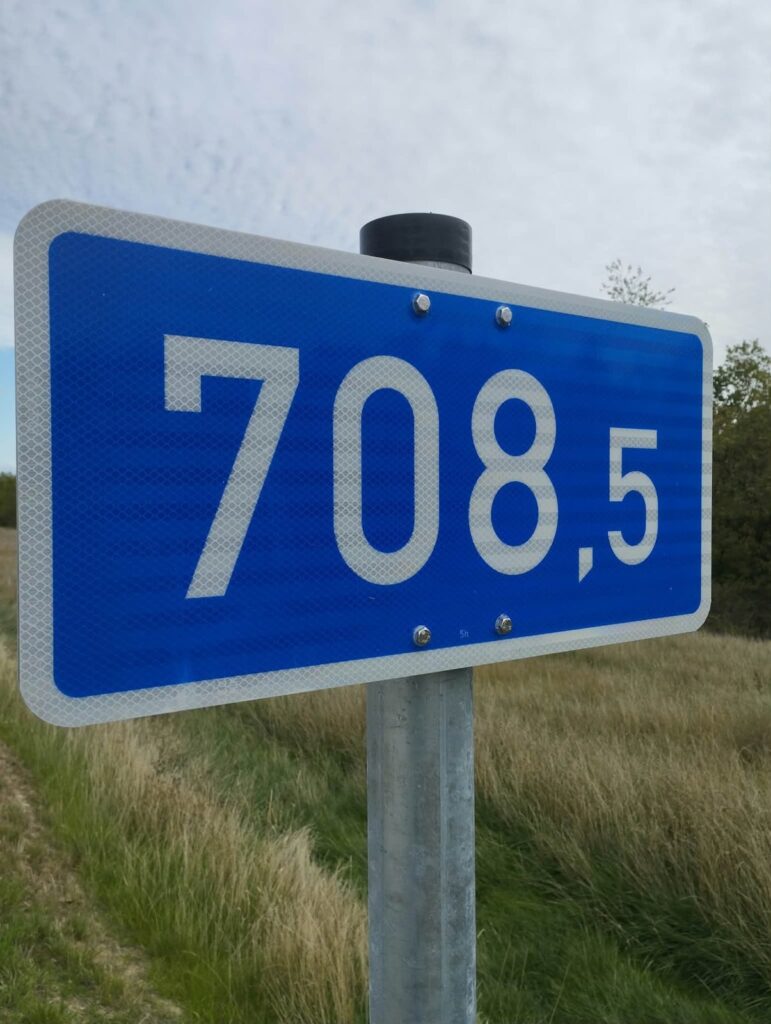
The A7 runs from Flensburg to the Austrian border and is one of the busiest freight corridors in Germany. Around Göttingen it carries a constant stream of lorries heading between Hamburg, Kassel and the south. The driver in this case was running an empty-ish semi-trailer towards Kassel when he felt the rear of the unit start to pull and shudder. He had the presence of mind to ease off, signal and roll onto a paved parking area rather than stopping on the hard shoulder.
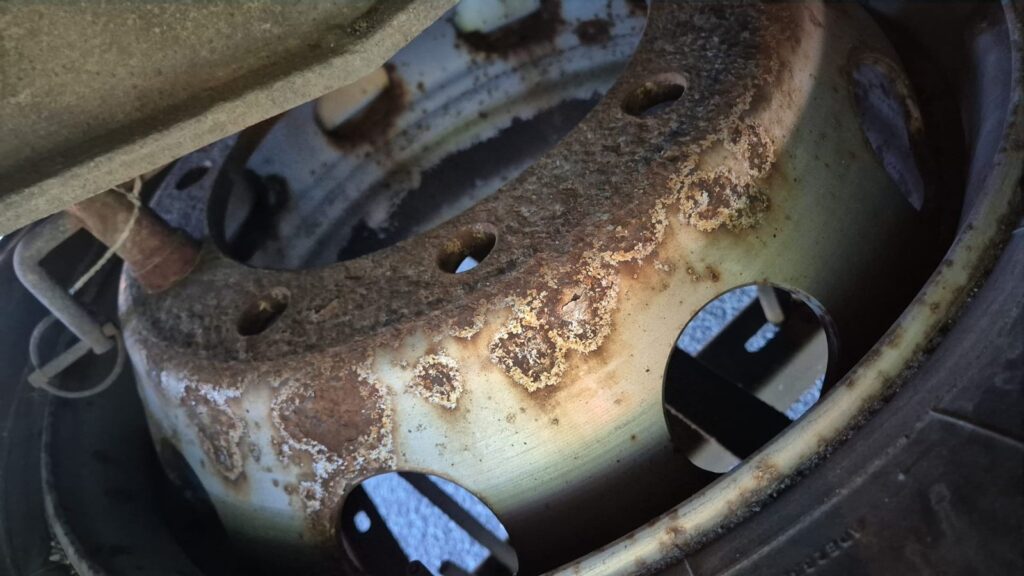
When he got out with a torch, the picture was clear. One tyre of the dual set on the trailer axle had come apart completely. The sidewall and tread were in ribbons, cord was hanging out of the carcass and the steel rim stood bare, with a rusty edge, against the concrete. The second tyre of the pair was intact, which was lucky. The tyre size was not legible on the remains of the sidewall, only a fragment of a marking, so we worked on the assumption of 385/65 R22.5, the standard trailer dimension, and confirmed it on site.
A burst like this rarely comes from nowhere. Typical causes are a slow loss of pressure that went unnoticed for hundreds of kilometres, an overheated tyre after riding underinflated, damage from debris or kerbs, or simply an old casing at the end of its life. In this case the driver had no warning light, since trailer tyres usually have no pressure monitoring. That is the usual story with trailer wheels: nobody notices until the damage is done.
How we organised the help
A dispatcher at our 24/7 desk took the call at 23:40 and collected the essentials in a few minutes: trailer, one tyre destroyed, wheel position, exact location, whether the vehicle was safe, and the likely size. The dispatcher also asked whether the driver could stay with the vehicle and whether the rim looked bent. Those answers decide which equipment goes into the van.
Then came the part that drivers never see. Within 15 minutes we had found the nearest night crew in our partner network and confirmed that a new 385/65 R22.5 tyre was already on board. Nobody had to hunt for a tyre in a regional depot at midnight, which is where most of the delay usually comes from. The crew confirmed a travel time of 35 minutes.
The steps of dispatch, in the order we run them:
- Take the call, record location, vehicle type and what the driver can see.
- Confirm that the vehicle stands safely and the driver is out of traffic.
- Check the size and load index, and decide on tyre and tools.
- Find the closest available night crew with the right stock.
- Give the driver an arrival time and stay reachable until the crew is there.
Every one of these is also on the mobile truck service page and the tyre service page, but here you can see them in a real timeline.
Situation on site: why a burst tyre cannot be ignored
A destroyed tyre on a twin axle is not a “limp to the next yard” problem. The remaining tyre now carries the full axle load alone, and a 385/65 R22.5 trailer tyre is rated for roughly 4,000 kg when used as a single, not as half of a pair. Drive on it and you risk a second burst within a few kilometres.
The rim suffers too. A bare steel rim running on tarmac or concrete gets ground down, can crack at the bead seat and may bend. A bent rim means a second repair bill and a longer wait for a replacement wheel. The hub and brake components sit right next to the burst: flying cord and rubber can cut the brake hose or the ABS cable, which is why our crew inspects those items before anything else.
There is a legal side as well. Under § 36 StVZO tyres must be suitable for the vehicle and in a safe condition, and a vehicle with a visibly destroyed tyre is not roadworthy. A trailer that carries on regardless risks a fine, a ban on continuing and, in the worst case, an accident.
The working pressure of a trailer tyre of this size is high. Heavy-goods tyres run at around 8.5 to 9.5 bar, which is nearly four times what a car tyre carries. That is why a burst is not a gentle event and why nobody should lean over a damaged tyre during inflation.
Step-by-step: how the wheel was changed
Step 1: Inspection (00:15 to 00:20)
The crew arrived at 00:15, parked the service van so that it shielded the working area and switched on beacons. Before touching a tool, the technician walked round the trailer with a lamp: remains of the tyre, rim, hub, the intact twin tyre, the brake chamber, the brake hose and the wiring. The photo in this article was taken in those first minutes, around 00:19. The hose was clean and the rim showed no deep deformation, so the plan was a straight tyre replacement.
Step 2: Securing the site (00:15 to 00:25)
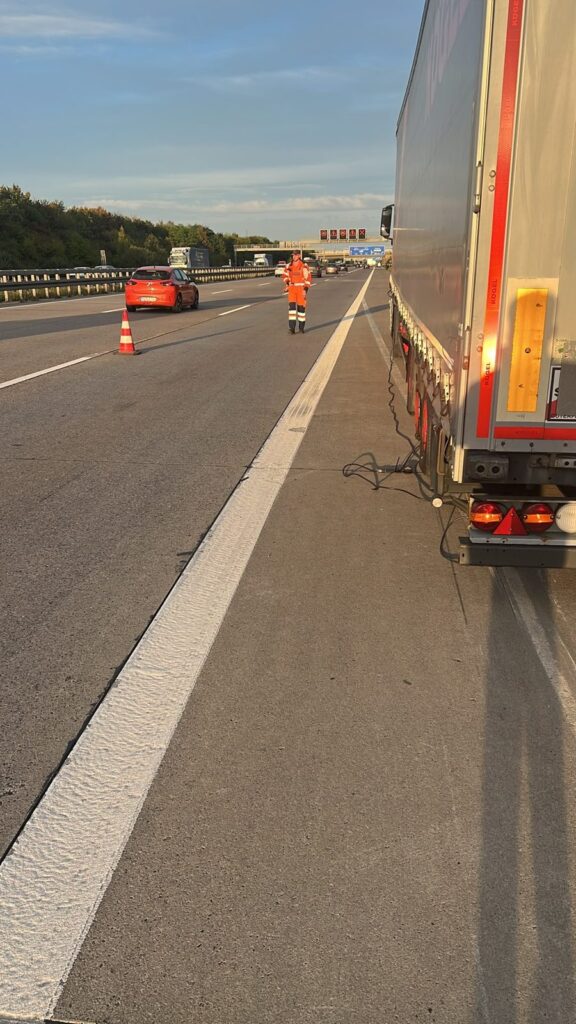
Hazard lights, a warning triangle and high-visibility vests came first, even on a parking area. Wheel chocks went under the opposite wheels, the trailer brakes were applied and the jack was positioned on a firm base. A concrete surface is a good place to work, because tarmac softens in heat and gravel shifts under a jack.
Step 3: Removal (00:25 to 00:45)
The technician loosened the wheel nuts slightly, raised the axle, removed the nuts and lifted the complete wheel off the hub. The torn remains were then stripped from the rim with the bead breaker and tyre irons. This took 20 minutes, mostly because the shredded casing had folded into the rim well. The rim was then cleaned, checked for cracks around the bead seat and the valve was replaced.
Step 4: Fitting the new tyre (00:45 to 01:20)
The new tyre was mounted on the rim, inflated carefully in a safety cage and balanced. It was fitted to the hub, with the nuts started by hand to avoid cross-threading. The whole stage took 35 minutes. Balancing matters even on a trailer, because an unbalanced wheel wears bearings and the new tyre in an uneven way.
Step 5: Final checks (01:20 to 01:30)
Nuts were tightened in a star pattern with a torque wrench to the value specified by the axle manufacturer, which for most M22 stud systems is in the region of 600 to 650 Nm. Our guide to wheel nut torque lists the typical figures. The technician then checked the pressure at 8.5 to 9 bar, noted everything in a short protocol and told the driver to have the nuts retightened after the first 50 to 100 kilometres. At 01:30 the trailer was free to leave.
Full timeline: 110 minutes from call to departure
| Time | Phase | Action |
|---|---|---|
| 23:40 | Call | Driver rings, dispatcher records trailer, burst tyre, location, size |
| 23:55 | Dispatch | Nearest night crew in the partner network found, tyre 385/65 R22.5 on board (15 min) |
| 00:15 | Arrival | Crew on site after 35 minutes on the road, site secured with hazard lights, triangle and vests |
| 00:20 | Inspection | Tyre remains, rim, hub, twin tyre, brakes and hoses checked (5 min) |
| 00:25 | Removal | Jack, wheel removal, stripping of the remains (20 min) |
| 00:45 | Fitting | New tyre on rim, inflation, balancing, wheel back on hub (35 min) |
| 01:20 | Final check | Star-pattern tightening, pressure check, protocol, re-tightening (10 min) |
| 01:30 | Done | Trailer released and back on the road |
Total: 110 minutes (1 hour 50 minutes) from the first call to departure. The time on site, from arrival to release, was 75 minutes. At night the journey is slower, because the crew drives the same roads in the dark and tunnel or roadworks sections slow everyone down. In heavy rain or snow we would add 20 to 30 minutes.
Cost: what the job came to
| Item | Price (EUR) |
|---|---|
| Anfahrt (call-out, night) | 240 |
| Nachtzuschlag (night surcharge, +30 % on call-out) | 72 |
| Tyre 385/65 R22.5 (new trailer tyre) | 480 |
| Montage und Auswuchten (fitting and balancing, 1.5 h x €110) | 165 |
| Entsorgung des Altreifens (disposal of the burst tyre) | 20 |
| TOTAL | 977 |
All amounts are net, plus VAT (zzgl. MwSt.).
What moves the price? The biggest variable is the tyre itself: a 385/65 R22.5 trailer tyre sits at roughly €420 to €540 depending on make and quality class, while a steer-axle or drive-axle tyre in 315/80 R22.5 costs a little more. The second factor is the call-out charge, which depends on distance and time of day. Night and weekend work adds 25 to 50 per cent, here 30 per cent on the call-out only. The third is labour, usually €90 to €140 per hour. If the rim had been bent, a replacement wheel would have added several hundred euros. For a deeper breakdown of what drivers pay, see our article on truck tyre change cost.
Compare that with the alternative. A rig that stands overnight because nobody could come loses €800 to €1,200 per day in lost transit, missed delivery slots and driver idle time. The €977 for this job is less than one day of standing time, and the trailer was moving again before the driver’s rest period would have been over.
Why a professional should do this
Changing a truck wheel at the roadside looks simple on paper and is risky in practice. A pair of drivers with a car jack and a wrench cannot do it safely. The reasons are specific:
- A truck tyre weighs 60 to 80 kg and the complete wheel more than that, so lifting it onto a hub is a two-person or lift-assisted job.
- Heavy-goods tyres run at 8.5 to 9.5 bar, and a bead that lets go during inflation can injure someone seriously.
- Wheel nuts need a proper torque wrench, because a nut tightened by feel can loosen on the autobahn.
- Standard car jacks are not rated for a loaded axle.
- Without a bead breaker and the right irons, a tyre cannot be removed from a rim without damaging it.
- A hidden brake hose or ABS cable problem is invisible to someone who only looks at the tyre.
Add the insurance and liability aspect: if a wheel comes off after an amateur repair, the driver and the operator carry the responsibility. A documented job by a professional crew leaves a paper trail.
Typical situations where we are called out
The A7 night job is one of dozens of similar calls we handle every week across Germany. The most common are:
- Burst or shredded tyre on a semi-trailer or tractor unit, as in this case.
- Slow puncture from a nail or screw found at a rest area or loading dock.
- Tyre damaged by a kerb or pothole, often with a bulge on the sidewall.
- Worn tyres that fail an inspection and must be replaced before the vehicle can continue.
- Lost wheel nuts or loose wheels found during a driver’s check.
- Seasonal wheel changes at a yard when the fleet cannot spare a day in a workshop.
If you want the full range, our contact page lists how to reach the dispatch desk, and many of these jobs are described as separate case studies. The principle is the same each time: collect facts, send the right crew and tyre, document the work.
Prevention: how drivers and fleets avoid the call
Most burst tyres are avoidable. A short habit before every trip prevents the majority of them.
- Check pressure on every wheel, including both tyres of a twin set, at least weekly and always when cold. Our page on truck tyre pressure explains the correct values and how to measure them.
- Look for bulges, cuts, exposed cord and embedded stones in the tread, particularly after gravel yards.
- Tap or inspect the twin tyres: a lower note often means a leak.
- Respect the load index and speed rating on the sidewall and never overload an axle.
- Keep the tread depth well above the legal minimum. § 36 StVZO sets the minimum at 1.6 mm, though most fleets replace earlier.
- Rotate or inspect tyres on a schedule and log pressure and damage.
- Have valves and valve caps checked, because a missing cap invites dirt and slow leaks.
A fleet that checks every trailer wheel once a week and logs it in a simple sheet spots a failing tyre days before it goes. A single pressure gauge costs less than a tenth of the bill in this article.
Tyres and fleet care: a few facts worth knowing
Trailer tyres sit in a different world from drive-axle tyres. They carry load but do not transmit power, so they wear differently: shoulder wear, flat spots from braking and cupping from misaligned axles. Axle alignment on a trailer is often neglected, and an axle that tracks a few millimetres out wears a tyre in a few thousand kilometres. The axle specialist BPW publishes service guidance for trailer axles, and a regular alignment check is cheaper than a new tyre.
Choosing a brand is a question of use. Long-haul fleets often fit premium makes such as Michelin, Continental, Goodyear or Bridgestone, because the casing can be retreaded and the rolling resistance saves fuel. Regional and distribution fleets sometimes choose mid-range brands for lower purchase cost. Whichever you pick, the size, load index and speed rating must match the vehicle documents. If you are unsure how to read the code, our guide to the 385/65 R22.5 size explains each figure.
Retreading deserves a mention. A good casing can be retreaded once or twice, which cuts cost and waste. But a casing that has run flat or been damaged by overheating is finished, and no retreader will accept it. That was the case with the tyre in our photo.
For fleet managers, the useful figures are cost per kilometre and downtime per incident. A burst tyre is rarely the real cost. The real cost is the idle driver, the late delivery and the penalty clause. A relationship with a mobile service that responds at night, 365 days a year, is in practice cheap insurance. The Michelin truck pages and similar manufacturer sites give maintenance advice by tyre line, and the inspection bodies such as DEKRA offer fleet safety checks.
Why drivers and fleets choose us
We are a dispatch company with a verified partner network, which means we are not tied to one depot or one van. When a call comes in at 23:40, we do not have to hope that a local workshop picks up. The people who answer know the networks, the stock and the roads.
- 24/7 availability: the desk answers on nights, Sundays and bank holidays.
- Checked partners: every crew works to our procedure, with a torque wrench, a protocol and documented disposal.
- Transparent pricing: you get an estimate before the crew sets off, split into call-out, tyre, labour and disposal, with no surprises on the invoice.
- Multilingual desk: drivers from Poland, Lithuania, the Netherlands, Romania and many other countries get help in a language they understand.
- Nationwide coverage: from the coast to the Alps, including the unglamorous stretches in between.
It is not about promising miracles. It is about sending the right tyre and the right people, and telling you honestly how long it will take.
FAQ: truck tyre service on the autobahn
How long does a mobile truck tyre change take?
A mobile truck tyre change usually takes 45 to 90 minutes on site, plus 10 to 20 minutes of dispatch and 35 to 70 minutes of travel. In this case the total was 110 minutes from call to departure. Rain, snow or a bent rim extends that time.
What does a truck tyre change cost at night?
A night job with a new 385/65 R22.5 trailer tyre cost €977 net in this case: €240 call-out, €72 night surcharge, €480 tyre, €165 fitting and balancing and €20 disposal. Prices vary with tyre type, distance and time of day.
Can I drive on a burst twin tyre to the next yard?
No. The remaining tyre then carries the full axle load alone, the rim can be ground down and the brake lines may be damaged. Driving on a visibly destroyed tyre also breaches the rules on roadworthiness under § 36 StVZO. Call a mobile service instead.
What should I do first after a tyre blowout?
Hold the steering wheel firmly, ease off the accelerator without hard braking, indicate and steer to a safe place such as a parking area. Switch on the hazard lights, set out a warning triangle and put on a vest. Then call for help. Our blowout checklist, linked below, lists every step.
Do you need to give the tyre size when you call?
It helps, but it is not essential. Read the size from the sidewall of the intact tyre next to the burst one, since twin tyres share the same dimension. If you cannot read it, the dispatcher can ask for the vehicle type and work from there.
Are the wheel nuts checked again after the job?
Yes. Nuts can settle after the first kilometres, so we advise re-tightening after 50 to 100 kilometres. The crew in this case also ran a short final check and recorded the pressure of 8.5 to 9 bar.
Summary: the key figures
| Item | Value |
|---|---|
| Vehicle | Semi-trailer, twin-wheel set |
| Damage | Tyre burst down to the rim, one tyre destroyed |
| Tyre | 385/65 R22.5 (assumed standard trailer size, confirmed on site) |
| Location | A7 near Göttingen, paved parking area |
| Call | 23:40 |
| Crew arrival | 00:15, 35 minutes after dispatch |
| Dispatch time | 15 minutes |
| Total time | 110 minutes (1 hour 50 minutes) |
| Cost | €977 net |
| Secondary damage | None, rim and brakes undamaged |
| Final pressure | 8.5 to 9 bar |
Need help now?
If a tyre has gone on the autobahn, do not wait until morning. Call us on +49 160 5753826, tell the dispatcher where you are and what you can see, and we will send the closest crew with the right tyre. More information is on www.lkwhelp24.com. Round the clock, all across Germany.
Keywords: truck tyre service | mobile reifenservice | truck tyre replacement | truck tyre change | truck tyre callout | truck tyre roadside assistance | truck tyre repair | trailer tyre service | truck tyre burst | truck tyre germany | mobile truck tyre service | trailer tyre replacement | truck tyre breakdown | A7 Göttingen