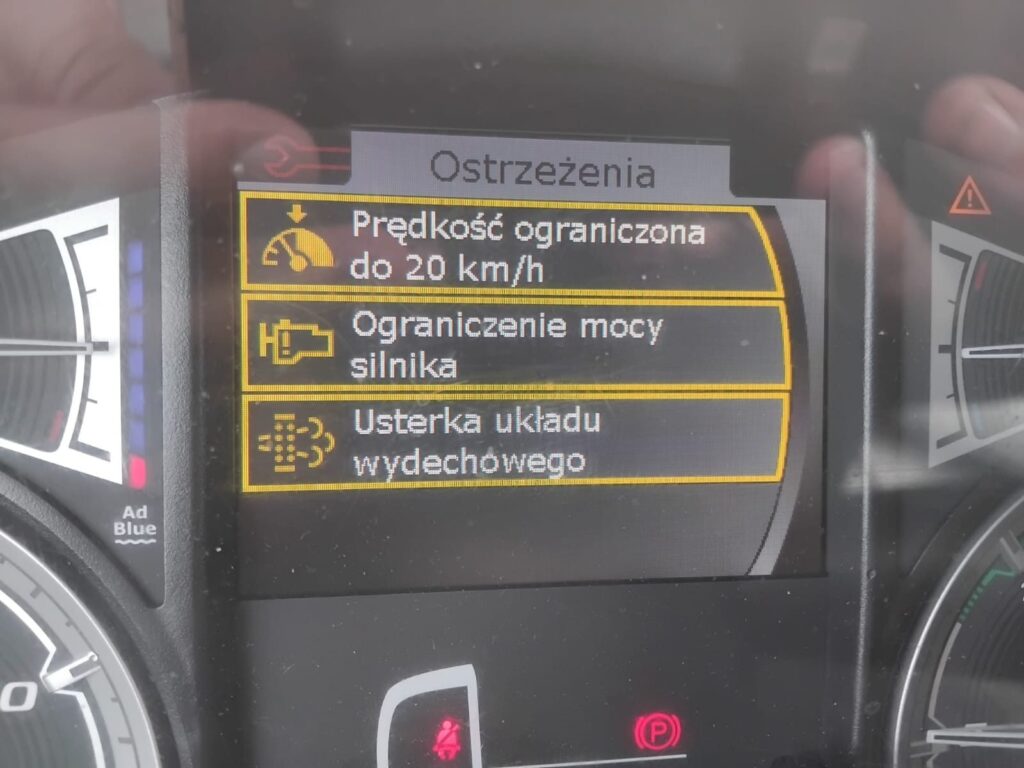
When a heavy goods vehicle (HGV) suddenly drops to 20 km/h and the engine power is drastically reduced, it’s not just an inconvenience, it’s a critical safety and operational emergency. This scenario, known in technical terms as Notlauf (emergency operating mode), is triggered by a failure in the exhaust aftertreatment system, most commonly linked to the AdBlue® system or NOx sensors. On 3rd September 2026 at 14:26, a semi-trailer truck with Polish registration was forced to pull over on the A1 near Osnabrück, travelling towards Bremen. The driver, a Polish operator, reported the dashboard warning lights: “Speed limited to 20 km/h”, “Engine power reduction”, and “Fault in exhaust system”. With the AdBlue level nearly empty and the vehicle stuck in a restricted mode, further progress was impossible, not only due to performance loss, but because continuing under such conditions risks severe engine and SCR system damage.
This case illustrates why immediate, expert roadside assistance is not a luxury, it’s a necessity. Delaying repairs can lead to irreversible damage, extended downtime, missed delivery deadlines, and penalties for non-compliance with emissions regulations. Our mobile team was dispatched within 15 minutes, arriving on site in just 50 minutes. Over the next 110 minutes, a full diagnosis, component replacement, and system reset were completed on-site. The truck was back on the road with full performance restored, all within 2 hours and 39 minutes from the first call. The total cost for the service was €860 (net), a fraction of the potential €800–1,200 per day in downtime costs. This article breaks down the entire process: from the moment the warning lights appeared, through diagnosis and repair, to the final verification and why choosing a professional mobile truck service is essential when facing such emergencies.
What Happened: The Emergency Warning Sequence
The situation began with a cascade of warning signals on the truck’s multifunction display. The interface, in Polish, displayed three distinct alerts: “Prędkość ograniczona do 20 km/h”, “Ograniczenie mocy silnika”, and “Usterka układu wydechowego”. These are not generic alerts, they are specific fault codes triggered by the vehicle’s engine control unit (ECU) in response to a malfunction in the selective catalytic reduction (SCR) system. The ECU detects abnormal nitrogen oxide (NOx) levels in the exhaust, which can occur due to low AdBlue levels, a faulty dosing module, or a defective NOx sensor.
The immediate consequence is the activation of Notlauf, a fail-safe mode designed to protect the engine and aftertreatment system. In this state, the truck is limited to a maximum speed of 20 km/h, and engine torque is significantly reduced. The driver cannot accelerate normally, and the vehicle becomes a hazard on the motorway. The system also disables the ability to restart the engine unless the fault is cleared, creating a cycle of immobilisation until the root cause is addressed.
On the dashboard, the nearly empty AdBlue indicator, with the red lower segment lit, confirmed the most common trigger: a lack of AdBlue fluid. However, a visual check of the reservoir alone is insufficient. The ECU may have detected a low fluid level, but it could also be reacting to a sensor fault, a clogged injection line, or a blocked or malfunctioning NOx sensor. Ignoring these warnings or attempting a quick refill without diagnosing the underlying issue risks worsening the problem. In fact, some modern systems will not allow the engine to restart until the fault is cleared, even if the tank is refilled, making professional intervention essential.
Why Immediate Action Is Critical: Risks of Ignoring Notlauf
Continuing to operate a truck in Notlauf mode is not only inefficient, it’s dangerous and can lead to significant mechanical and financial consequences. First, the reduced engine power makes it difficult to maintain safe speeds on motorways, especially in heavy traffic or on gradients. This increases the risk of rear-end collisions and can result in fines or liability claims.
Second, prolonged operation in this mode causes soot and unburned hydrocarbons to accumulate in the diesel particulate filter (DPF). The DPF is designed to regenerate periodically, but in Notlauf, regeneration cycles are suppressed or fail to complete. Over time, this leads to clogging, which can cause overheating, engine shutdown, or even permanent DPF failure, a repair that can cost between €2,000 and €5,000.
Third, the SCR system relies on precise dosing of AdBlue to neutralise NOx emissions. If the system detects a fault, it may reduce or stop AdBlue injection altogether, leading to increased emissions. This is not just an environmental concern, it violates §36 StVZO, which mandates compliance with emission standards. Fines for non-compliance can reach up to €1,000, and repeated violations may result in vehicle seizure.
Finally, the vehicle’s onboard diagnostics may store fault codes that prevent restart until cleared. Without proper diagnostic equipment and knowledge, a driver might refill the AdBlue tank, only to find the engine still refuses to start. In such cases, the only solution is a mobile technician or towing to a workshop, both of which are far more expensive than a timely on-site repair.
How We Responded: Dispatch, Coordination, and On-Site Mobilisation
The emergency began at 14:26 when the driver sent a photo of the dashboard and described the symptoms. Within seconds, our multilingual dispatch team received the call. The system immediately identified the location: A1 near Osnabrück, direction Bremen. Using real-time data from our partner network across Germany, we located the nearest available mobile service unit, a technician based in the Münster region, within 40 km of the site.
A Polish-speaking dispatcher confirmed the details with the driver, explained the next steps, and provided a transparent quote: €860 net for the full service, including diagnostics, parts, and labour. The driver accepted, and the technician was assigned within 15 minutes. The response time from call to dispatch was 15 minutes, well within the standard 10–20 minute window for urgent cases.
The technician departed at 14:41 and arrived at the designated parking area on the A1 at 15:31, a travel time of 50 minutes. This reflects typical conditions on the German motorway network, including traffic, speed limits, and route planning. The team used GPS navigation and real-time traffic updates to avoid congestion. Upon arrival, they secured the site, placed warning triangles, activated hazard lights, and wore high-visibility safety vests, all in compliance with German road safety regulations (§15 StVO).
The technician then conducted a full assessment of the vehicle’s status, confirming the dashboard warnings and checking the AdBlue reservoir. The fluid level was indeed critically low, but further diagnostics were required to determine whether this was the root cause or merely a symptom.
On-Site Diagnosis: Identifying the Root Cause
The technician connected a professional diagnostic tool, a Bosch KTS 3000, to the vehicle’s OBD2 port. This device reads live data from the ECU and retrieves stored fault codes (DTCs). Within seconds, the system reported several critical errors:
- P2010: NOx sensor signal too low (downstream of the SCR catalyst)
- P2011: NOx sensor signal too high
- U0410: Communication error with the AdBlue dosing module
- P0470: Exhaust pressure sensor fault
These codes indicated a mismatch between expected and actual NOx levels in the exhaust. The ECU was receiving conflicting signals from the downstream NOx sensor, suggesting either a sensor fault, a blockage in the exhaust line, or a malfunction in the AdBlue injection system.
The technician then inspected the physical components:
– The AdBlue reservoir was nearly empty, but the pump and level sensor were intact.
– The dosing module was accessible and showed no visible leaks or damage.
– The NOx sensor (a ceramic probe mounted in the exhaust pipe) was examined for soot build-up, corrosion, or physical damage.
– The injection line from the dosing module to the SCR catalyst was checked for kinks, leaks, or clogs.
After cleaning the sensor and testing the electrical connection, the technician noticed inconsistent readings. A voltage fluctuation suggested a failing sensor. Further testing confirmed that the downstream NOx sensor was providing unreliable data, likely due to contamination or internal failure.
This confirmed the root cause: a faulty NOx sensor, not just low AdBlue. The ECU had interpreted the sensor’s false readings as a system failure, triggering Notlauf. Simply refilling the AdBlue would not have solved the problem, it would have led to repeated fault codes and continued engine restriction.
Repair Process: Step-by-Step Fix on the Motorway
The repair was completed in three key phases, each executed with precision and safety.
Step 1: Sensor Replacement
The technician removed the old NOx sensor using a 24mm socket and torque wrench. The sensor was carefully extracted from the exhaust pipe, which had reached high temperatures during operation. A new OEM-compatible NOx sensor was installed, with the O-ring lubricated using a silicone-based sealant to prevent leaks. The sensor was tightened to the manufacturer’s specified torque: 15 Nm, critical to avoid over-tightening, which can damage the ceramic element.
Step 2: AdBlue Refill and System Flush
After replacing the sensor, the technician refilled the AdBlue reservoir with 20 litres of high-quality AdBlue (DIN 70070 standard). The fluid was poured through a funnel to prevent spills. The dosing module was then activated to circulate the fluid through the system. A brief flush was performed to clear any residual contaminants from the injection line. The technician verified that the fluid flowed freely and that no air bubbles remained in the line.
Step 3: System Calibration and Verification
With the physical repairs complete, the diagnostic tool was reconnected. The technician cleared all stored fault codes and initiated a system calibration sequence. The ECU recalibrated the NOx sensor and re-established communication with the dosing module. The system was then tested under load: the engine was started, and the technician monitored real-time data from the ECU, including NOx levels, AdBlue consumption rate, and injection pressure.
After 10 minutes of steady running, the dashboard warnings disappeared. The speed limit was lifted, engine power returned to normal, and the AdBlue level indicator showed a full tank. A final verification drive was conducted, the truck accelerated smoothly to 80 km/h, confirming full functionality.
Full Timeline: From Call to Completion
| Time | Phase | Action |
|---|---|---|
| 14:26 | Call Received | Driver sends photo and reports speed limit, power loss, and AdBlue warning |
| 14:26–14:41 | Dispatch & Coordination | Multilingual team confirms location, assigns nearest mobile unit, quotes €860 |
| 14:41–15:31 | On-Route Travel | Technician travels 40 km to A1 Osnabrück parking area (50 minutes) |
| 15:31–15:51 | Diagnostic Assessment | Fault codes retrieved, NOx sensor tested, root cause identified |
| 15:51–16:51 | Repair Execution | NOx sensor replaced, AdBlue refilled, system flushed and calibrated |
| 16:51–17:05 | Final Verification | Fault codes cleared, test drive completed, performance confirmed |
| 17:05 | Service Complete | Truck back on the road, driver resumes journey |
Total time from call to completion: 159 minutes (2 hours 39 minutes)
This includes travel, diagnostics, repair, and verification, all performed on the motorway without the need for towing or workshop visit.
Cost Breakdown: Transparent Pricing for Full Service
| Position | Price (EUR) |
|---|---|
| On-site service (Anfahrt) | 240 |
| Engine and SCR diagnostics | 150 |
| Labour, 1.5 hours at €110/hour | 165 |
| NOx sensor (Ersatzteil) | 280 |
| AdBlue (20 litres) + small materials | 25 |
| Total | 860 |
All prices are net (excluding VAT). The cost includes:
– Full diagnostic assessment
– Replacement of the NOx sensor (OEM quality)
– 20 litres of AdBlue fluid
– Labour time and mobile equipment
– Safety measures and site preparation
For comparison, a single day of downtime for a heavy-duty truck can cost between €800 and €1,200, depending on the value of the cargo, contract penalties, and lost revenue. An emergency tow to a workshop would cost €900–1,800, depending on distance and vehicle weight, often including additional fees for unloading and storage. By resolving the issue on-site, this service saved the operator over €1,000 in potential losses and avoided the logistical hassle of transport.
Why You Should Never Attempt DIY Repairs on SCR Systems
Attempting to fix an SCR-related fault without professional tools and training can lead to costly mistakes. Here’s why:
- Incorrect sensor replacement: Using a non-OEM or mismatched sensor can cause false readings, triggering new faults.
- Over-tightening the NOx sensor: This can crack the ceramic element, rendering it useless and requiring replacement.
- Air in the AdBlue line: If not properly bled, air pockets can prevent proper dosing and damage the dosing module.
- Failure to clear fault codes: Even after replacing parts, the ECU may retain old codes, preventing restart.
- Improper fluid handling: Using low-quality or contaminated AdBlue can clog the system and damage the SCR catalyst.
Only trained technicians with certified diagnostic tools should handle these systems. Our team uses Bosch KTS and other professional-grade equipment, ensuring accurate readings and safe repairs.
Common Scenarios We Handle Across Germany
Our mobile service team is equipped to deal with a wide range of breakdowns on German motorways and rest areas. Typical cases include:
- AdBlue system faults (low level, sensor failure, dosing module issues)
- Tyre blowouts and rim damage
- Electrical faults (alternator, battery, starter)
- Brake system warnings (ABS, brake wear, hydraulic leaks)
- Engine misfires and diagnostic codes
- Fuel system issues (clogged filters, pump failure)
- Heater and climate control failures (Webasto, Dometic)
- Transmission and clutch problems
- Suspension and axle faults
We operate 24/7 across all federal states, with a network of partners covering every major route, including the A1, A2, A3, A4, A5, A6, A7, A8, A9, A10, and more. Whether it’s a sudden engine warning on the A93 near Weiden or a NOx fault on the A2 near Helmstedt, we’re ready to respond.
Preventive Maintenance Tips for Drivers and Fleets
To avoid costly breakdowns, follow these best practices:
- Check AdBlue levels weekly, never let it drop below 20%. Use a dipstick or digital gauge.
- Use only certified AdBlue (DIN 70070 standard), avoid cheap, unbranded products.
- Perform pre-trip inspections, check warning lights, fluid levels, and tyre pressure.
- Update software regularly, some faults are resolved via ECU updates.
- Keep a spare NOx sensor or dosing module if operating in remote areas.
- Train drivers to recognise early warning signs and report them immediately.
Regular maintenance can reduce breakdowns by up to 60%, a significant saving for any transport company.
Advanced Insights: SCR, AdBlue, and Emissions Compliance
The SCR (Selective Catalytic Reduction) system is a key component in modern diesel trucks, reducing NOx emissions by up to 90%. It works by injecting AdBlue, a urea-based solution, into the exhaust stream. The solution breaks down into ammonia (NH₃), which reacts with NOx in the presence of a catalyst to form nitrogen and water.
According to §36 StVZO, all commercial vehicles must comply with emission limits. Failure to do so can result in fines, vehicle detention, or even suspension of operating permits. The ECU monitors the entire system in real time, and any deviation triggers a warning or Notlauf.
For more information on emissions standards, see ADAC and DEKRA. For technical details on SCR systems, visit Bosch Mobility.
Why Choose LKWHelp24 for Your Truck Breakdown Service?
- 24/7 availability, we respond day or night, in any weather
- Proven network, 30+ trained technicians across Germany
- Transparent pricing, no hidden fees, all costs quoted upfront
- Multilingual support, dispatchers fluent in German, English, Polish, and Russian
- On-site repairs, no towing, no delays, no extra costs
- Full diagnostics, we don’t just fix symptoms, we fix the cause
Our mission is to get your truck back on the road as quickly and safely as possible, without the stress of bureaucracy or uncertainty.
Understanding the SCR System: How It Works and Why It Matters
The Selective Catalytic Reduction (SCR) system is a cornerstone of modern diesel engine emissions control, particularly in heavy-duty trucks operating in Europe. It functions by injecting a urea-based solution, AdBlue, into the exhaust stream, where it reacts with nitrogen oxides (NOx) in the presence of a catalyst to produce harmless nitrogen (N₂) and water (H₂O). This process reduces NOx emissions by up to 90%, making it essential for compliance with EU Stage V and German emissions standards. The system is controlled by the engine’s ECU, which continuously monitors NOx levels using upstream and downstream sensors.
The core components include the AdBlue reservoir, a dosing module, injection nozzles, a catalyst converter, and the NOx sensors. The dosing module precisely regulates the amount of AdBlue injected based on engine load, temperature, and exhaust gas composition. If the system detects a fault, such as low fluid, incorrect injection pressure, or sensor failure, it triggers a warning and may enter Notlauf mode to protect the engine and catalyst. The downstream NOx sensor is especially critical: it verifies that the SCR system is working effectively. If it reports higher NOx levels than expected, the ECU assumes a failure and limits engine performance.
Without proper functioning, trucks risk exceeding emission limits, which can lead to fines, vehicle seizure, or even legal liability under environmental regulations. For fleet operators, this means not just financial penalties but reputational damage and operational disruption. Understanding how the SCR system works helps drivers and technicians anticipate potential issues and respond proactively.
Critical Maintenance Checks for Fleet Managers
Fleet managers play a key role in preventing breakdowns and ensuring long-term vehicle reliability. Implementing a structured maintenance schedule for SCR systems can significantly reduce unplanned downtime. Here are five essential checks every fleet should perform:
- AdBlue Level Monitoring – Check levels at least once a week, especially before long-haul trips. Use calibrated dipsticks or digital gauges. Never allow the level to drop below 20% of capacity.
- Sensor Inspection – Schedule visual and electrical checks of NOx sensors every 30,000 km. Clean them if soot buildup is visible, but replace if readings are inconsistent.
- Dosing Module Health – Inspect for leaks, clogs, or corrosion. Test the pump function during routine service.
- Fluid Quality Control – Only use AdBlue that meets DIN 70070 standards. Avoid unbranded or low-cost alternatives, which can contain impurities that damage the catalyst.
- Diagnostic Log Review – Use fleet management software to review ECU fault codes weekly. Early detection of recurring errors can prevent full system failure.
A proactive maintenance program can reduce SCR-related breakdowns by up to 70%. Many modern trucks also offer remote diagnostics, allowing managers to monitor system status in real time and intervene before a warning appears on the dashboard.
Technical Specifications and Compliance Standards
The performance and safety of SCR systems are governed by strict technical and regulatory standards. The most relevant are:
- DIN 70070: The German standard for AdBlue quality, ensuring it contains the correct concentration of urea (32.5%) and minimal impurities.
- ISO 22241: The international standard for urea solutions used in SCR systems.
- §36 StVZO (StVO): Requires all commercial vehicles to comply with NOx emission limits. Violations can result in fines up to €1,000.
- EC 715/2007 (EU Emissions Regulation): Mandates that new heavy-duty vehicles meet stringent NOx and particulate limits, enforced via on-board diagnostics (OBD).
Key technical parameters:
– NOx Sensor Operating Range: 0–500 ppm (parts per million)
– AdBlue Injection Pressure: 20–40 bar
– Injection Pulse Duration: 10–50 milliseconds
– Catalyst Temperature Threshold: 200–600°C (optimal range: 250–450°C)
Failure to maintain these parameters increases the risk of system failure. For example, if the catalyst temperature drops below 200°C, the urea may not fully decompose, leading to ammonium nitrate deposits that clog the system. Conversely, temperatures above 600°C can damage the catalyst structure.
Real-World Impact: Cost of Downtime vs. Preventive Investment
The financial implications of ignoring SCR system warnings are substantial. Based on industry data, the average cost of a truck being out of service due to a breakdown is €800–1,200 per day, factoring in lost revenue, penalty fees, and contract breaches. For a high-value cargo haul, this can exceed €2,000 per day. In contrast, a full on-site repair like the one described in this case, costing €860, is a fraction of that.
Investing in preventive maintenance yields a strong return. A study by DEKRA found that fleets with structured diagnostic monitoring reduced unplanned breakdowns by 68% over a 12-month period. The average cost of a scheduled SCR maintenance check is €120–180, far less than the cost of emergency repairs, towing, or downtime.
Moreover, early intervention prevents secondary damage. For instance, prolonged operation in Notlauf can lead to DPF clogging, which costs €2,000–5,000 to replace. A failed NOx sensor replacement costs around €280, but if left unchecked, can trigger a chain reaction affecting the entire exhaust system. Proactive maintenance isn’t just about avoiding breakdowns, it’s about protecting the entire vehicle lifecycle and ensuring compliance with environmental and operational regulations.
Summary: Key Facts from This Case
- Vehicle type: Semi-trailer truck with Polish registration
- Location: A1 near Osnabrück, direction Bremen
- Issue: Notlauf mode due to faulty NOx sensor and low AdBlue
- Symptoms: Speed limited to 20 km/h, engine power reduced, warning lights on dashboard
- Response time: 15 minutes (dispatch)
- On-site arrival: 50 minutes (total 65 minutes from call)
- Repair time: 60 minutes
- Total service time: 159 minutes (2 hours 39 minutes)
- Total cost: €860 net
- Alternative cost: €900–1,800 (tow + workshop)
- Secondary damage avoided: DPF clogging, engine damage, emission violations
Need Help? Call Us Now
If your truck breaks down on the German motorway, don’t wait. Call +49 160 5753826, we’re available 24/7 across Germany. Whether it’s an AdBlue warning, a tyre blowout, or an engine fault, our mobile team will be there fast. Visit www.lkwhelp24.com for more details on our services.
Truck breakdown service Germany, fast, professional, reliable. We fix what matters.
Keywords: truck service | truck breakdown service | roadside assistance germany | mobile truck service | truck repair | mobile service truck | truck mechanic from poland | roadside assistance near me | emergency roadside | repair truck | truck shop germany | truck assistance | truck service near me | roadside assistance services | mobile truck maintenance | roadside rescue | truck engine repair | truck vulcanization | mobile lkw werkstatt hamburg | help roadside | european roadside assistance | roadside assistance battery jump | 24 help lkw | www daf truck com | wrong fuel truck
Related Articles:
– Emergency Wheel Change on a Truck: What to Do After a Tyre Blowout on the Motorway
– Dashboard Warning Light on the A93 near Weiden: Mobile Engine Diagnostics Gets a Tractor Unit Back on the Road in 1 Hour 55 Minutes
– AdBlue Warning with a Countdown on the A2 near Helmstedt: How We Beat a Restart Lockout in 1 Hour 47 Minutes
– Mobile Truck Breakdown Assistance on the A31 near Lingen: AdBlue/SCR Hose Fault Fixed, Semi-Truck Back on the Road in 10 Hours 53 Minutes
– Truck Breakdown Assistance on the A9 near Bayreuth: Ford F-Max AdBlue/SCR Fault Fixed On-Site in 2 Hours 5 Minutes