Skip to content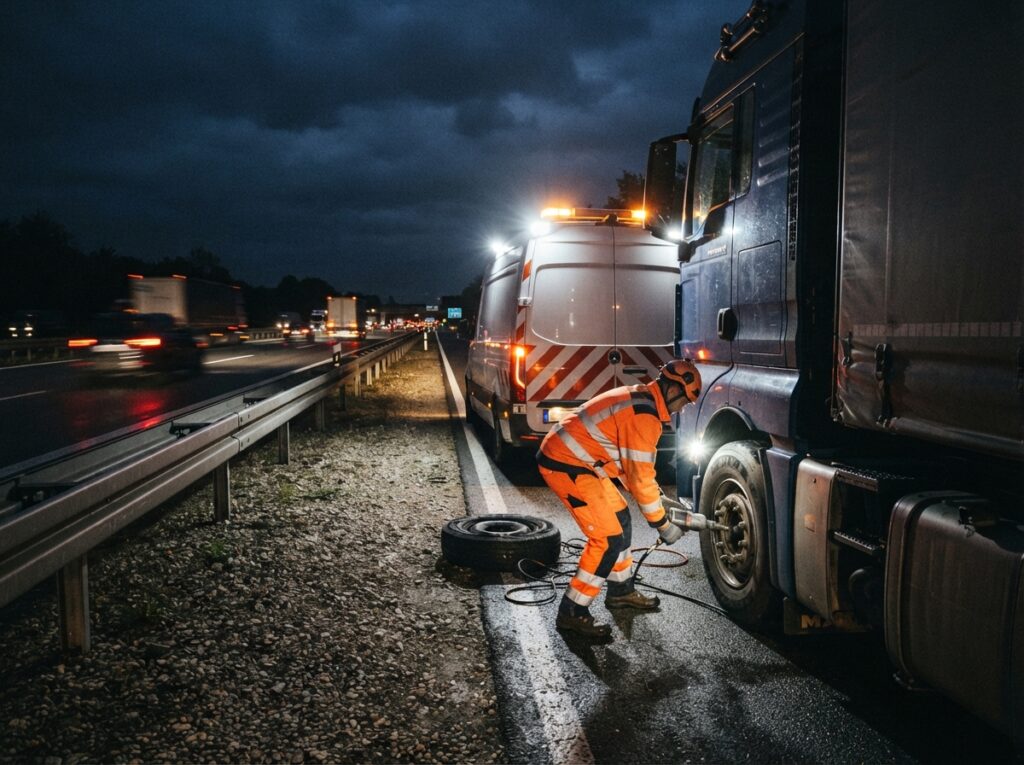
When a Truck Tire Blows on the Motorway
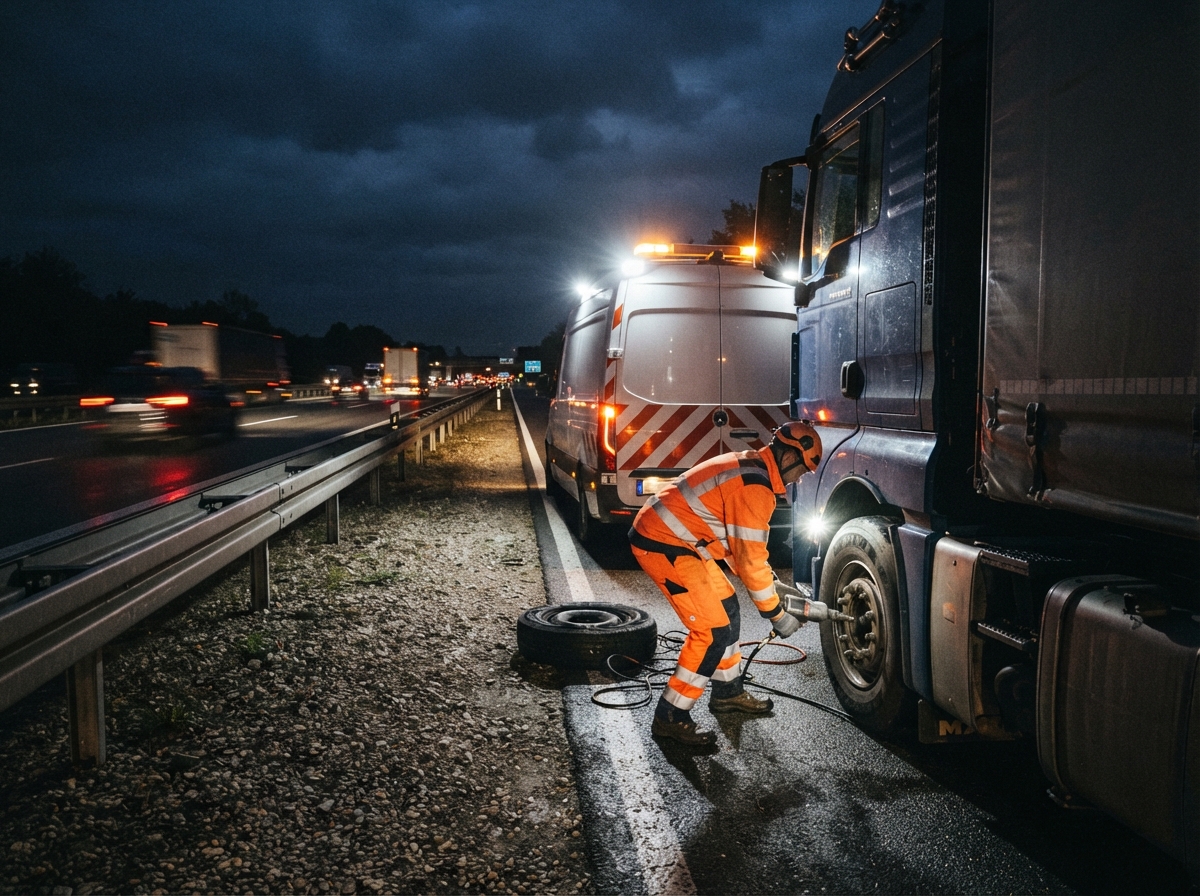
A loud bang, a jerk in the steering wheel, then the pull to one side. For a truck with a semi-trailer, a tire blowout usually happens without warning, often at full speed on the motorway. In that moment every second matters, but not in the way many drivers instinctively react. Slamming the brakes and yanking toward the shoulder can make a dual tire failure worse and send the trailer into a skid. The right response is calmer than instinct suggests.
LKWHelp24 handles exactly these calls every week: a tire failure on a motorway, a driver alone, cargo strapped down, the clock running. This article covers what actually matters in the first minutes, what a genuine emergency tire service for trucks above 7.5 tonnes needs to get right, and when an on site repair makes more sense than a full recovery.
The First 90 Seconds After Tire Failure
The urge to stop immediately is understandable but dangerous if it turns into a hard brake in the lane. A controlled roll out with light counter steering is safer, letting the vehicle settle on the hard shoulder or, if none exists, as far right as physically possible. Hazard lights go on right away, even while the truck is still rolling.
Once the truck has stopped, the driver leaves the cab only on the side away from traffic. This matters most on narrow shoulders, where the right door opens onto a barrier or a verge and the left door opens straight into moving traffic. The high visibility vest goes on inside the cab, not after stepping out. A driver who searches for the vest after already standing on the roadside spends several unprotected seconds there, and those seconds are exactly when rear end collisions with stopped trucks happen.
A warning triangle for a truck needs to sit much farther back than for a car. A rough rule is somewhere between 150 and 400 meters, depending on visibility and the speed limit on that stretch. On a motorway with good visibility, 150 meters is often not enough when vehicles are approaching at 130 km/h or more. Whoever places the triangle should always walk behind the barrier or on the verge, never on the carriageway itself.
Secure First, Fix Second: the Order That Saves Lives
A common mistake among both experienced and younger drivers is the urge to fix the problem immediately. The jack is within reach, the spare wheel sits in its bracket, and instinct says: change it fast before traffic backs up. That is exactly the wrong approach for a 40 tonne combination parked on the hard shoulder. Changing a wheel on a tractor unit or trailer with roadside tools often takes an hour or more, and during that hour the driver stands unprotected next to a heavily used lane.
The order LKWHelp24 recommends to partners and customers is simple: secure the scene first, call for help second, and only attempt any repair yourself if conditions genuinely allow it. Securing means hazard lights, high visibility vest, warning triangle, and moving the vehicle as far from the carriageway as possible, even limping at walking pace to the next emergency bay or exit if the tire is already flat. A tire that has already blown will not get meaningfully worse over a few hundred meters at walking speed, but the position at the roadside can be the difference between a calm repair and a life threatening incident.
Emergency Number or Specialist Service: Who to Call First

For a simple tire failure with no injuries and no blocked carriageway, the emergency number is usually not the right first call. It stays free for genuine emergencies. Instead, calling a specialized emergency tire service for trucks, one built for commercial vehicles above 7.5 tonnes with the right stock on board, gets a driver back on the road faster.
The difference from a general breakdown service matters here. A van set up for passenger cars rarely carries the right truck tire sizes, the correct impact wrench, or a lift rated for a loaded semi. At LKWHelp24, the technician who arrives works exclusively with commercial vehicle tires, including dual wheel setups on the drive axle and the less common sizes found on trailers and specialized units.
The fastest way to reach the team is WhatsApp at +49 160 5753826, since a location pin can be shared in seconds, photos of the damage can follow immediately, and the language barrier that often trips up foreign drivers simply does not come up. The service runs around the clock, every day of the week, because a tire failure does not check office hours. Communication happens in German, English, Polish, and Russian, which often matters most for international haulage companies running mixed fleets of drivers.
How Fast Help Actually Arrives
Realistically, arrival time with LKWHelp24 falls between 30 and 60 minutes, depending on exact location, time of day, and current traffic conditions. That range is communicated deliberately, because flat promises of 15 or 20 minutes on a motorway simply are not realistic once the site is anything but close to a major city. A driver who knows the honest time window can plan the wait, update dispatch, and manage expectations with the client waiting on the delivery.
While waiting, the driver should stay at a safe distance from the vehicle, ideally behind the barrier, rather than in the cab if it sits in the danger zone. In heavy rain or cold, staying in the cab is reasonable as long as the hazard lights are on and the triangle is correctly positioned.
On Site: Wheel Change or Recovery
Not every tire failure can be fixed on the spot. The technician first checks whether a straightforward swap for a spare wheel, or a vulcanized repair of the damaged tire, is enough, or whether structural damage to the rim, the body, or even the suspension rules out continuing the journey.
For a classic blowout with no secondary damage, a mobile wheel change right at the stopping point is usually sufficient. The technician brings the correct spare or repairs the tire depending on the damage, lifts the axle, swaps the tire, and then checks air pressure and wheel nut torque before releasing the vehicle. After that the truck can generally continue on its own to the nearest workshop or straight to its destination.
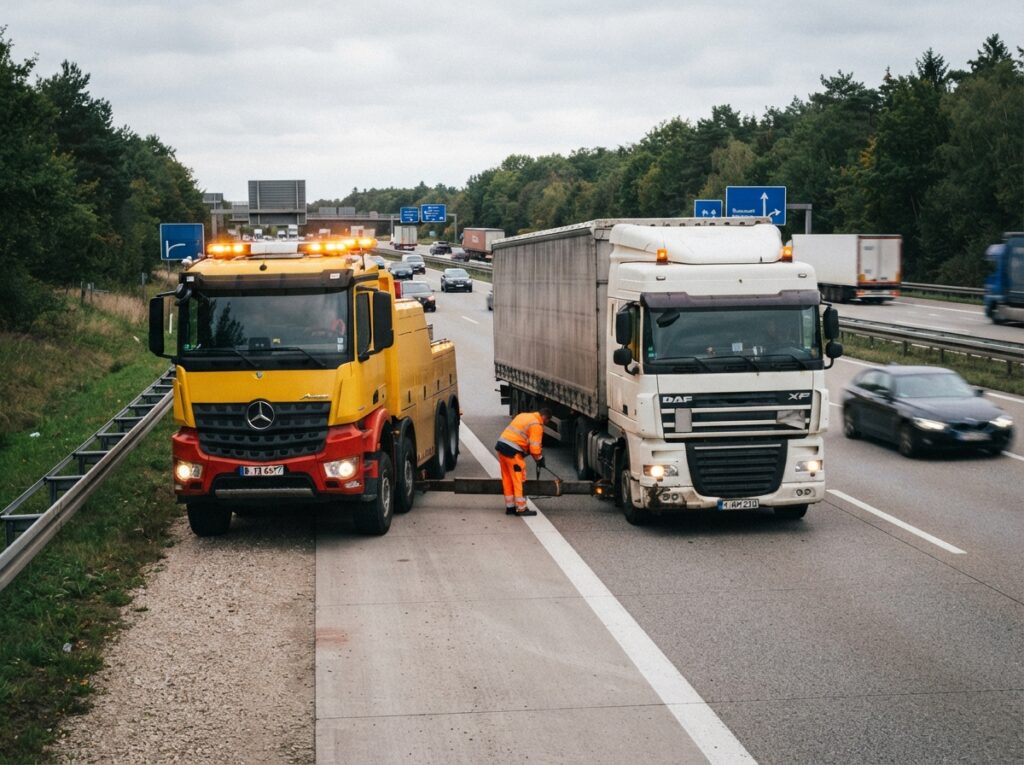
The picture changes when both tires of a dual wheel setup are damaged, when the rim is bent, or when no spare of the required size is available, which happens with less common dimensions on specialized vehicles. In that case LKWHelp24 arranges recovery through a truck towing service, with full details on pricing and process available on the dedicated page about truck towing costs. The choice between on site repair and towing is always made by the technician on the scene after visual inspection, never by the driver over the phone, because the real extent of damage often only becomes clear underneath the vehicle.
What an Emergency Wheel Change on a Truck Actually Involves
A professional emergency wheel change looks very different from what a driver alone can manage with roadside tools. First the technician adds extra safety measures around the vehicle, often reflective cones that are far more visible than a single triangle. Then a hydraulic jack or mobile lifting equipment rated for the weight of a loaded semi comes into play, something a passenger car jack simply cannot handle.
Once the axle is lifted, wheel nuts are loosened with a torque wrench and later tightened back to the exact specified torque. This is not a minor detail, it is a safety matter: nuts tightened too loosely can work free within a few kilometers, nuts tightened too hard can damage the threads. A detailed walkthrough of the full process for an emergency wheel change on a truck is available on the site.
Finally the technician checks air pressure across the entire affected axle, not just the replaced wheel, since a single tire failure often traces back to an overloaded axle or a low baseline pressure across the pair. Anyone wanting to dig deeper into correct pressure levels can find further reading on truck tire pressure.
What an Emergency Tire Service Costs
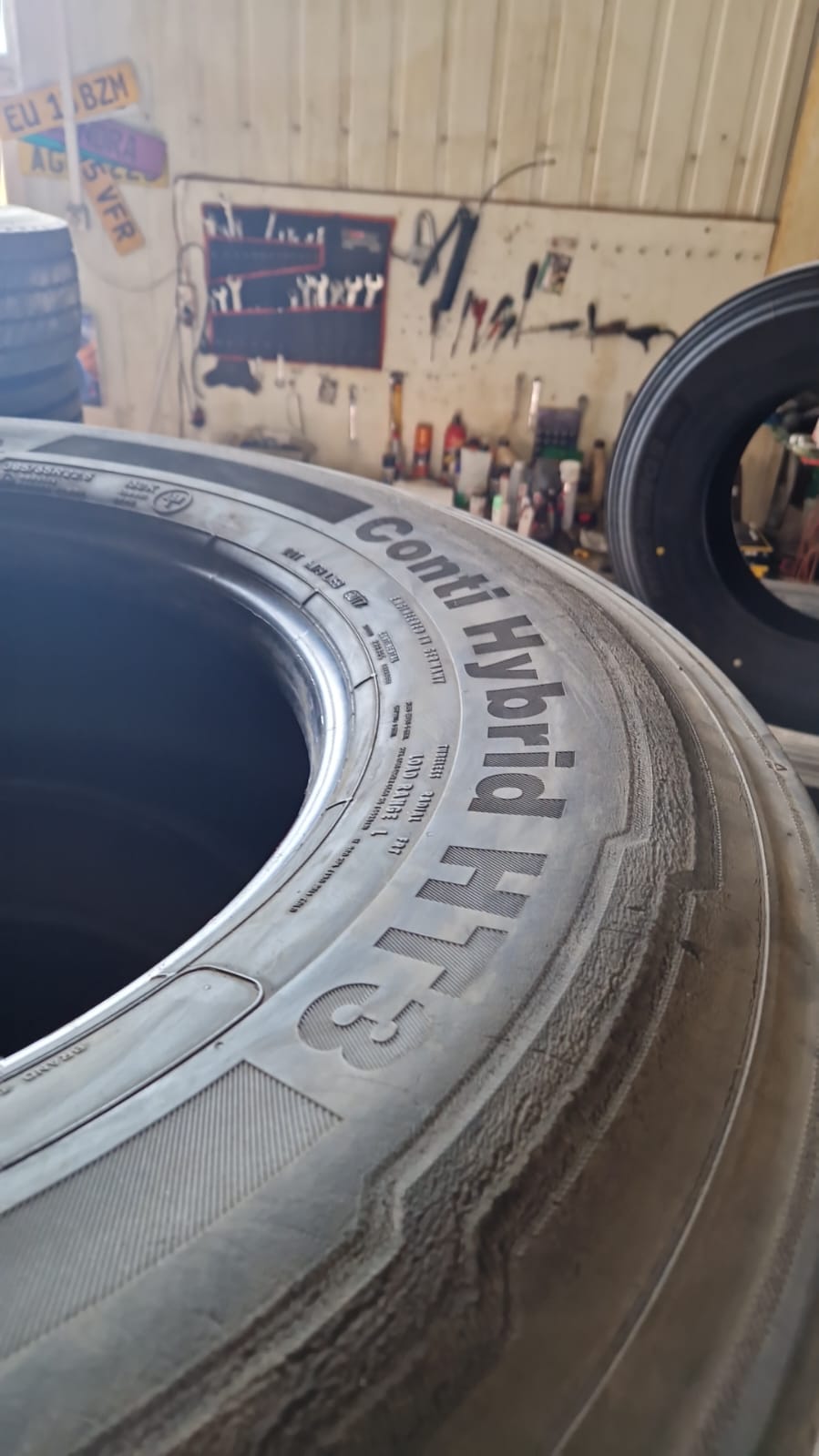
Costs for a mobile tire callout depend on the type of damage, the location, and the time of day. LKWHelp24 works with transparent flat rates so a driver or dispatcher on the phone can get a solid figure immediately instead of being surprised after the job. A standard callout with a wheel change runs at a flat 429 euros, while more extensive jobs, for example with additional material or more complex wheel access, run at 549 euros. These flat rates cover travel, on site labor, and the base service, while the tire material itself is billed separately depending on size and availability.
Worth factoring in: a tire failure left untreated on the hard shoulder usually ends up costing more than the callout itself, since a blocked truck on the motorway can trigger fines, downtime, and in the worst case damage to the cargo. Fleets that want to compare on site repair against towing in detail can find figures on the truck towing cost page.
Legal Basics: Tread Depth and Tire Requirements
Requirements for commercial vehicle tires in Germany sit in the Road Traffic Licensing Regulation, the StVZO. Under paragraph 36, tires on vehicles above 3.5 tonnes gross weight must have a minimum tread depth of 1 millimeter, though in practice manufacturers and inspection bodies recommend replacement much earlier, usually around 2 to 3 millimeters remaining, to avoid aquaplaning and sudden pressure loss. The full legal text can be checked directly at gesetze-im-internet.de on the StVZO.
On top of that, the EU regulation on tire pressure monitoring systems, known as TPMS, sets out when continuous pressure monitoring is required, something now standard on most modern tractor units. Details sit in EU Regulation 2014/19 on tire pressure systems. A system that flags a slow leak before an outright blowout often buys a driver precious minutes to find a safe stopping point in a controlled way rather than being caught completely off guard.
It is also worth looking at general breakdown guidance from the ADAC, which, while mostly aimed at passenger cars, still applies the same underlying safety principles that matter for truck drivers, available in the ADAC traffic section.
A Real Callout: Motorway, Night, 30 Tonnes of Chilled Cargo
A haulage company from the Rhineland reached out to LKWHelp24 via WhatsApp around two in the morning. Their driver had a blowout on the drive axle on a quiet stretch of motorway outside a major city, carrying chilled goods with a fixed morning delivery slot. The driver had done everything right: a controlled roll out to the next emergency bay, hazard lights on, vest already on, triangle placed at a safe distance.
Sharing the location via WhatsApp let the technician plan the route directly, arriving in just under 40 minutes, within the usual 30 to 60 minute window. Inspection revealed a classic blowout with no rim damage, so an on site wheel change was enough. After around 50 minutes of work, including checking air pressure and torque on all nuts, the driver was back on the road and completed the delivery with only a minor delay. The cold chain held because the total stop stayed under ninety minutes.
This case shows why the combination of correct driver behavior in the first minutes and a specialized tire service with the right stock on hand is the difference between a small delay and a missed delivery window.
Finding Help Nearby vs. Calling a Dedicated Emergency Line
Some drivers instinctively search for the nearest breakdown service the moment a tire fails, hoping proximity alone guarantees a fast response. That approach has real limits on a motorway at night, since a nearby generic garage rarely carries commercial tire stock or the right lifting gear. A broader look at how to search for and evaluate a tire breakdown service nearby explains why proximity matters less than specialization once the vehicle is above 7.5 tonnes.
The Difference Between Steer Axle, Drive Axle, and Trailer
Not every tire failure affects handling the same way, and that difference also affects how urgent the situation really is. A blowout on the steer axle changes handling immediately and noticeably, since there is no dual wheel setup acting as a buffer there. The truck pulls hard to one side, and control over the lane becomes significantly harder in the first seconds. That is exactly why extra caution matters when rolling out after a steer axle failure, using small, gentle corrections rather than a fast counter steer.
On the drive axle, the dual wheel setup means a single blown tire can be compensated for temporarily, since the second tire in the pair briefly carries the extra load. That buys the driver more time to stop in a controlled way, but it also means the remaining tire can overheat from the sudden extra load if the truck keeps driving too long. Damage on a trailer or semi trailer is usually the least critical for the tractor’s steering, but should still be dealt with quickly, since a damaged trailer tire can wreck the rim and brake lines over a longer distance.
A Cab Checklist Worth Keeping
A well equipped truck reduces the risk of being caught unprepared in a real emergency. The basics include a working high visibility vest within reach of the driver’s seat, a warning triangle with intact reflectors, a flashlight with a charged battery for callouts in the dark, and a current photo or note with the vehicle’s tire size. That last detail speeds things up considerably, since the technician can plan the correct spare or material before even arriving, instead of figuring it out on site.
Just as useful is a saved contact number for the emergency tire service, so a driver is not searching a browser while traffic rushes past the cab. Having LKWHelp24 saved in the phone means sharing a location and a photo of the damage takes seconds, which speeds up the assessment considerably.
Season and Weather as a Risk Factor
Tire failures cluster noticeably around certain weather conditions. In midsummer, long motorway stretches push tire operating temperature up sharply, especially if pressure was already too low before setting off. Low pressure increases flex inside the tire, which in turn drives up heat buildup and raises the risk of a sudden blowout considerably. In winter, the combination of cold, wet roads, and road salt makes rubber more brittle and speeds up tread aging, which becomes a real problem on older tires.
In rain, stopping distance grows sharply once remaining tread sits near the bottom of the legal minimum set out in paragraph 36 of the StVZO. A driver who checks tread depth regularly, rather than waiting until the legal minimum is nearly reached, cuts the risk of a tire failure on wet roads considerably.
Working With Dispatchers and Haulage Companies
For haulage companies running larger fleets, a standing arrangement with a specialized emergency tire service beats searching for a suitable provider from scratch every time damage occurs. LKWHelp24 regularly works with dispatchers who register vehicle data, common routes, and preferred contact channels in advance, so that in an actual emergency only the location and the type of damage need to be sent. That saves valuable minutes, especially when the driver is already stressed and under time pressure.
Billing is also straightforward for fleet customers, since the flat rates of 429 and 549 euros give a reliable basis for planning without negotiating price after every single callout. That gives both dispatchers and accounting departments a predictable budget line.
Why Specialized Help Gets You Back on the Road Faster
A general breakdown service can help quickly with a passenger car, but often runs into technical and legal limits with a loaded semi. Lifting equipment needs to handle multiple tonnes of axle load, tools need to match larger wheel nuts and higher torque specs, and the technician needs to understand how a dual wheel failure differs from a simple passenger car flat. That is exactly why LKWHelp24 specializes exclusively in commercial vehicles above 7.5 tonnes rather than offering a broad service for every vehicle type.
That specialization shows in communication too. A message on WhatsApp usually gets a reply within minutes with a realistic estimate of arrival time, not after sitting on hold for several minutes on the phone. For a driver standing alone at the roadside, that difference makes up a meaningful share of the total wait.
Which Vehicles This Service Covers
LKWHelp24 covers commercial vehicles from 7.5 tonnes gross weight upward, from a standard tractor unit to tippers, refrigerated trucks, and specialized transporters. Coaches and construction machinery with comparable tires also fall within scope. Anyone unsure whether their vehicle fits should simply mention the vehicle type and tire size, if known, in the first WhatsApp message.
Prevention Beats Reacting
Many tire failures on the motorway are not pure chance but the result of slow pressure loss, overloading, or aging tires that have run near the limit for too long. A regular visual check before setting off, especially after long standstills or sharp temperature swings, cuts the risk of a blowout considerably. Anyone wanting an overview of suitable tire types and supply sources for commercial vehicles can find information at LKWHelp24’s page on the truck tire wholesaler and mobile tire service.
Choosing the right vehicle also plays a role, since different models and drivetrains place different demands on tires. An overview of common truck models and their characteristics regarding breakdown assistance from 7.5 tonnes is available in the article on trucks in Germany: models, drivetrains, and breakdown assistance.
Frequently Asked Questions
What should I do if a truck tire blows out on the motorway?
Let the truck roll out calmly, avoid a hard brake, steer in a controlled way toward the shoulder or the next emergency bay, switch on the hazard lights immediately, put the vest on while still in the cab, and only step out on the side away from traffic.
How far back should the warning triangle go for a truck?
Generally between 150 and 400 meters behind the vehicle, depending on visibility and the speed limit on that stretch. On a motorway, the larger distance is the safer choice.
How fast can LKWHelp24 get to me?
Realistically between 30 and 60 minutes, depending on location, time of day, and traffic. Sharing an exact location is fastest through WhatsApp with a location pin.
What does an emergency tire change cost?
Flat rates run at 429 euros for a standard callout and 549 euros for more extensive jobs, plus the tire material required.
Is every tire failure fixed on site, or does it always require towing?
The technician decides after a visual inspection on site. A simple blowout is usually changed directly, while rim damage, a double failure on a dual wheel setup, or no spare in the right size means arranging recovery through a towing service.
What languages does the service work in?
Contact runs in German, English, Polish, and Russian, by phone and WhatsApp, around the clock, every day of the week.
Contact in an Emergency
For a tire failure on a vehicle above 7.5 tonnes, reach LKWHelp24 around the clock via WhatsApp at +49 160 5753826 or through the website at lkwhelp24.com. A technician with the right stock for commercial vehicle tires is on the way within 30 to 60 minutes, in German, English, Polish, and Russian.