Skip to content
A truck rarely breaks down at a convenient time. Workshop and roadside assistance records show the same pattern year after year: a disproportionate share of breakdowns happens between 10 p.m. and 5 a.m., exactly when the drive has lasted longest, attention is lowest, and the road looks darkest. Anyone stuck on a German motorway at night quickly learns that towing at midnight is a different business than towing at noon. At LKWHelp24 (https://lkwhelp24.com/) we run these calls every night, so we know what actually matters and where the line sits between a real 24/7 service and a nice slogan on a homepage.
Why a night call is different from a day call
During the day, a broken-down truck has several advantages that only become obvious once they disappear. It is light, other drivers spot the warning triangle and hazard lights from a distance, the Autobahnmeisterei (motorway maintenance authority) is fully staffed, workshops are open, and the driver himself is usually rested because he has only been on the road a few hours.
At night nearly all of that flips. Visibility on the motorway shrinks to the reach of headlights, and a stranded truck on the hard shoulder is often noticed only 150 to 200 meters before the danger zone, instead of the 500 meters possible in daylight. According to Germany's Federal Statistical Office, a disproportionately high share of severe motorway accidents happens during dark hours, even though traffic volume is much lower than during the day. Less traffic but more severe crashes: that is the blunt arithmetic of night driving.
Then there is fatigue. A driver who has been behind the wheel for nine or ten hours reacts more slowly, decides less confidently, and misjudges distances more easily. That is exactly the state he is in when he has to step out onto the shoulder, put on a hi-vis vest, and set up a warning triangle while other trucks pass at 90 km/h. Driving and rest time regulations, now overseen by Germany’s federal logistics and mobility authority, exist precisely for this reason: exhaustion on the road is not an abstract risk, it is a measurable factor in crash statistics.
Infrastructure partly sleeps too. The Autobahnmeisterei runs with fewer staff at night, police have to set priorities, and a simple breakdown without injuries is often handled later than during the day. Workshops are closed, spare parts sit behind locked shutters, and the dispatcher at the driver’s own company is frequently unreachable at 3 a.m. Anyone who needs a towing service in this situation quickly learns that what matters at night is not the homepage banner promising “24/7,” but who actually answers the phone or WhatsApp.
Is “24/7” real or just marketing
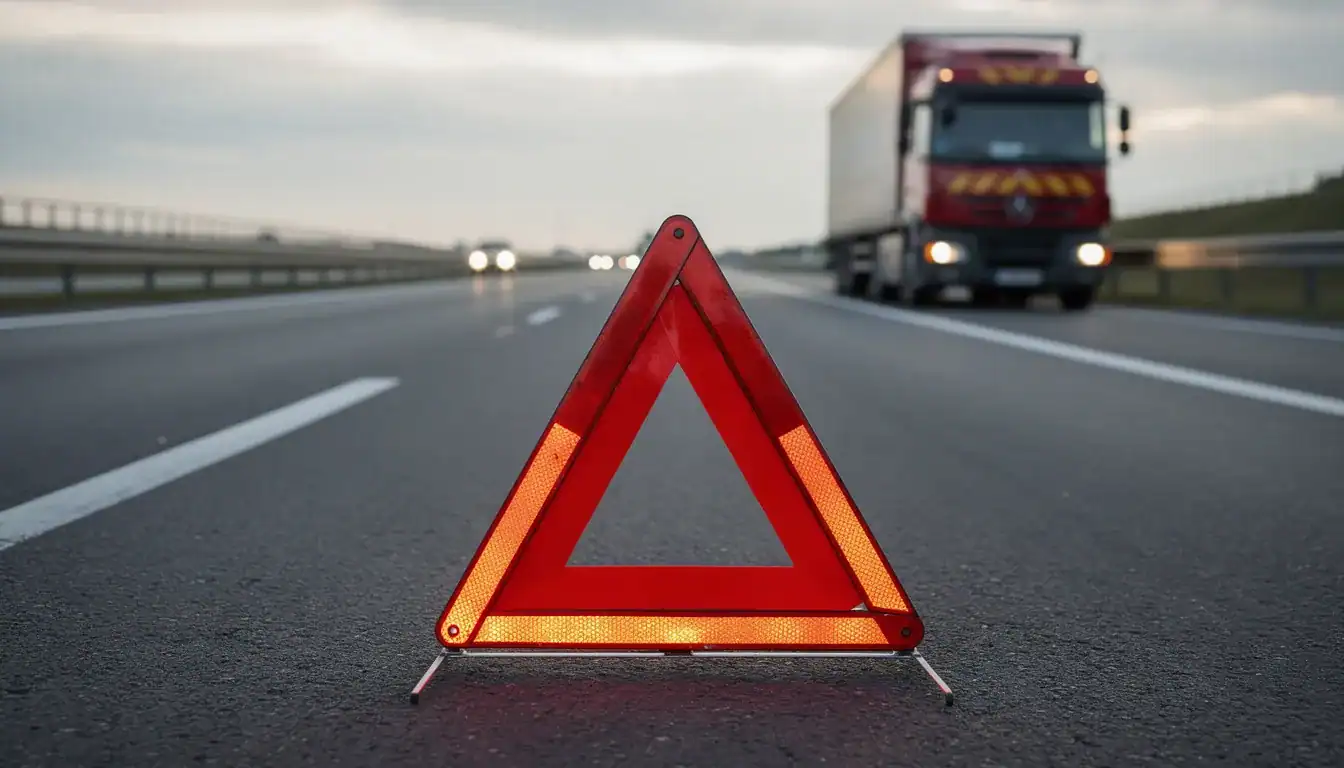
Almost every roadside assistance company in Germany writes “available around the clock” on its homepage. The reality at many small operators looks different: an answering machine runs overnight, a message gets picked up at 7 a.m., and a driver who broke down at 2 a.m. only gets a reply once the sun is up. For a car driver that is annoying. For a truck carrying 40 tons of cargo and blocking part of a motorway shoulder, it is both a safety problem and a financial one, because every hour of standing time costs money, and a stranded truck at night is an extra collision risk for everyone driving past.
A company that genuinely works around the clock needs several things at once: a dispatcher who is actually awake at night, not just a call forwarded to voicemail, drivers and vehicles ready to roll in shifts, and a response time that does not double or triple simply because it is dark outside. At LKWHelp24, our truck breakdown assistance in Germany runs on a 30 to 60 minute response window, whether the request comes in at 2 p.m. or 3 a.m. That is not marketing copy, it is the basis on which we plan crew shifts and vehicle positioning.
How to tell if a night service actually works
There are a few simple checks any driver or dispatcher can run before the night ever becomes a problem. The most useful one: send a WhatsApp message at an odd hour, say 1 a.m., and see whether a real, specific reply comes back within a few minutes, not a canned auto-response but something that addresses the actual question. If the answer only shows up the next morning, that already answers the question of whether the service is genuinely 24/7.
The second check is about language. A large share of truck traffic in Germany is driven by drivers from Poland, Romania, Ukraine, and other countries. At night, under stress, and often with limited German, it matters a great deal whether the dispatcher on the other end speaks English, Polish, or Russian, or whether communication simply breaks down. At LKWHelp24 we handle requests in German, English, Polish, and Russian, because these four languages cover most of the drivers on German motorways.
The third check is location and a realistic arrival estimate. A serious operator gives an honest time window, usually 30 to 60 minutes depending on location, instead of vague phrases like “as soon as possible.” An operator who dodges the question, or gives no time at all, probably has no vehicle nearby that is actually ready to move at night.
Anyone who wants extra reassurance can read up on truck towing costs beforehand and compare that with what gets quoted on the phone. Serious operators state their pricing structure openly, including night and weekend surcharges, instead of springing a surprise number once the crew is already on site.
Night and weekend surcharges: why they are justified
A daytime rate starting at 290 euros and a night, evening, or weekend rate starting at 429 euros can look like a big gap at first glance. The difference has a concrete cause that has nothing to do with arbitrary pricing. Night work means higher staffing costs for the towing company, because drivers on night shifts have to be paid differently than day-shift crews. It also means a vehicle and crew have to stay on standby continuously, including nights when no call comes in, since the alternative would be offering no service at night at all.
Then there is the higher risk of the work itself. A recovery driver who has to secure and load a vehicle on the shoulder of a motorway at night operates in a zone where rear-end collision risk is measurably higher than during the day, even with full lighting and safety measures in place. Road safety authorities repeatedly point out how exposed people are who have to stand on the hard shoulder or right next to live traffic at night. Paying this surcharge is not paying for “the dark hour” itself, it is paying for the real increase in effort and risk that hour brings with it.
From a fleet’s perspective, it still pays to compare the night surcharge with the alternative. Waiting until morning means paying standing time, risking a penalty clause with the consignee, and in the worst case blocking a lane for hours, which raises the accident risk for everyone else on the road. In most cases, an immediate night recovery ends up cheaper than waiting, even though the hourly rate looks higher at first.
Safety technique for night recoveries on the Autobahn
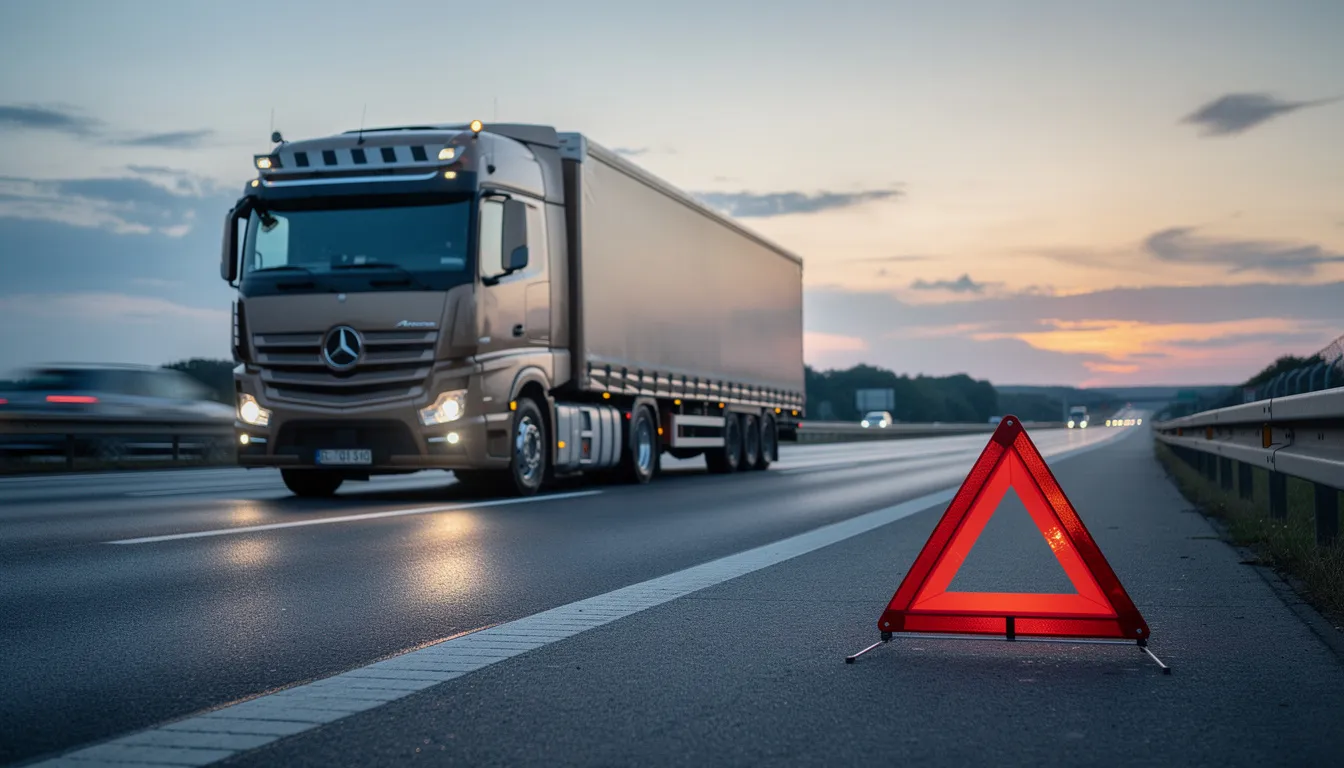
Anyone working on the hard shoulder at night, or on the narrow verge of a two-lane federal road, needs more than a warning triangle. The German road traffic regulations require a warning triangle and a hi-vis vest for a stranded vehicle, and these minimum requirements are not a formality in the dark, they are literally life-saving. A driver standing next to his truck at night without a hi-vis vest is practically invisible to oncoming traffic at the worst possible moment.
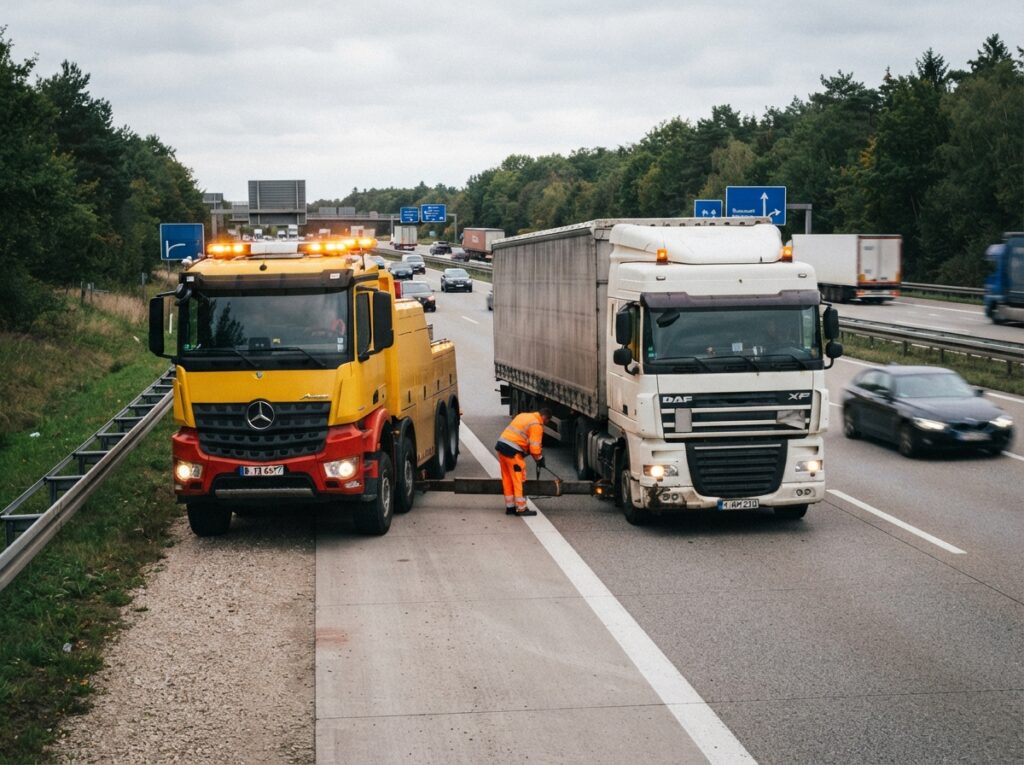
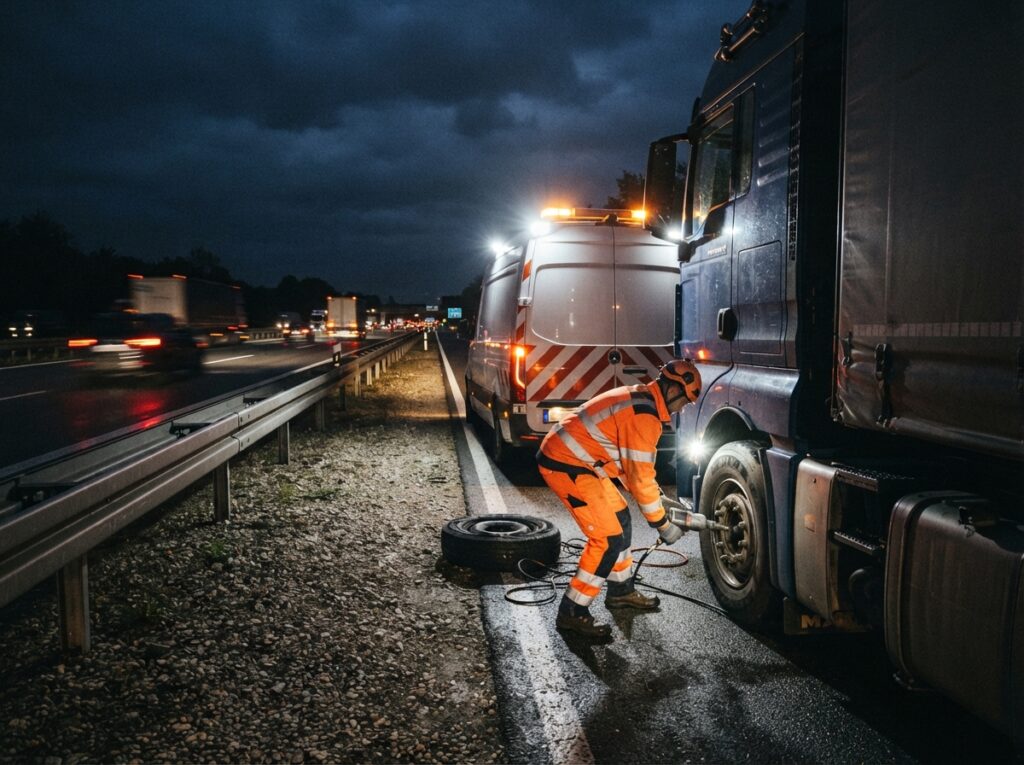
For a professional towing operation, the legal minimum is not enough on its own. On night calls we use extra warning cones, portable flashing lights, and, when traffic conditions require it, a second vehicle positioned ahead to make the recovery site visible to approaching traffic well in advance. Additional work lights on the recovery vehicle are mandatory, because without enough light neither the damage assessment nor the loading process can be done safely. Germany's Federal Highway Research Institute regularly publishes data on crash severity in the dark, and those figures confirm that rear-end collisions with vehicles parked at the roadside are disproportionately severe at night.
The order of work also changes at night. During the day a crew can first assess the damage and then calmly decide on the best recovery method. At night, securing the site always comes first, before any technical work begins, even if that means the recovery takes a few minutes longer. Reversing that order to finish faster raises the risk for the crew and for everyone driving past.
Anyone interested in the full procedure can read our overview of what to keep in mind when towing a truck, including the differences between a straightforward recovery and a more complex winter recovery of an articulated truck, where ice and darkness together create a much higher risk than either factor alone.
Typical night scenarios: a driver from Poland at 3 a.m.
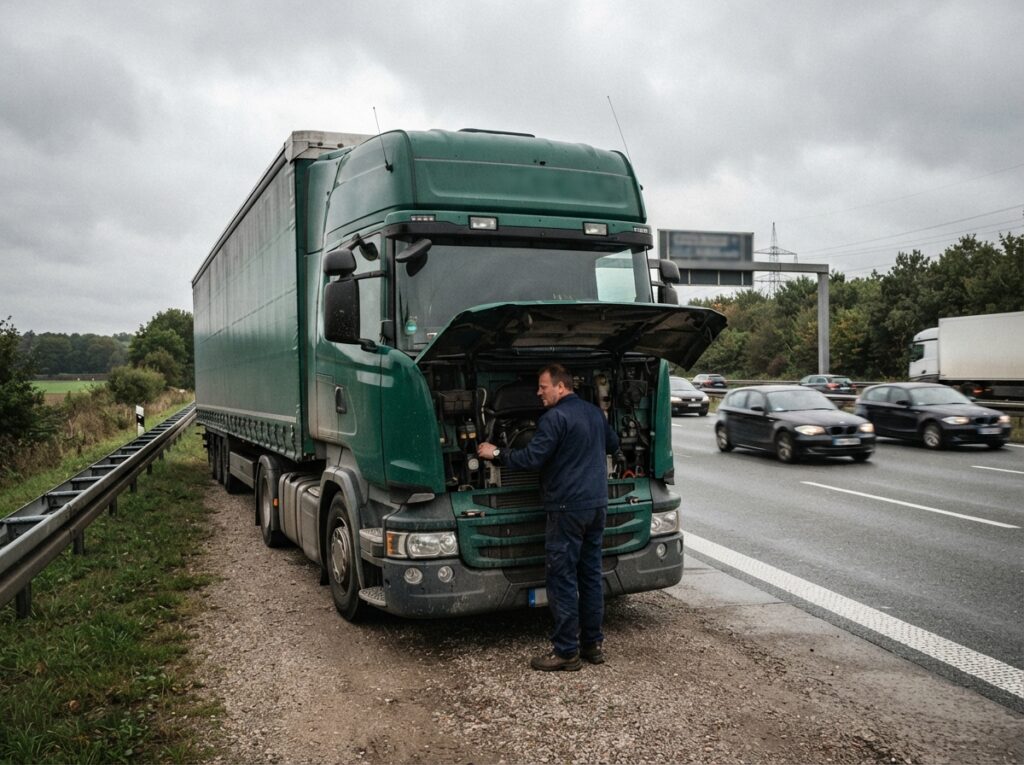
One scenario repeats itself in our work over and over. An articulated truck from Poland or Romania is on its way to a delivery point in southern Germany, the driver wants to make full use of his allowed driving time, and continues in the early morning hours when traffic is thinnest. Around three in the morning a warning light appears on the dashboard, the tractor loses noticeable power soon after, and the driver has to stop on the hard shoulder.
That is where the real problem begins, and it usually has little to do with the mechanical fault itself. The driver tries to reach his own dispatch office, but nobody picks up because the office does not open until eight. The driver himself speaks little or no German, and his English covers simple sentences but not a technical conversation with a German roadside service over the phone. Right in that gap, between a home company that is asleep and a language that does not stretch far enough, the biggest delay appears, not the distance to the breakdown itself.
When a WhatsApp message in Polish or Russian is possible, that delay shrinks dramatically. The driver can share his location, attach a photo of the warning light or the damage, and get a reply with an estimated arrival time within minutes, in his own language. That is why LKWHelp24 built multilingual WhatsApp support in from the start, not as an add-on but as a core part of the service, because a large share of our night calls involve exactly this group of drivers.
A second common scenario involves tire failures at night, often combined with poor lighting at the breakdown site itself. A driver who gets a flat tire on the motorway at night should not attempt to change it himself but call a mobile tire emergency service that arrives with its own lighting and safety setup. Darkness, time pressure, and a tool in hand is exactly the combination behind most tire-related work accidents on the roadside.
A realistic case from practice
A concrete example from our work shows how such a call plays out. An articulated truck with Romanian plates stopped around 1:30 a.m. on the A7 shortly before a motorway junction in northern Bavaria, after a transmission failure that left the vehicle completely immobile. The driver had already tried to reach his colleague at the head office without success, and stood alone with his hazard lights on, on the shoulder, while occasional trucks passed at high speed.
The first WhatsApp message arrived at 1:42 a.m., with a shared location and the simple line “truck broken, need help.” Within four minutes our dispatcher confirmed the job, asked about the exact lane and vehicle type, and sent an estimated arrival time of 45 minutes. The recovery vehicle arrived at 2:31 a.m., with extra warning cones set up before the actual hookup began, because visibility at that spot was reduced by a slight bend in the road.
Loading itself took about 35 minutes, noticeably longer than a comparable daytime job, because every step was carried out under extra lighting and with additional caution. By 3:20 a.m. the truck was on its way to the nearest specialist workshop for that transmission type. The whole process, from the first message to arrival at the workshop, took just under 100 minutes, a span that would likely have been 20 to 30 minutes shorter in daylight, simply because of the extra safety steps darkness forces on the crew.
For the driver, the decisive point was not the exact number of minutes but the fact that somebody answered within four minutes, in a language he understood. That is the difference a real night service makes, compared with a website that promises “24/7” but reaches nobody once the sun goes down.
Cooperation with police and the motorway authority at night
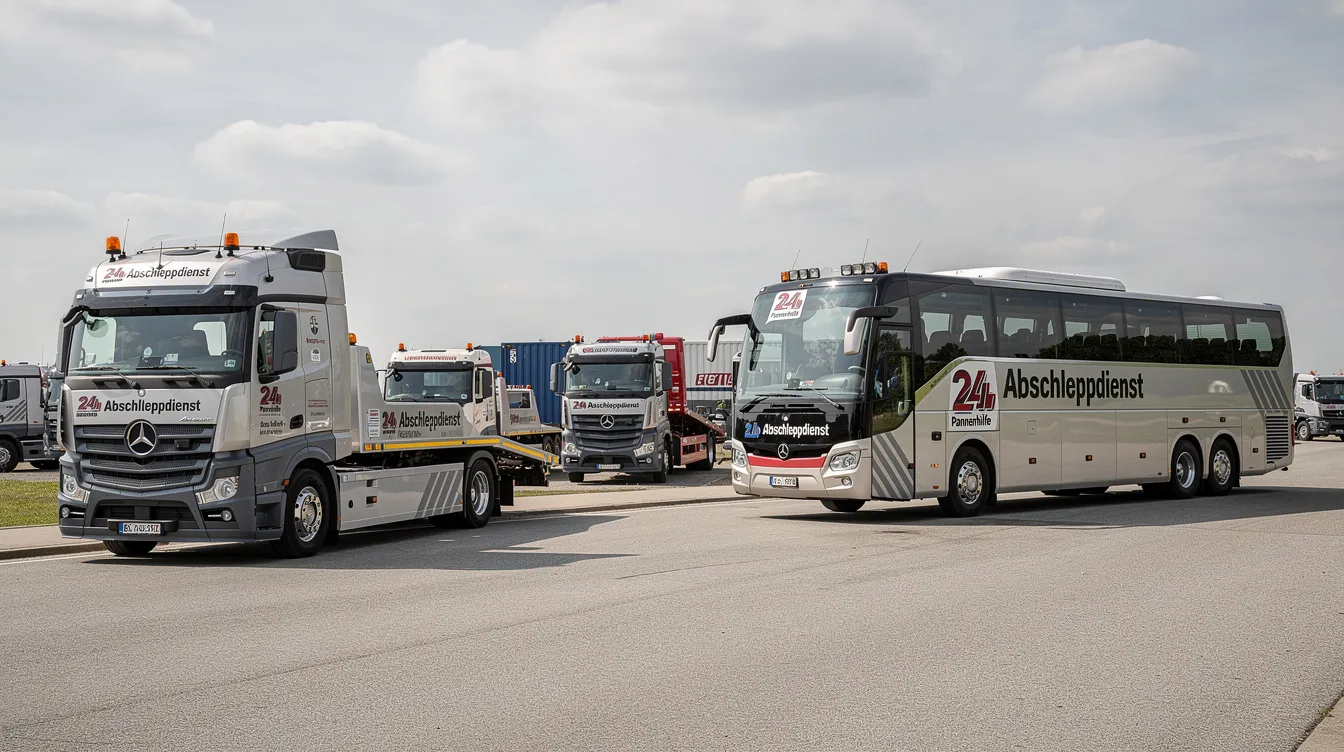
One point often underestimated when planning a night recovery is how cooperation with police and the Autobahnmeisterei changes after dark. During the day the motorway authority is usually fully staffed and can quickly send its own vehicle to add extra protection, for example near a construction zone or on a particularly confusing stretch of road. At night staffing is reduced, and response time can stretch noticeably longer, especially in rural areas where a single patrol car has to cover several districts at once.
Police also set different priorities at night. A stranded truck without injuries is often placed lower in the queue than accidents involving injured people, which means a patrol car sometimes arrives only after 30 or 40 minutes, if it is dispatched at all. For this reason our own crew always takes charge of securing the site first, without waiting for an official vehicle, because every minute without adequate protection raises the risk for the stranded driver and for our own team.
In cases where a whole lane needs to be closed off, for example on a breakdown around a bend with limited visibility, we coordinate directly with the responsible control center so additional warning signs or a temporary speed reduction can be arranged. That coordination works the same way at night as during the day, but it typically takes a bit longer because less staff is available at once. An experienced towing operation builds that time buffer into its planning from the start, instead of using it afterward as an excuse for a delay.
Documentation and insurance for night jobs
A frequently overlooked part of a night recovery is documentation. In daylight, damage to a vehicle or cargo can be captured well with simple photos, which matters later for insurance or for the fleet operator. At night, image quality is noticeably worse even with a good smartphone, which is why our crews carry extra hand lamps used specifically for documentation, not only for the recovery work itself.
For fleets working with foreign drivers, it also helps if the damage report is written in a language everyone involved can actually read, so it can be submitted to the insurer later without translation issues. On request we provide clients with a short written record of the job, including the time of first contact, arrival time on site, and a brief description of the work carried out. On night jobs, where witnesses are rare, clean documentation is often the only proof of when and how fast help actually responded.
What fleets and drivers can prepare in advance
A few simple preparations shorten response time considerably in an emergency. The phone and WhatsApp number of a verified towing service should be saved directly in the driver’s phone, not just written on a note in the glove compartment that is hard to find in the dark anyway. It also helps to have the fleet’s key vehicle data on file in advance, such as axle count, gross weight, and trailer type, so no time is lost describing the vehicle when it matters most.
Fleets that employ many foreign drivers should also make sure their drivers know they are allowed to contact a multilingual roadside service directly in an emergency, without waiting hours for a reply from their home office first. This small organizational clarification often saves more time in a real emergency than any technical measure on the vehicle itself.
Reading up on the basics of truck models and drivetrains in Germany also helps explain why certain faults show up more often at night on certain vehicle types, such as transmission problems on older tractor units after long night runs at full load. A quick look at the basics of correct tire pressure for trucks helps prevent many night-time tire failures in the first place, since an underinflated tire heats up much faster on a long night stretch than a properly filled one.
For comparison, it is also worth looking at larger, established providers such as ADAC, whose structure shows how a nationwide breakdown network can be organized, even though their focus has traditionally leaned more toward passenger cars than heavy commercial vehicles above 7.5 tons.
Frequently asked questions
Is LKWHelp24 really reachable at 3 a.m.?
Yes. Our dispatch runs in shifts, and WhatsApp messages get a reply from a real dispatcher within a few minutes, even at night, not from an answering machine.
Why does a night recovery cost more than a day recovery?
Because night work involves higher staffing costs, constant standby, and greater safety risk for the crew. Our daytime rate starts at 290 euros, and our night, evening, and weekend rate starts at 429 euros.
How long does help take to arrive at night?
Usually between 30 and 60 minutes, depending on exact location and traffic conditions. That window applies with us regardless of the time of day.
Does the dispatcher speak Polish or Russian?
Yes. We handle requests in German, English, Polish, and Russian, since a large share of drivers on German motorways come from those language regions.
What should a driver do immediately if the truck breaks down at night?
Turn on hazard lights, put on a hi-vis vest, set up the warning triangle at a safe distance, position the vehicle as far right as possible, and contact a verified roadside service by WhatsApp right away instead of trying to fix the fault alone.
Does the service cover all truck types above 7.5 tons?
Yes, our focus is exclusively on heavy commercial vehicles above 7.5 tons, from tractor units to heavy haulage trailers, not passenger cars or vans.
A night recovery on the motorway is not a smaller version of a day job, it is a different job with different risks, different demands on equipment and communication, and different costs that follow directly from those risks. Understanding that before the breakdown happens means not losing time searching for a service that actually picks up.