Skip to content
A loud bang, the truck pulls to the right, the steering wheel shakes hard. A tyre blowout on the motorway. What now? This guide explains step by step how drivers and dispatchers should react correctly to a tyre failure on a heavy goods vehicle – from securing the breakdown scene to a finished emergency wheel change. And when it is safer to call a mobile tyre service instead of doing it yourself.
Key points at a glance
- Lkwhelp24 offers 24/7 breakdown assistance across Germany – exclusively for trucks and commercial vehicles from 7.5 tonnes. No cars, no vans, no motorhomes.
- In case of a tyre blowout: brake in a controlled way, secure the vehicle, contact Lkwhelp24 immediately by phone or WhatsApp with your location.
- Response time is usually 30–60 minutes. Typical arrival time is 30–60 minutes, depending on the distance to the nearest partner.
- Prices start at €290 (daytime), from €429 (evenings, nights, weekends), each net plus the tyre.
- About 90% of tyre problems are fixed directly on site – towing is avoided in most cases.
- This article explains step by step how a professional wheel change works and when drivers should call a mobile tyre service right away instead.

Who is this emergency wheel change guide for?
This guide is aimed at truck drivers, HGV drivers and fleet dispatchers travelling on German motorways with heavy commercial vehicles. It covers vehicles from 7.5 tonnes: tractor units, rigid trucks, semi-trailers, trailers and buses.
A tyre change on a heavy goods vehicle is far more demanding than on a car. The wheels weigh many times more than a car tyre, the wheel bolts are tightened to a high torque, and air suspension plus twin tyres require special tools and experience. If you are unsure or face unfavourable conditions, you should not work at the roadside yourself. In such cases, calling Lkwhelp24 is the safer option.
Lkwhelp24 only serves trucks and commercial vehicles from 7.5 tonnes and offers comprehensive 24/7 truck roadside assistance in Germany for this purpose.
First steps right after a tyre blowout – what to do in the first minutes
Securing the scene is the top priority. Here is the step-by-step sequence immediately after a bang or a sudden loss of air:
How a tyre blowout announces itself:
- A loud bang or hissing sound
- Strong pulling on the steering wheel
- Heavy vibrations in the cab
- Smoke or a smell of burning rubber from the wheel arch
The first steps to take:
- Do not brake abruptly. Reduce speed in a controlled way and keep your lane.
- Switch on the hazard lights immediately to warn other road users.
- Roll onto the hard shoulder, a car park or a service area if at all possible. A tyre blowout requires stopping immediately at a safe spot.
- Apply the parking brake, switch off the engine.
- Put on a hi-vis vest, and only leave the cab on the side away from traffic.
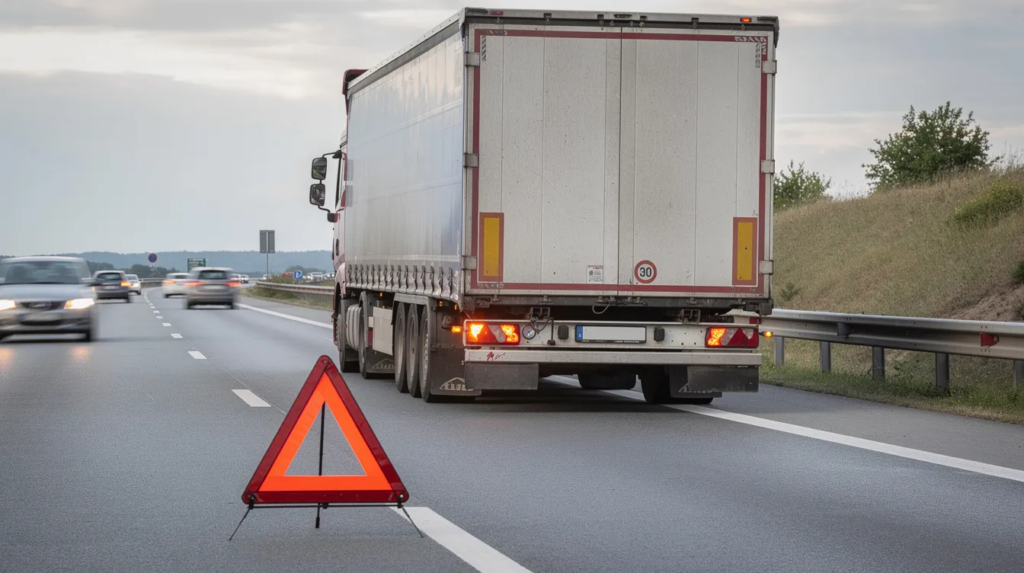
- Set up a warning triangle – on motorways at least 100 metres behind the vehicle, considerably more in fast-moving traffic. A warning triangle should be placed at least 45 metres behind the vehicle; on motorways, § 15 StVO recommends a greater distance.
If the tyre or the rim is badly damaged, you must not continue driving. Driving on a completely flat tyre destroys the rim, brakes and suspension within a few hundred metres.

Where is it actually safe to carry out an emergency wheel change on a truck?
The wheel change should only be carried out once safety is guaranteed. Safety always takes absolute priority over time pressure.
Suitable locations:
- Rest area, truck stop, depot yard
- A wide car park or industrial site
- An emergency bay or breakdown lay-by
Unsuitable locations:
- A narrow hard shoulder in heavy traffic
- Soft ground (verge, grass strip)
- Bends or sections with poor visibility
The vehicle should be parked on level ground where the jack and stands will not sink in. A truck wheel change requires stable ground. Soft verges can cause the jack to sink and the truck to tip uncontrollably.
Switch off the engine, apply the parking brake, and place wheel chocks. If possible, stay behind the crash barrier. Working directly on the hard shoulder of a busy motorway is extremely dangerous. Call a breakdown service if the location is unsafe.
What equipment do you need for a safe emergency wheel change on a truck?
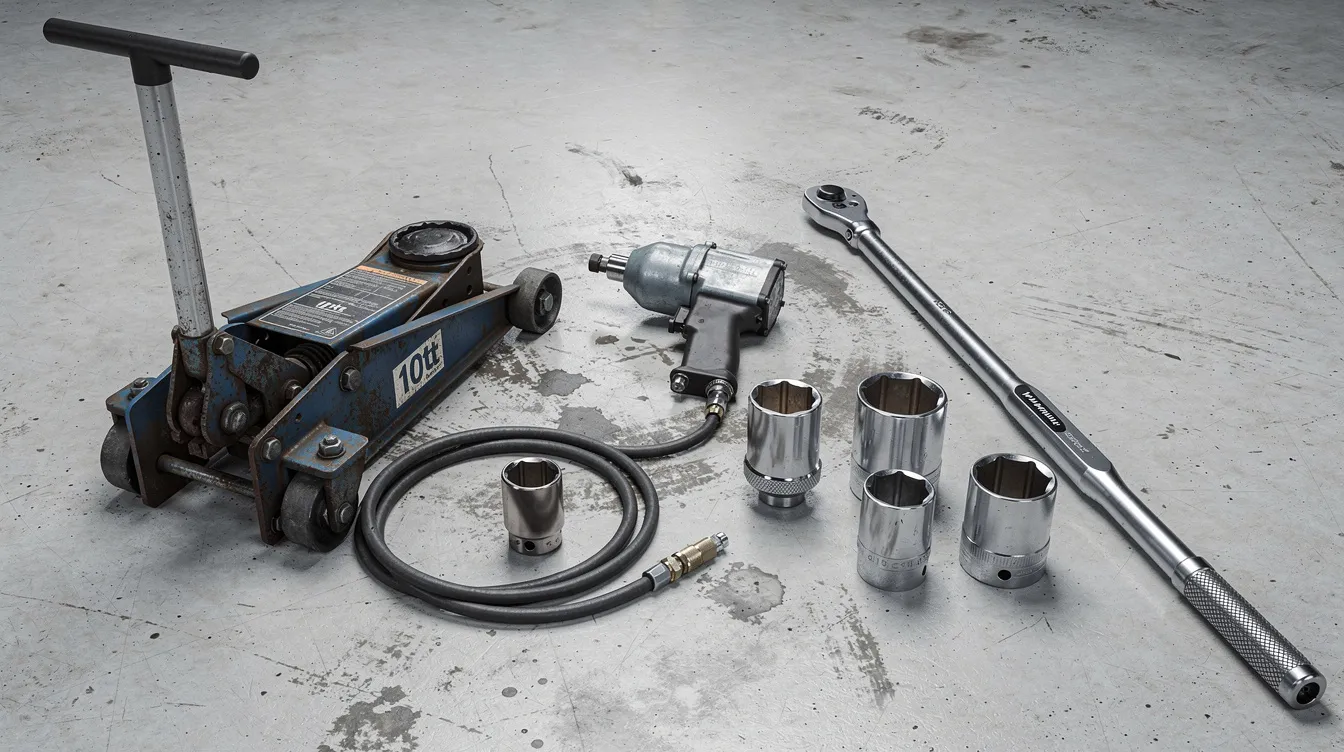
A wheel change on a heavy goods vehicle only works with the right professional tools. Tools such as a jack and wheel nut wrench must be ready before you start.
Necessary equipment:
Tool | Function |
|---|---|
Heavy-duty jack or air-bag jack | Lifting the vehicle with sufficient load capacity |
Impact wrench | Loosening the highly torqued lug nuts |
Matching sockets | For the respective wheel nuts / wheel bolts |
Torque wrench (truck range) | Final tightening to the manufacturer’s value |
Wheel chocks | Securing against rolling away |
Stable jack stands | Extra safety while lifting |
Truck tyre gauge | Checking tyre pressure (much higher than on a car) |
Gloves, safety glasses, work light | Personal protection and visibility at night |
The jack must be positioned at the designated lifting points on the vehicle – incorrect positioning can damage the frame or cause the truck to slip off the jack. |
The reality: most drivers don’t have all of this equipment on board. This is exactly where Lkwhelp24’s mobile tyre service steps in – the technician brings everything you need straight to the scene.
How do you check the damage, wheel position and tyre pressure before the wheel change?
Assess the damage before the wheel change – but without unnecessarily exposing yourself to moving traffic. Only inspect from the side away from traffic.
Visual inspection of the tyre:
- Cracks, burst sidewalls, visible carcass
- Foreign objects such as screws, nails or metal parts
- Signs of smoke or heat
Further checks:
- Check the rim and wheel hub for deformation, dents or scoring
- Nearby components: mudguards, air lines, brake lines, cables
- Determine the exact position of the damaged wheel: front/rear, inner/outer, single wheel or twin tyres, steer axle, drive axle or trailer axle
The tyre pressure of the spare wheel and the neighbouring tyres should be checked with a pressure gauge. After the change, all tyres on the axle should be evenly loaded as far as possible. Check the spare – it must match the vehicle in load capacity and size. Photos of the damage help the dispatcher or Lkwhelp24 decide whether a mobile wheel change is enough or recovery is needed.
Step-by-step guide: how does a professional emergency wheel change on a truck work?
Here is a step-by-step overview of the typical procedure used by professional service technicians. It serves drivers as guidance.
The process in broad steps:
- Secure the vehicle: parking brake, wheel chocks, warning triangle set up behind the vehicle.
- Loosen the wheel nuts: the wheel nuts should be loosened before the truck is lifted – with a tyre blowout it is important to loosen them before lifting so the wheel doesn’t spin freely. Loosen the wheel nuts with an impact wrench or lug wrench.
- Lift the vehicle: position the jack at the correct point and lift the vehicle until the damaged wheel hangs free. The vehicle must be lifted until the damaged wheel is clear of the ground.
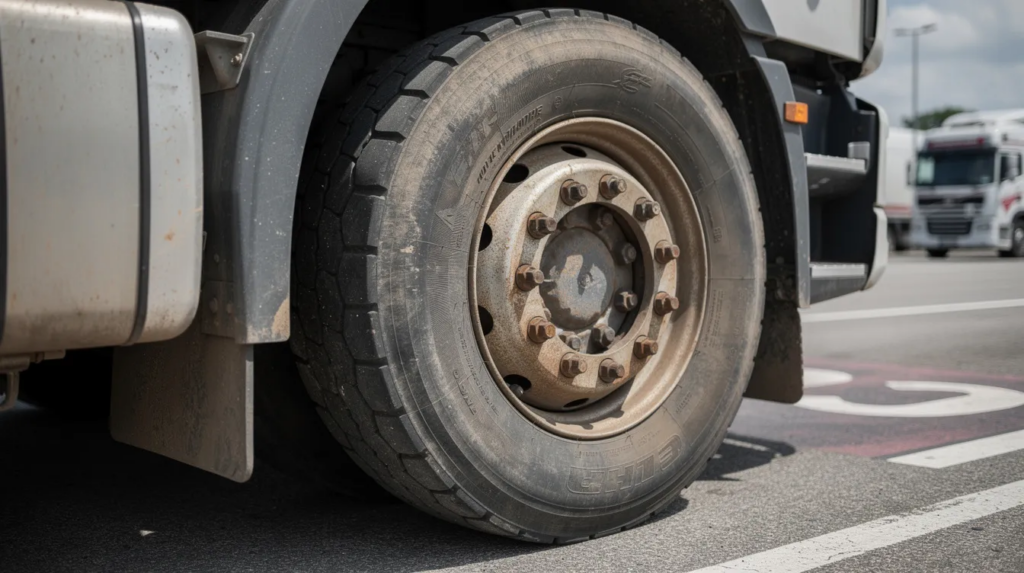
- Remove the wheel: take off the loosened wheel nuts completely and remove the damaged wheel.
- Clean the hub: free the wheel hub and rim contact surface from dirt, rust and debris.
- Fit the new tyre: mount the spare or new tyre and attach the wheel nuts by hand.
- Tighten the wheel nuts: tighten the wheel nuts crosswise – they must be tightened in a star pattern. First pre-tighten to half torque, then finish with a torque wrench to the manufacturer’s specification. The wheel change should always be finished with a torque wrench.
- Lower the vehicle: remove the jack and stands, lower the vehicle in a controlled way. Only lower the truck once all nuts are fully tight.
- Final check: check the new tyre for correct seating, no leaks and the correct air pressure. Tyre pressure must be checked after the wheel change.
At Lkwhelp24, around 90% of tyre problems are fixed directly on site without the vehicle needing to be towed – thanks to a specialised 24/7 truck tyre service in Germany. The wheel change is carried out on site at motorways and service areas – fast and professionally.
How do you correctly loosen and tighten the wheel nuts / wheel bolts on a truck?
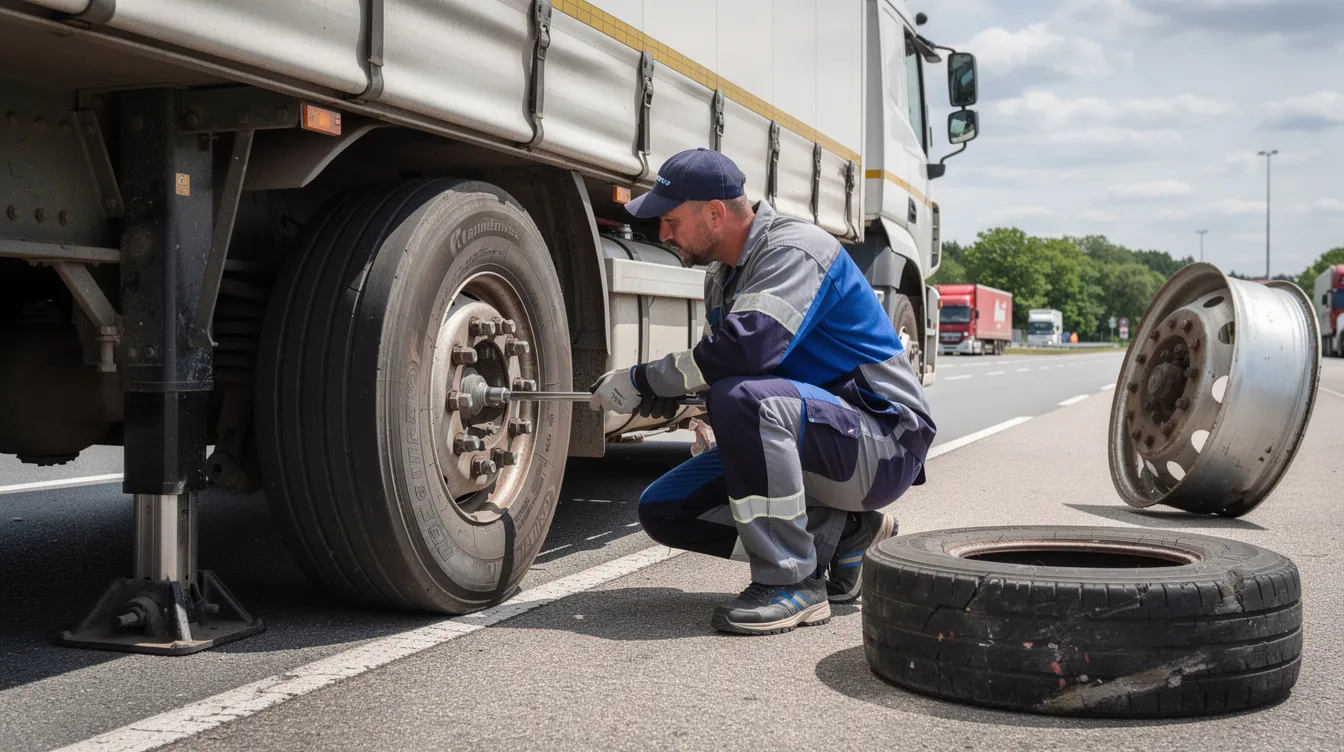
Correctly loosening and tightening the wheel nuts is safety-critical. Mistakes here can lead to a wheel coming loose while driving.
Loosening:
The lug nuts on a truck are tightened to a very high torque. You usually need a powerful impact wrench to loosen them. Loosen the nuts in a sensible order – crosswise – to reduce stress on the wheel rim.
Tightening:
- Attach the nuts by hand first so the thread doesn’t cross-thread.
- Pre-tighten crosswise with a tool – to half torque first.
- Final tightening with a torque wrench to the manufacturer’s specification. Never use an impact wrench for the final tightening – it leads to over-tightening or uneven seating.
After driving on:
The wheel nuts should be re-torqued at a workshop after 50 kilometres of driving. Continental recommends this so-called retorquing as a standard safety measure. Visual wheel nut indicators offer extra control, especially for fleets.
How do you check tyre pressure after an emergency wheel change?
Correct tyre pressure is crucial for driving stability and tyre life after a wheel change. Tyres should be checked regularly for the right pressure – especially after an emergency callout.
How to check pressure correctly:
- Check the tyre pressure of all tyres on the affected axle at the nearest petrol station or workshop if you don’t have your own gauge on board.
- The required pressure values come from the vehicle documents or from the fleet dispatcher. Make sure you don’t use guessed figures.
- Only set tyre pressure precisely when the tyres are cold. Warm tyres show higher readings that don’t match the actual operating pressure.
- Recheck regularly during strong temperature changes (summer/winter, day/night).
Lkwhelp24 service partners set the tyre pressure directly after the change using professional equipment. The driver doesn’t need to make an extra stop at a garage or petrol station in this case.
When should drivers skip a DIY wheel change and call for help directly?
In many situations, attempting to change a tyre yourself is too dangerous or not worthwhile. The wheel change should only be carried out once safety is guaranteed.
Critical situations – call roadside assistance immediately:
- Little room on the hard shoulder, heavy traffic
- Night, rain, snow, fog or a section with poor visibility
- Soft, uneven ground (verge, gravel)
- Missing professional tools: too weak a jack, no impact wrench, no torque wrench
- Visible damage to the rim, axle, wheel hub or brakes
- Bent wheel bolts or lug nuts that won’t loosen
Fleets often have clear instructions to always call professional truck roadside assistance or a mobile truck service in Germany, available 24/7 during a breakdown, to keep the schedule and stay safe. Dispatchers calculate: an hour of trying it yourself on the road often costs more than the professional callout.
Recommendation: in all of these cases, contact Lkwhelp24 directly by phone or WhatsApp with all the necessary information.
What information does the dispatcher or Lkwhelp24 need for the emergency call?
For help to arrive quickly and go straight to the right spot, the dispatcher or Lkwhelp24 needs precise data. This checklist helps speed up the process:
Checklist for the emergency call:
Information | Example |
|---|---|
Exact location | A7, southbound, km 312, rest area XY |
Vehicle type | Tractor unit, rigid truck, semi-trailer |
Number plate | ABC-DE 1234 |
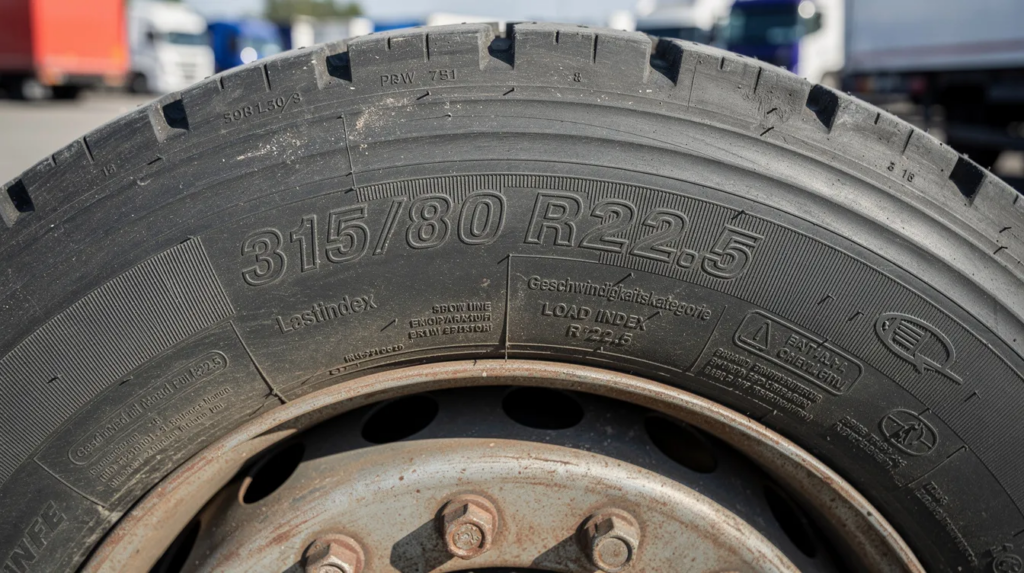
Tyre size | 315/70 R22.5, 385/65 R22.5 |
Position of the damaged wheel | Outer left, drive axle / trailer axle 2 |
Single or twin tyres | Twin, inner |
Type of damage | Blowout, slow pressure loss, sidewall tear |
Photos sent via WhatsApp of the type plate, the tyre and the surroundings help enormously. Lkwhelp24 uses this data to quickly organise the right tyre from the stock of one of around 2,500 partner workshops. To do this, simply share your location via WhatsApp’s location feature and send the photos too. |
How does Lkwhelp24 support a mobile truck wheel change on the road?
Lkwhelp24 offers a fully mobile truck tyre service across Germany. This truck tyre service in Germany is available around the clock – 365 days a year.
The key facts:
- Typical arrival time: 30–60 minutes
- A network of around 2,500 service partners across the whole country
- The service is available for trucks from 7.5 tonnes
- The technician comes with a tyre-fitting machine, compressor and matching tyre straight to the truck – whether on a motorway, a main road, a rest area or an industrial site
This often avoids towing. Around 90% of tyre blowouts are resolved directly on site. Prices start at €290 for tyre service during the day, from €429 in the evening, at night and on weekends – each net, plus the tyre. The exact cost is explained transparently on site or over the phone.
Whether you’re stuck in Berlin, Zwickau or Osnabrück – Lkwhelp24 coordinates the callout nationwide.
Which tyres are available in an emergency, and can I choose the brand and tread?
In a breakdown, getting back on the road quickly is the priority, not your preferred brand. The tyre comes from the nearest service partner’s stock. Brand and tread can therefore vary.
What the driver or dispatcher should provide:
- Tyre type: steer axle, drive axle or trailer
- Size: e.g. 295/80 R22.5, 315/70 R22.5 or 385/65 R22.5
- Single or twin tyres
Specific brand requests are generally possible but cause delivery time and extra cost. In a genuine roadside emergency, that’s rarely worthwhile. If you have a particular brand preference, mention it when you make contact – the dispatcher will check availability.
All tyres fitted meet the safety and quality requirements in force in Germany. Using a tyre repair kit only makes sense for minor damage – with a genuine blowout, only a full wheel change will help.
How do you pay for the emergency wheel change, and what receipts do you get?
Payment on the road is straightforward. Drivers usually pay directly on site – cash or card. No hidden costs.
Payment options:
- Cash or card payment directly with the service technician
- For hauliers and fleets: an invoice with full documentation on request
- A clear breakdown of callout, labour, materials and surcharges
Lkwhelp24 communicates transparent prices. The exact cost is always agreed by phone or WhatsApp before work begins. If you have a question about billing, clarify it beforehand – so there are no surprises.
Prices start at €290 for roadside assistance (daytime, net). At night and on weekends, from €429. Tyres are charged separately.
How can international drivers (PL, RU, EN) request an emergency wheel change?
Many drivers on German motorways don’t speak German. That’s not an obstacle. With its multilingual 24/7 truck roadside assistance service for Germany, Lkwhelp24 communicates in German, English, Polish and Russian – by phone and via WhatsApp.
Recommendation for non-German-speaking drivers:
- Open WhatsApp, send your location (via the location feature or a photo of the km sign).
- Briefly describe the problem in your own language: “flat tyre, trailer, right side.”
- Send photos of the damaged tyre and the type plate.
Dispatchers abroad can get in touch on the driver’s behalf and pass on all the breakdown details together. For more extensive damage, a Polish-speaking HOLOWANIE truck towing service is also available. All you need is the location, vehicle type, tyre size and a description of the damage.
Contact details:
- Phone: +49 160 5753826
- WhatsApp: https://wa.me/491605753826
- Email: info@lkwhelp24.com
Prevention: how can you avoid tyre blowouts and emergency wheel changes?
Good maintenance prevents many emergencies on the road. You’ll find current tips from real cases and safety news from Lkwhelp24 regularly in the news section for truck breakdown assistance. A tyre blowout with follow-on damage and downtime is always more expensive than timely prevention.
Preventive measures:
- Regular visual checks: inspect the tread and sidewalls for cuts, bulges and embedded objects – especially after roadworks or gravel sections.
- Check tyre pressure on a schedule: before long trips and with heavy loads, check your tyres are at the correct pressure. Tyres should be checked for pressure regularly.
- Keep an eye on the wheel nuts: check visually for looseness or rust marks. Wheel nut indicators (loose-nut markers) offer a quick visual check if you have them fitted.
- Replace tyres in good time: replace tyres showing visible wear before they blow out. A planned change at a truck workshop is cheaper than an emergency callout on the motorway.
Common mistakes when changing a wheel on the road – and how to avoid them
Mistakes during a wheel change put safety and equipment at risk. Here are the most common problems and how to prevent them:
Mistake | Countermeasure |
|---|---|
Working without securing the scene | Warning triangle, hazard lights, hi-vis vest – always first |
Truck not secured against rolling away | Parking brake, wheel chocks, gear engaged |
Jack placed on soft ground | Only lift on firm, level ground |
Wrong lifting point on the frame | Only place the jack at the designated lifting points |
Wheel nuts not tightened crosswise | Always follow a star pattern, otherwise stress and a loose wheel |
Final tightening with an impact wrench | Only tighten the nuts with a torque wrench to the manufacturer’s value |
Spare tyre air pressure too low | Check pressure before fitting, or at the latest at the next petrol station |
Wrong tyre fitted | Check the load and speed rating |
If in doubt: skip the DIY attempt and call Lkwhelp24. That avoids these mistakes and ultimately saves time and money. |
When is recovery or towing needed instead of a wheel change?
Not every tyre blowout can be solved with a new tyre. With serious damage to the rim, axle mounting, brakes or frame, a flat tyre can be the lesser problem – in that case, a recovery or a specialised 24/7 truck towing service in Germany is needed.
Lkwhelp24 offers round-the-clock truck towing services for commercial vehicles from 7.5 tonnes. This specialised 24/7 truck towing and emergency service in Germany comes into play especially when a safe wheel change on site is no longer possible. The decision between an on-site wheel change and towing is made after an initial visual check and photos of the damage. You’ll find information on truck towing costs in our separate guide.
The goal is always to choose the most economical and safest solution for the driver and the fleet. In many cases a mobile wheel change is enough – but if not, Lkwhelp24 also arranges the recovery.
Conclusion & immediate help: how to reach Lkwhelp24 for an emergency wheel change
Summary: secure the breakdown scene, document the damage, avoid risky DIY attempts, gather all the information – and call the professionals. How do you change a truck tyre safely and quickly? In most cases: not by yourself at all, but with Lkwhelp24.
In case of a tyre blowout on a truck or trailer from 7.5 tonnes in Germany – contact Lkwhelp24 immediately:
- Emergency phone: +49 160 5753826
- WhatsApp: https://wa.me/491605753826
- Email: info@lkwhelp24.com
Lkwhelp24 is on site within 30–60 minutes on average and enables you to continue your journey without towing in around 90% of cases. Response time is usually 30–60 minutes.
Drivers and dispatchers can reach a German-, English-, Polish- or Russian-speaking contact around the clock. Every minute of downtime costs money – we help get your truck rolling again fast.
FAQ on the emergency wheel change for trucks
Do I always have to stop immediately after a tyre blowout, or can I keep driving?
With visible or audible damage – a bang, strong vibrations, pulling on the steering wheel – reduce speed immediately and head for a safe spot as quickly as possible: a rest area, car park or wide hard shoulder. Continuing to drive on a flat tyre destroys the rim, brakes and suspension within a few hundred metres. The goal: cover the shortest safe distance to a full stop. Safety always takes priority over the tyre damage itself. You’re only back on the road once the tyre has been professionally changed or the damage repaired. A spare wheel should not be driven faster than 80 km/h.
Am I allowed to carry out a wheel change myself on the hard shoulder as a driver?
For safety reasons, this is not advisable in many situations – especially in heavy traffic, poor visibility or at night. When working on a vehicle on motorways, professional help should generally be used. Your employer or haulage company usually has internal rules for handling breakdowns. If you feel unsure or don’t have the right tools, it’s better to call Lkwhelp24 – the service partner takes over the whole process on site. Also read our guidance on what to watch out for when towing, in case an on-site change isn’t possible.
How far can I drive with a replacement wheel or spare wheel?
Unlike many cars, trucks rarely use a classic space-saver spare wheel. Usually a full-size tyre is fitted to replace a damaged wheel. The maximum distance you can cover depends on the manufacturer, tyre type and extent of the damage – check this with your vehicle manufacturer, the workshop or the fleet manager. A spare wheel should not be driven faster than 80 km/h, and only to the nearest garage or workshop. After every emergency wheel change, a thorough check of the tyre and axle at a workshop is recommended as soon as possible. Don’t ignore safety concerns – a follow-up check is essential.
Can I also arrange planned tyre changes through Lkwhelp24, or only emergencies?
Lkwhelp24 focuses on emergency callouts, but can also coordinate planned tyre work through its partner network. Ideally, the dispatcher gets in touch with enough lead time and agrees on tyre types, quantities and locations. Planned changes at a depot or at low-traffic locations reduce downtime and costs compared with an emergency callout on the motorway. Have a planned route with tyre needs coming up? Get in touch early.
Does Lkwhelp24 also help with breakdowns involving vans under 7.5 tonnes or cars?
No. Lkwhelp24 exclusively serves trucks and commercial vehicles from 7.5 tonnes. No cars, no vans, no light commercial vehicles or motorhomes under 7.5 tonnes – no Sprinter, no Ducato, no Transit. All content in this guide is specifically tailored to heavy commercial vehicles and their technology.