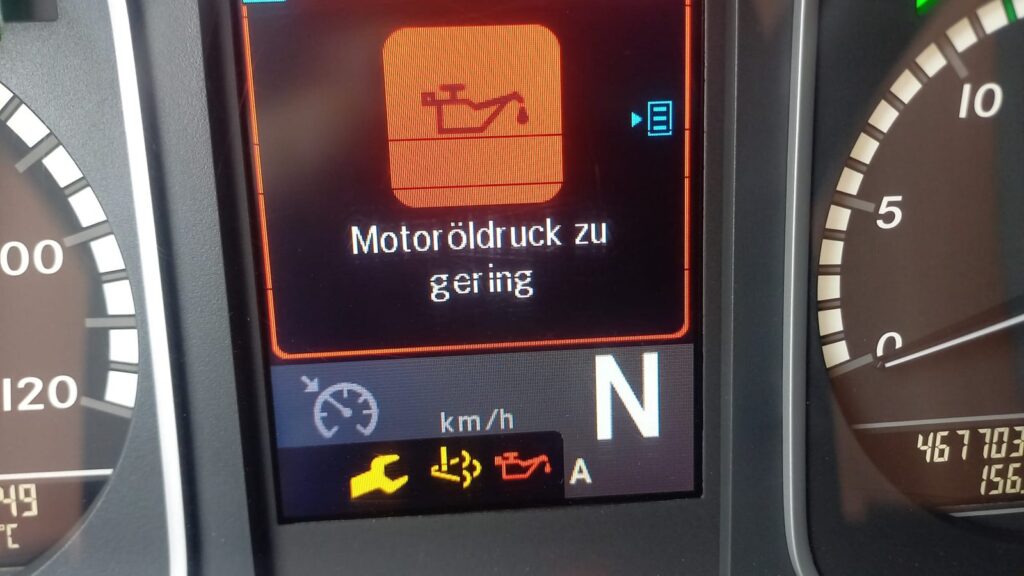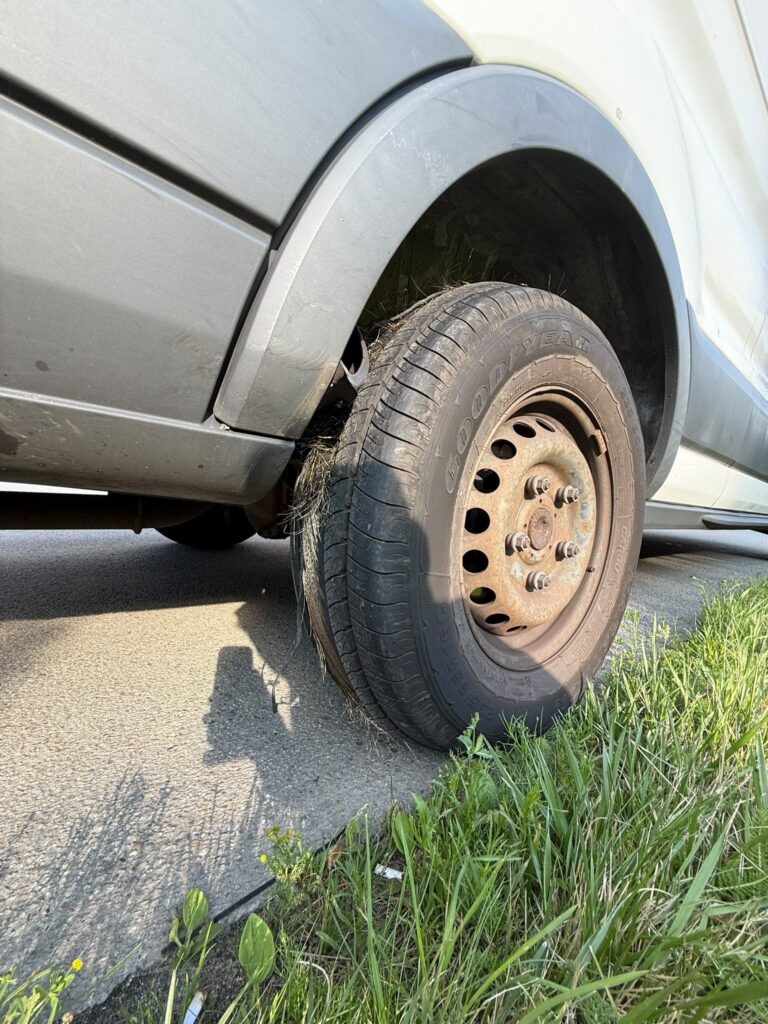
A blown tyre on a trailer axle is often harder to notice on an articulated combination than on the tractor itself. The driver barely feels a change in steering, because the tractor’s drive axles stay unaffected. Only the rattling in the mirror, a slight pull of the combination, or a passing driver’s glance gives it away. On the A19 near Rostock, heading towards Berlin, that was exactly the case on 10 July: a MAN TGX with a tandem-axle trailer, hauling a boat as freight for a boatyard on the Baltic coast.
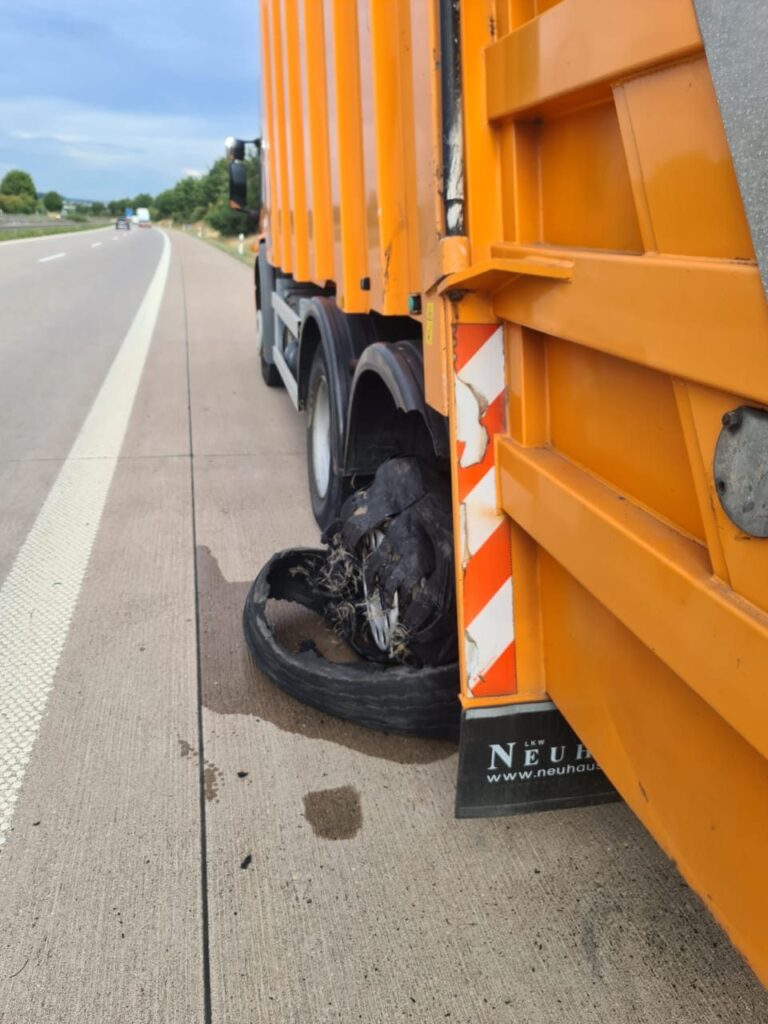
The trailer carried the boat on a flatbed, secured with lashing straps and wheel chocks, plus tools and equipment for the handover. The right tyre on the trailer’s tandem axle, size 385/65 R22.5, had blown out. Not a collision in the classic sense, but a 40-tonne combination stopped on the hard shoulder of a busy motorway, with a trailer visibly rocking every time a truck passed.
In this post we show how the callout went, what technique was behind it, and why trailer tyres on semi-trailer and drawbar combinations are an underestimated risk. The figures and the sequence are real; names and plates are omitted for data-protection reasons.

The situation on the hard shoulder
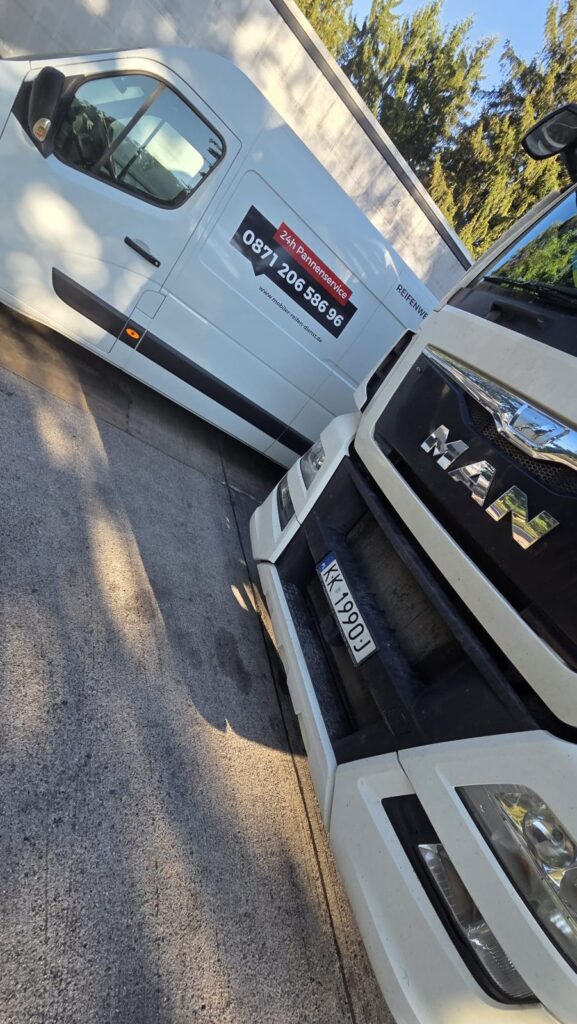
The MAN TGX was travelling with a tandem-axle trailer, loaded with a boat as a commercial haulage job. Such combinations are a familiar sight on northern German motorways in July and August, heading for the coast. The tractor itself runs on 315/70 R22.5, the trailer on 385/65 R22.5 – a size fitted on countless tandem and tridem trailers in heavy-goods transport.
It was exactly this trailer tyre that failed. Not gradually through a slow leak, but a classic blowout: the carcass tore open and the tyre abruptly lost its load capacity. The driver noticed the combination’s unusual handling, a slight pull and rattling behind him, and reacted correctly: he reduced speed in a controlled way and steered onto the hard shoulder without braking or steering abruptly.
Stopping on the A19’s hard shoulder is not a safe place to linger. Traffic passes at 120 to 130 km/h, and the draught of passing trucks visibly rocks even a loaded trailer. High-vis vest on, warning triangle out, waiting behind the barrier – that was the first task, before our call was even answered.
How we organised the callout
One call to our emergency number is enough, around the clock, even on a summer afternoon in the middle of holiday season. Our dispatchers work in several languages, because German motorways in July carry far more than German number plates.
Here is how the response unfolded:
- Location check via motorway markers, here A19 towards Berlin near Rostock.
- Query on tyre size and axle – tractor, steer axle, drive axle, or, as here, trailer tandem axle.
- Risk assessment: vehicle on the hard shoulder, hazard lights on, warning triangle already placed.
- Selection of the nearest partner workshop in our network carrying a matching replacement tyre for vehicles above 7.5 t.
- Transmission of location, vehicle data and tyre size to the response crew.
- Ongoing updates to the driver on the estimated arrival time.
For standard sizes such as 385/65 R22.5, availability through our partner network is generally good, though it still pays to check in advance, since not every mobile tyre service carries heavy trailer tyres as standard.
Why you should not try to wait it out
Trailer tyre damage is often underestimated because the tractor itself still seems roadworthy. That is a misconception. A trailer with a blown tyre can start to sway at higher speed, an effect known as trailer snaking. With a load that raises the centre of gravity, such as a boat, this risk increases further.
A few technical facts that matter here:
- Trailer tyres often rack up different mileage than the tractor’s tyres, but age all the same – rubber becomes brittle over time regardless of tread depth.
- Tyre pressure on tandem and tridem axles is easily overlooked during checks, since attention usually focuses on the tractor.
- The actual axle load of a laden trailer is frequently underestimated, leading to chronic tyre overload, especially with uneven load distribution.
- Not every trailer carries a spare wheel in the right size, particularly on special runs with bulky cargo.
A driver stopped on the hard shoulder with a trailer should not try to “just make it to the next exit”. A damaged tyre can wreck the rim, damage the trailer’s brake system, or in the worst case cause a complete loss of control over the combination.

The tyre change, step by step
Once our response crew arrived, the process ran routinely and without rush:
Step 1: Visual inspection. The technician assessed the damaged tyre, the rim and the trailer itself. With a blowout, it is crucial to check whether only the tyre is affected or whether the rim, suspension or load securing has also been damaged.
Step 2: Securing the work area. Warning cones were set out in addition to the existing triangle, and the high-vis vest stayed on throughout. On a motorway with dense holiday traffic, this is not a formality but essential, especially with a 40-tonne combination.
Step 3: Removing the damaged wheel. The trailer was raised with a hydraulic jack and secured with stands, the wheel nuts were loosened with an impact wrench, and the damaged wheel was taken off. On tandem axles, the second axle often adds extra stability against tipping during the change.
Step 4: Fitting the replacement wheel. The new wheel in size 385/65 R22.5 was mounted, the nuts tightened crosswise and then finished to the specified torque with a torque wrench. Cross-tightening prevents brake drum distortion and ensures even clamping pressure.
Step 5: Final check. Tyre pressure checked and set to the manufacturer’s value, wheel nuts checked again with the torque wrench, visual inspection of the wheel bearing, coupling and load securing. Only then did the technician clear the combination to continue.
The full timeline
| Time | Phase | Action |
|---|---|---|
| 14:10 | Emergency call | Driver reports trailer tyre damage on the A19 near Rostock |
| 14:10–14:25 | Dispatch | Location and size check, partner workshop selected (15 min) |
| 14:25–15:10 | Drive out | Response vehicle reaches the breakdown on the hard shoulder (45 min) |
| 15:10–16:05 | Tyre change | Removal, fitting, torque check, pressure check (55 min) |
Total time from call to departure: 1 hour 55 minutes.
On a normal working day outside peak hours, this timeline is realistic – our experience shows the drive-out usually falls within 30 to 90 minutes. During heavy holiday traffic, as is common on northern German motorways in July, the drive-out can take a little longer, since our response vehicles sit in the same queues.
What the callout cost
| Item | Price (EUR) |
|---|---|
| Call-out fee (daytime) | from 290 |
| Labour | from 110 |
| Trailer tyre 385/65 R22.5 | from 420 |
| Old tyre disposal | from 25 |
| Total | from 845 |
All amounts net, plus VAT, with the fixed price confirmed by phone before the job starts. At night, on Sundays or public holidays, the call-out fee is from 549 euros. Tyres from size R17.5 upward start from 315 euros with us; the exact size and availability determine the final price.
For comparison: a combination stranded overnight, for instance because no matching tyre was available and a tow was needed, would have cost considerably more through lost freight time, possible penalties for late delivery, and organising a replacement transport, than the repair itself.
Why this quickly overwhelms a non-professional
Changing a tyre on a trailer axle sounds like a twenty-minute job. In practice, several pitfalls lie in wait:
- Missing or wrongly sized tools, especially the right wheel-nut wrench and impact wrench for heavy trailer axles.
- No spare wheel of the right size on board, especially on special trips with rented or rarely used trailers.
- Wrong torque value when tightening wheel nuts, which can distort the brake drum or crack a wheel under vibration.
- Underestimating the danger from flowing traffic on the hard shoulder with a 40-tonne combination.
- Lack of expertise to assess whether the axle, suspension or load securing suffered follow-on damage from the blowout.
A jack not rated for the trailer’s load can itself become a hazard. Anyone unsure should call a specialist rather than experiment on the hard shoulder.

Typical callouts for trucks with trailers
Alongside classic semi-trailer breakdowns, callouts for drawbar combinations and tandem/tridem trailers are part of our daily work across Germany:
- Tyre damage on tandem trailers carrying heavy freight, often on routes towards the coast or boatyards.
- Flat tyres on haulage tractors with tight delivery schedules.
- Tyre problems on refrigerated trailers, where perishable cargo adds extra time pressure.
- Tyre blowouts on low-loaders carrying construction machinery to site.
- Emergencies with swap-body trailers, whose axle load varies sharply with the load carried.
The common thread: these combinations are often under a tight schedule and need fast, competent help regardless of whether the tractor or the trailer is affected.
Prevention: what trailer operators should know
Most trailer tyre damage is avoidable with a few regular checks:
- Check tyre pressure before every longer trip, even for trailers that stood idle between runs. Air escapes slowly even without visible damage.
- Read tyre age from the DOT code. Four digits give the week and year of production. Tyres older than six years should be inspected critically regardless of tread depth, since the rubber compound becomes brittle even when tread still looks adequate.
- Assess actual axle load realistically, especially with bulky or unevenly distributed cargo such as a boat on a flatbed.
- Carry out a visual check before every run, looking for sidewall cracks, particularly on trailers after a long standstill.
- Carry a spare wheel and the right tools, including the correct wheel-nut wrench for the specific axle and a jack rated for the axle load.
Ageing by date rather than tread depth is regularly overlooked on trailer tyres. A tyre can look almost new on the outside and still be brittle inside from UV exposure, ozone and standing load.
Frequently asked questions about trailer tyre blowouts
What does a tyre change on a truck trailer cost on the motorway?
In our case, the total bill came to from 845 euros net, including call-out, labour, replacement tyre and disposal of the old one. The exact price depends on the time of day, distance to the nearest partner workshop and the available tyre size. At night, on Sundays or public holidays, surcharges usually apply, with the call-out fee then from 549 euros. We confirm the fixed price before the job starts.
How long does the drive-out take for a motorway breakdown?
Typically between 30 and 60 minutes, depending on traffic and location. In our case it was 45 minutes after 15 minutes of dispatch. In heavy holiday traffic or sparsely populated regions, the drive-out can take longer.
Who pays for the tyre change on a rented trailer?
That depends on the rental contract. Some rental companies have a breakdown assistance clause or their own emergency number; others require the renter to cover costs upfront and submit receipts afterwards. It is worth checking the contract before setting off.
Can I keep driving to the next exit with a damaged trailer tyre?
We advise against it. A tyre that has already lost its carcass can damage the rim or affect brake lines. The safest option is to stop in a controlled way on the hard shoulder and call for help, rather than risk continuing with a 40-tonne combination.
Do you carry trailer tyres in heavy commercial vehicle sizes?
Our partner network stocks common sizes such as 385/65 R22.5 and other commercial tyres from R17.5 upward, so long waits remain the exception.
How can I tell if a trailer tyre is too old?
From the DOT code on the sidewall, four digits for the week and year of manufacture. As a rule of thumb, tyres over six years old should be critically inspected, even if the tread still looks sufficient.
Tyre quality and maintenance in a wider context
For semi-trailer and drawbar combinations, branded products from established manufacturers are recommended. Continental, Michelin, Goodyear and Bridgestone offer reinforced-carcass models for truck and trailer tyres designed for sustained load and varying axle weights. For commercial fleets running several tractors and trailers, a fixed maintenance schedule tracking tyre pressure, tread depth and DOT age pays off.
One more point commercial operators running trailers often overlook: the tractor itself needs its own maintenance schedule too. Tyre pressure on the tractor’s steer and drive axles has a direct effect on steering precision when towing a laden trailer, especially in bends or crosswinds on the open motorway. Anyone regularly running with a trailer should treat tractor and trailer as one unit and have both checked together at every major inspection, including brakes, lighting and the coupling.
Standstill time also deserves more attention than it usually gets in practice. A trailer left stationary at the depot between jobs stresses its tyres differently to a vehicle in daily use. A load resting in one spot causes localised deformation of the carcass, which only becomes noticeable as vibration or sudden failure at higher speed. Anyone parking a trailer for longer periods should, where possible, store it on stands to relieve the tyres and carry out a thorough visual check before the first run.

A July afternoon, as it happens more often
The technician who took the callout on the A19 knew the situation well. In July and August, requests pile up from combinations carrying heavy special freight, often on a sunny afternoon when the motorway is full of holiday and delivery traffic. This mix of time pressure and dense traffic makes calm, clear phone communication essential, even before a vehicle is dispatched.
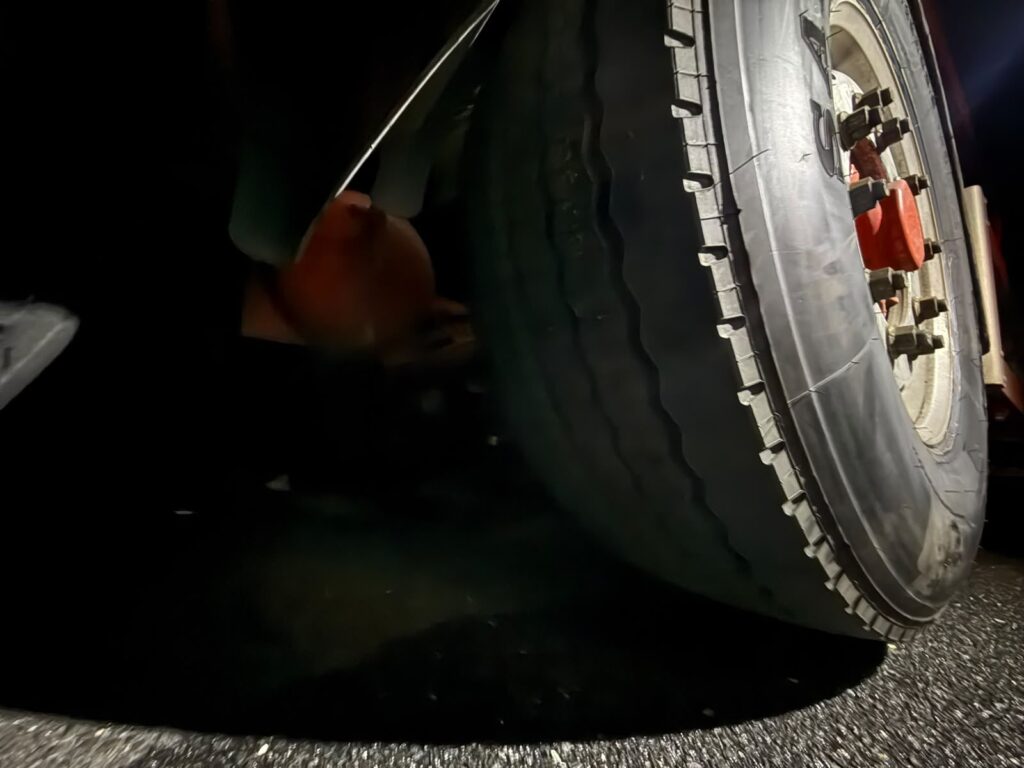
That afternoon was warm, the road surface shimmered in the heat, and traffic on the A19 rolled in dense columns towards Berlin. Such conditions add extra strain on tyres: higher ambient temperature means higher internal tyre pressure, and an already weakened tyre gives way faster under that extra load. The technician knew this and therefore checked not only the damaged tyre but also the remaining wheel on the opposite side of the tandem axle for signs of ageing.
Why customers trust us
We specialise in trucks and commercial vehicles from 7.5 t upward, with or without trailers, across Germany, around the clock. Multilingual dispatch matters especially in summer, when many international hauliers with trailer combinations are on the road. Our partner network stocks matching tyres for common truck and trailer sizes, so long waits remain the exception. Prices are communicated transparently before work begins, with no hidden surcharges, and a fixed price confirmed before the job starts.
Summary in numbers
- Vehicle: MAN TGX with tandem-axle trailer (boat transport)
- Tyre affected: Trailer tyre 385/65 R22.5 (tractor: 315/70 R22.5)
- Location: A19 near Rostock, direction Berlin
- Date: 10 July, holiday season
- Response time to arrival: 45-minute drive-out after 15 minutes of dispatch
- On-site repair time: 55 minutes
- Total time: 1 hour 55 minutes
- Cost: from 845 euros net
- Follow-on damage: none, thanks to the driver’s timely and controlled reaction
Request help now
Tyre blowout on a truck or trailer, anywhere in Germany: we are reachable around the clock, 24/7, in German, English, Polish and Russian. Call us or message us on WhatsApp at +49 160 575 3826, or visit www.lkwhelp24.com. Nationwide, with a fixed price confirmed before the job starts.
Keywords: mobile truck trailer tyre service | semi-trailer tyre blowout motorway | truck trailer tyre change A19 | trailer tyre 385/65 R22.5 | breakdown assistance drawbar trailer Baltic Sea | tyre service Rostock motorway

Truck service in the region
Our workshop and service locations are also available in Beckum, Bergisch Gladbach and Chemnitz.
Related posts
- Mobile truck tyre service on the motorway near Hamburg
- Truck tyre service for a tyre blowout on the A43 near Dortmund
- Emergency tyre service nearby – fast help with tyre blowouts
- Mobile truck tyre service near Berlin
- Truck tyre service: fast help with a tyre blowout on the motorway near Hof
More on this: our tyre service page, our towing service.