Skip to content
TL;DR: On 14 July, the EBS (electronic braking system) on an articulated lorry threw a fault on the A4 near Bad Hersfeld, direction Kirchheim. At 90 km/h the brakes dropped into limp-home mode and the dashboard warning appeared in Turkish. Our partner technician reached the hard shoulder in 50 minutes, traced the fault to a corroded ISO 7638 connector between tractor and trailer, repaired the wiring and connector, and had the lorry roadworthy again after 2 hours 10 minutes total. Cost: €580 net.
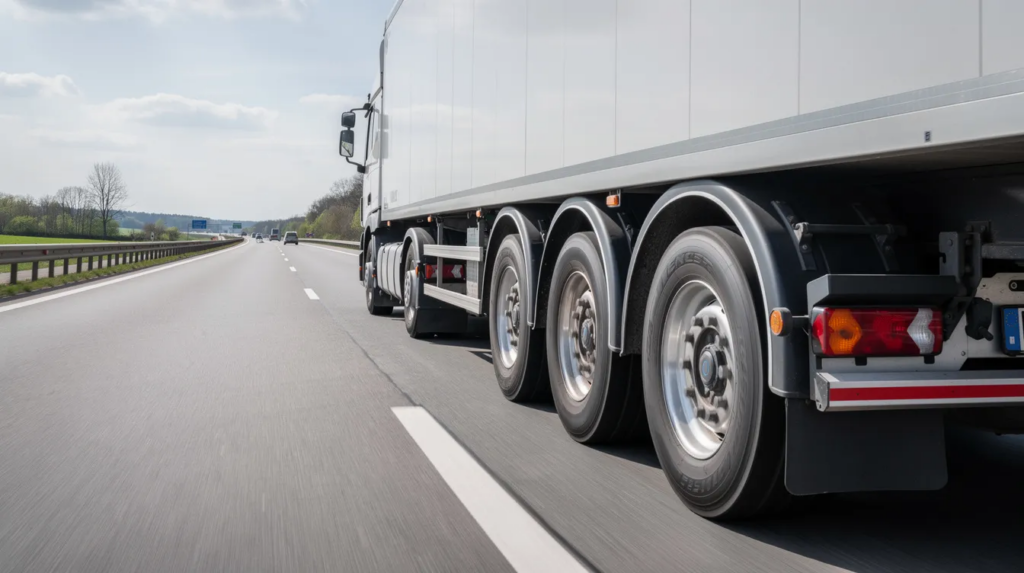
An EBS fault on the motorway is not something to shrug off. The brakes still work, but only through the backup pneumatic circuit, without ABS and without electronic force distribution between tractor unit and trailer. At 90 km/h, that means an emergency stop can end with wheels locking instead of braking cleanly.
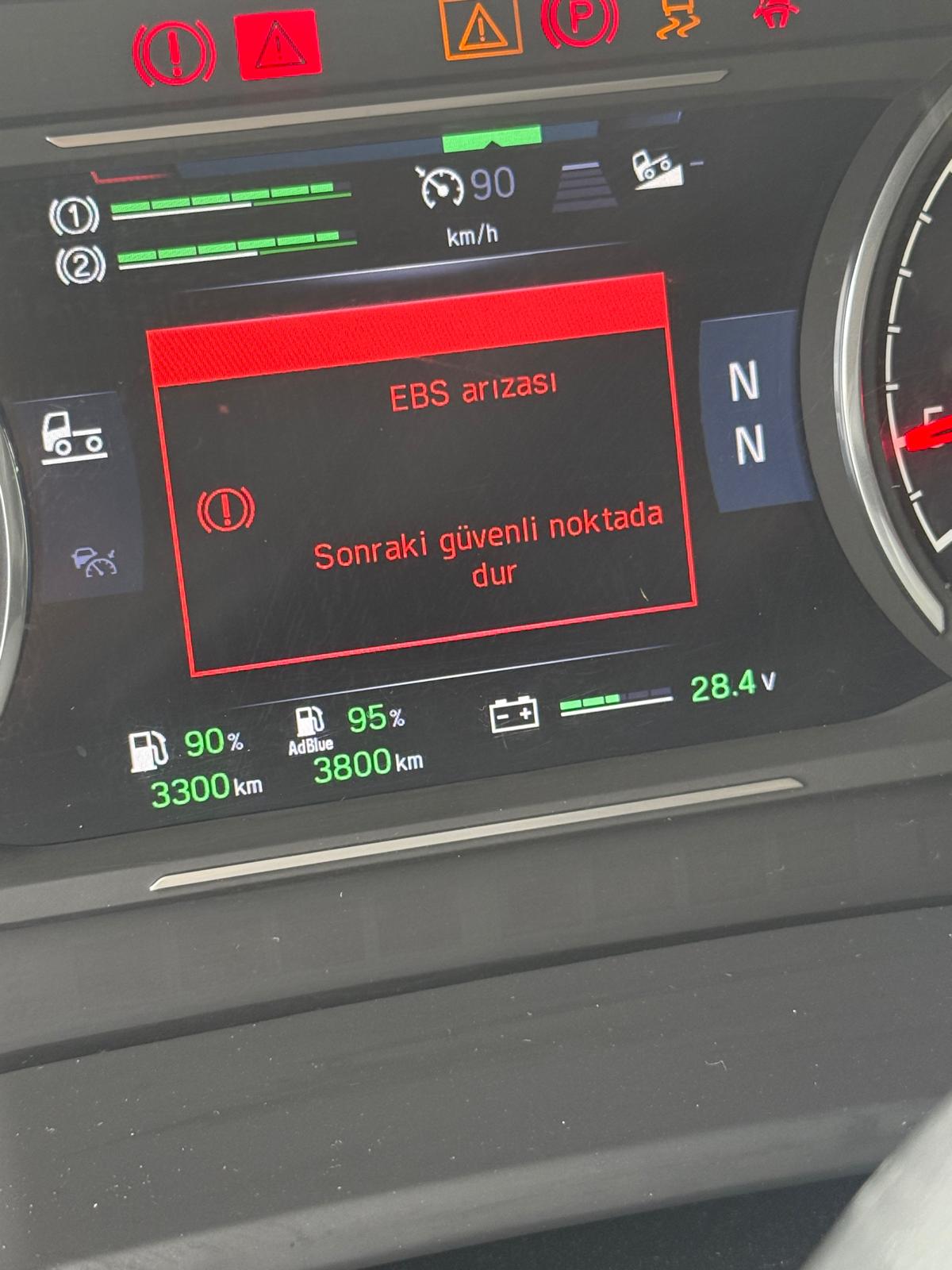
To make things harder, the fault message on the dashboard appeared in Turkish only: “EBS arızası – Sonraki güvenli noktada dur” (“EBS fault – stop at the next safe point”). Stranded on a German motorway far from his own haulage firm, the driver needed more than a mechanic — he needed a dispatcher who could actually understand what the screen was telling him.
What Is EBS and Why Is It More Than Just Air Brakes?
EBS (Electronic Braking System) is a system that controls braking force at each wheel electronically instead of relying purely on air pressure. On a modern tractor unit, EBS fine-tunes brake balance between the steer axle, drive axle and trailer in real time, based on load and driving conditions.
Traditional air brakes react more slowly and distribute force according to a fixed pattern. EBS, by contrast, measures wheel speed at each corner, compares the readings, and adjusts brake pressure electro-pneumatically, often several times a second. It’s tightly integrated with ABS (anti-lock braking), ASR (traction control) and ESP (stability control) — all three draw on the same wheel-speed sensors and the same control unit. When EBS fails, the tractor and trailer lose exactly that coordination; the brakes themselves are still there, but “blind” to what each wheel is doing.
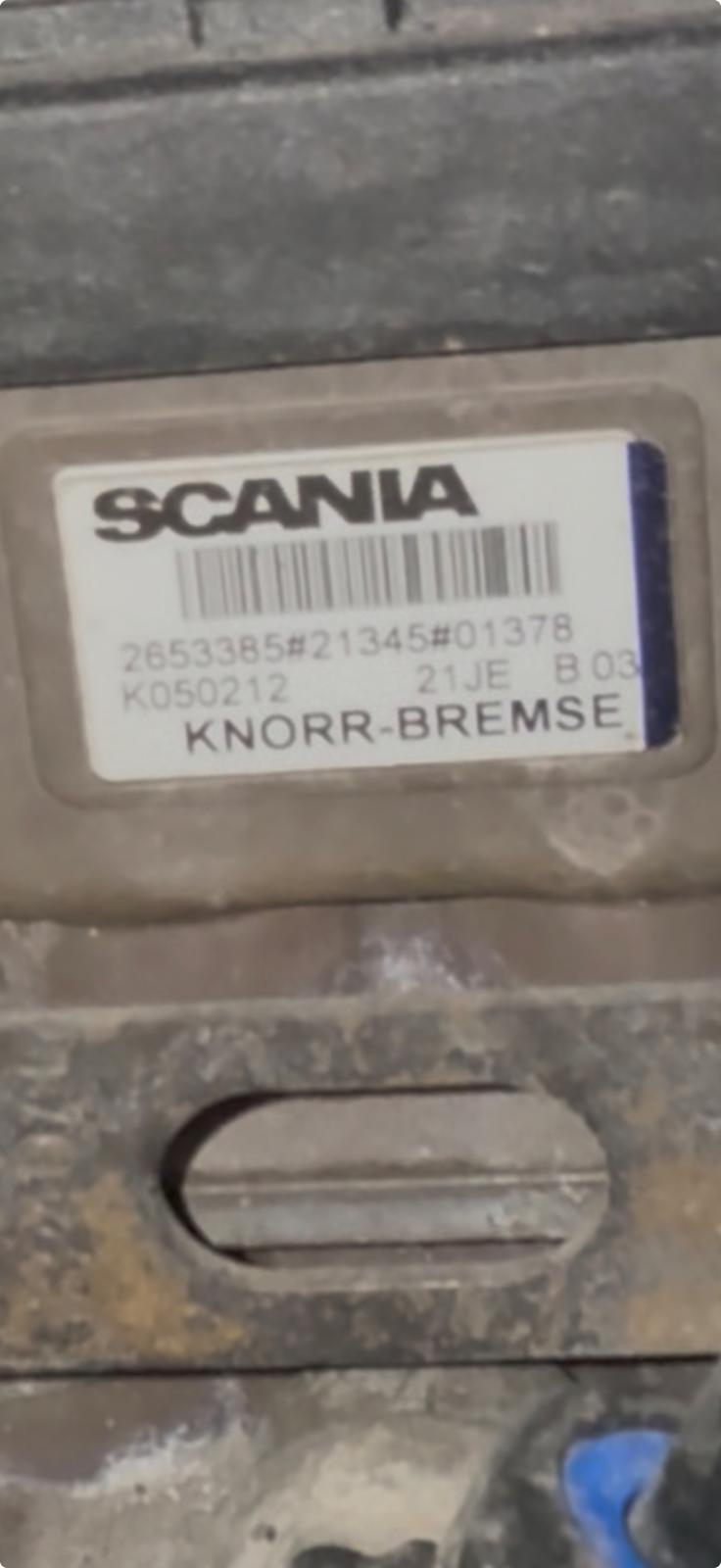
On an articulated lorry this matters more than on a rigid vehicle, because tractor and trailer are two separate braking circuits carrying different loads. Without EBS coordination, the trailer can lock up earlier or later than the tractor under braking — precisely the failure mode manufacturers like Knorr-Bremse and ZF built EBS to prevent.
Why Does EBS Drop Into Limp-Home Mode?
Limp-home mode kicks in the moment the control unit can no longer make sense of a signal — usually because of a failed sensor, a broken wire or a faulty connector, not because the brakes have failed outright. The system falls back to the mechanical backup circuit as a safety measure.
Causes we see repeatedly on jobs like this one:
- A failed wheel-speed sensor (ABS sensor), often from vibration, moisture or physical damage.
- A corroded or loose connector, particularly at the tractor-to-trailer interface.
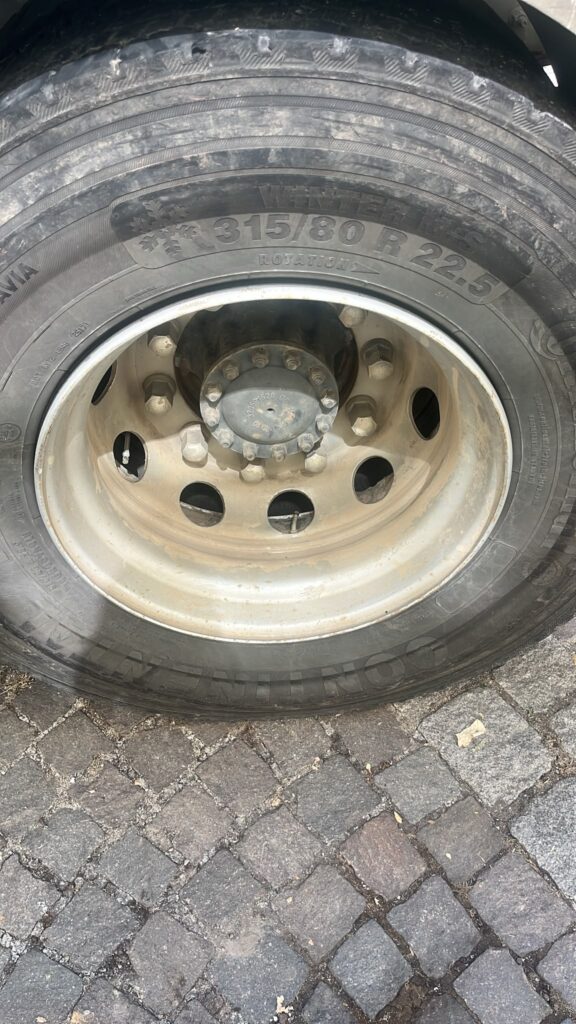
- Damaged wiring, frequently a knock-on effect of a tyre blowout that rips out cable runs near the axle.
- A faulty modulator — the valve that regulates brake pressure electronically.
- Onboard electrical problems, such as a weak battery or a poor earth connection.
In this case, battery voltage read 28.4 V — a normal figure for a 24V commercial vehicle system under load, which ruled out a simple power fault and pointed the technician straight at the connector.
The Tractor-Trailer Interface: Why the ISO 7638 Connector Matters
The ISO 7638 connector is the electrical link that lets tractor and trailer share EBS data — a dirty or damaged connector is one of the most common fault sources in international long-haul work. This seven-pin connector carries both the power supply for the trailer EBS and the data communication between the two control units.
The problem shows up fastest with swap trailers — an everyday scenario on international routes, where a tractor unit rarely stays hitched to the same trailer for long. Contacts that road grime, salt or damp have already weakened often throw exactly the fault we found here. On this job, the connector was visibly corroded, and one of the pins had come loose in its housing.
What Limp-Home Mode Actually Means for the Driver
In limp-home mode the lorry can still brake, but only through the mechanical-pneumatic backup circuit, without ABS support. That’s the key difference from a total brake failure, which is what most drivers fear when the warning first appears.
In practice, ordinary braking without an emergency remains controllable. The risk is a hard stop or a wet, slippery surface, where individual wheels can lock because ABS is no longer intervening, and the trailer can start to swing. That’s why the rule with an active EBS warning is clear: pull in at the next safe hard shoulder or lay-by, not carry on to the next services or across a border. Continuing to drive with the brake warning lit also falls foul of the roadworthiness standards bodies such as DEKRA apply during commercial vehicle inspections.
Why a Diagnostic Scanner Is Non-Negotiable
Without reading the fault codes, an EBS problem can’t be pinned down properly — swapping parts on a hunch wastes time and money without fixing the cause. Trucks from different manufacturers (Mercedes-Benz, MAN, Scania, DAF, IVECO, Volvo) each run their own diagnostic protocols and, in some cases, brand-specific connectors for fault reading.
A mobile diagnostic tool pulls the stored fault codes from the control unit — something like “sensor signal implausible, axle 2” or “trailer EBS communication error” — and shows whether the fault sits in the sensor, the wiring, the connector or the modulator. A roadside team can act on that: checking connectors, testing cable runs for continuity, and repairing minor wiring damage on the spot. What they can’t do is replace a failed EBS control unit or modulator outright — that calls for a workshop with the right part and calibration equipment, like our own truck service.
The Language Barrier on an International Run: A Case From the Road
The driver was Turkish, midway through a long international run across Germany. The fault message on his dash appeared in his own language — perfectly clear to him, not so much to a German technician on site. This is exactly where a multilingual dispatch team makes the difference between a five-minute conversation and an hour of confused waiting. Our team spoke directly with the driver, worked out what the Turkish warning actually meant, and passed the right information to the partner workshop instead of relying on hand gestures and a translation app.
Long-Haul Transit Routes Through Germany: Why These Breakdowns Hit Harder
On a long international transit route, an EBS failure hits a driver twice as hard — far from his own workshop, with no local service network and often an unclear way to pay. The A4 near Bad Hersfeld sits on one of Germany’s key east-west corridors, carrying thousands of long-haul vehicles daily from Turkey, Poland, Romania and the Benelux countries.
For a driver who’s over a thousand kilometres from home, a breakdown isn’t just a technical fault. His own haulier can’t send a replacement lorry at short notice, spare parts from home aren’t an option, and every hour standing still costs freight money and pushes back a contracted delivery slot. That’s exactly why an independent service network matters — one that works regardless of the driver’s nationality, language or preferred payment method, whether that’s card, transfer, or coordination with the haulier back home.
How We Organised the Job
- Call taken — driver reports the EBS fault and limp-home mode, location A4 near Bad Hersfeld, direction Kirchheim.
- Dispatch — a partner technician with commercial vehicle diagnostics is alerted in the region; the driver is talked through the situation in his own language.
- Response drive — the technician heads to the hard shoulder with a mobile diagnostic unit.
- On-site diagnosis — fault codes read, sensors and wiring checked, the trailer connector inspected.
- Repair — the corroded ISO 7638 connector cleaned and reseated, damaged wire sections repaired.
- Function check — EBS reset, fault codes cleared, a stationary and low-speed brake test.
Full Job Timeline
| Time | Phase | Action |
|---|---|---|
| 0 min | Call received | Driver reports EBS fault, limp-home mode active, 90 km/h |
| 0–15 min | Dispatch | Partner technician alerted, driver talked through in his own language |
| 15–65 min | Response drive | Technician reaches the hard shoulder, A4 near Bad Hersfeld |
| 65–130 min | Diagnosis & repair | Fault codes read, ISO 7638 connector and wiring repaired, function test |
| 130 min | Done | Lorry roadworthy again, free to continue |
Total time: 2 hours 10 minutes from the first call to driving off — a night job or heavy rain can stretch the response drive noticeably.
What the Job Cost
| Item | Price (EUR, net) |
|---|---|
| Callout fee | 220 |
| Scanner diagnostics | 150 |
| Labour (wiring/connector repair, 1.5 hrs) | 165 |
| Small parts (connector, cable, seals) | 45 |
| Total | 580 |
All figures are net, plus VAT. The final total depends on the time of day (night and weekend surcharges of 25–50%), distance to the breakdown, and whether the fault is a simple connector issue or a larger wiring repair. For comparison, a haulier typically loses £800–£1,200 a day in lost freight and standing costs while a lorry sits idle at a depot or on a workshop waiting list — a roadside callout is, in this case, the clearly better economic call.
Frequently Asked Questions About EBS Faults on the Motorway
How much does an EBS repair cost on the motorway?
For a connector or wiring fault like this one, the repair including callout and diagnostics runs to around €580 net. If a whole control unit or modulator needs replacing, costs rise sharply, since that usually can only be done in a workshop.
How long does an EBS repair take at the roadside?
In this case, 2 hours 10 minutes passed from the initial call to driving off again. The diagnosis and connector repair itself took 65 minutes, with the rest spent on dispatch and the response drive.
Can I keep driving with an EBS fault?
No, not to the next services or across a border. The rule is to stop at the next safe point. The brakes still work through the backup circuit, but without ABS support, which can cause individual wheels to lock during a hard stop.
Can I fix an EBS fault myself?
In most cases, no. Without a diagnostic scanner there’s no way to tell whether the sensor, wiring, connector or modulator is at fault. A visibly dirty ISO 7638 connector can be carefully cleaned, but confirming the actual fault requires reading the control units.
Why does this often affect international long-haul drivers?
With swap trailers and frequent coupling to different units, the ISO 7638 connector takes more wear than on a fixed tractor-trailer combination. That’s exactly the everyday reality of international haulage, as in this case with a Turkish driver midway through a long run.
Does insurance cover an EBS repair on the road?
That depends on the fleet or comprehensive policy. Straightforward wear or corrosion damage to a connector usually isn’t covered, while damage that follows an accident or tyre blowout can be.
How can I tell an EBS fault apart from an ordinary brake problem?
Typical signs are a brake warning light alongside an ABS warning light, a noticeably firmer or delayed pedal feel, and, as in this case, a specific text message on the dash. An ordinary mechanical brake issue usually shows up as noise, vibration or pulling to one side, without ABS or EBS symbols lighting up.
Why an EBS Fault Isn’t a DIY Job
- Misdiagnosis without a scanner — replacing a sensor achieves nothing if the actual fault is in the wiring.
- Safety risk if you keep driving — without ABS, a hard stop can send the trailer into an uncontrolled skid.
- Knock-on damage to the modulator — a badly reconnected plug can damage the expensive control unit further.
- No sign-off — after a repair, the system needs resetting and the brake test needs recording, or the warning light stays lit.
Typical EBS and Electrical Jobs We Handle on the Road
- Trailer EBS failure right after coupling to an unfamiliar trailer.
- Damaged sensor wiring following a drive-axle tyre blowout.
- A corroded ISO 7638 connector after a long spell parked in the rain.
- Onboard voltage fluctuations that knock out several control units at once — a pattern we cover in our wider truck breakdown assistance in Germany overview.
- Full electrical shutdowns, such as an IVECO S-Way in Frankfurt, which ultimately needed towing.
Prevention: How Drivers and Fleets Avoid EBS Failures
Regular connector care is the single most effective way to prevent EBS faults on long-haul routes. We recommend:
- Clean the ISO 7638 connector regularly and protect it with contact spray against corrosion, especially before a longer international run.
- Check the wiring after any tyre blowout — cable runs torn near an axle are one of the most common causes of EBS faults.
- Get electronics checked at every workshop visit, not only when a problem is already active, so sensor readings get flagged early.
- Inspect the connector when coupling, particularly with swap trailers on international routes.
Electronic Braking Systems in Fleet Operations: What Actually Matters
Modern tractor units from MAN, Scania, Volvo Trucks, DAF, IVECO and Mercedes-Benz Trucks all run EBS as standard, usually built by Bosch, Knorr-Bremse or WABCO/ZF. For fleet operators, that means brake maintenance is now, essentially, electronics maintenance. A visual check of the brake pads alone isn’t enough anymore — sensors, connectors and control units belong on the inspection list just as much as tyre pressure or tread depth. Tyre condition plays an indirect role too: a blowout on a drive axle frequently damages wiring runs right next to the hub, which is often the trigger for an EBS fault in the first place.
A further point many fleet managers underestimate is the service life of the connectors themselves. An ISO 7638 connector isn’t built for unlimited mating cycles, and with daily coupling to different trailers, the contact springs wear mechanically over time. Manufacturers recommend a visual check at every major workshop visit, not only once the warning light is already on.
Why LKWHelp24
We’re on the road 24/7 across Germany, backed by a vetted network of mobile technicians and diagnostic specialists. Our dispatch works in multiple languages, which matters when the fault message on the dash isn’t in German or English. We quote prices up front, with no hidden lines on the invoice. And when a repair genuinely can’t be done roadside, such as when a full control unit needs replacing, we arrange transport straight to the nearest suitable workshop.
Summary
- Vehicle: articulated lorry (tractor unit and trailer), international long-haul, Turkish driver
- Location: A4 near Bad Hersfeld, direction Kirchheim
- Date: 14 July
- Fault: EBS limp-home mode at 90 km/h, battery voltage 28.4 V
- Response time: 50 minutes to arrival
- Total time: 2 hours 10 minutes
- Cost: €580 net
- Cause: corroded ISO 7638 connector between tractor and trailer
Get Help Now
EBS warning on the dash, brakes stuck in limp-home mode? Call us on +49 160 5753826. We’re available around the clock across Germany, with multilingual dispatch and a vetted partner network for fast on-site diagnostics. More at www.lkwhelp24.com.
Keywords: EBS fault truck | electronic braking system | ISO 7638 connector | articulated lorry limp-home mode | truck breakdown assistance A4 Bad Hersfeld | mobile brake diagnostics | ABS ASR ESP HGV