Skip to content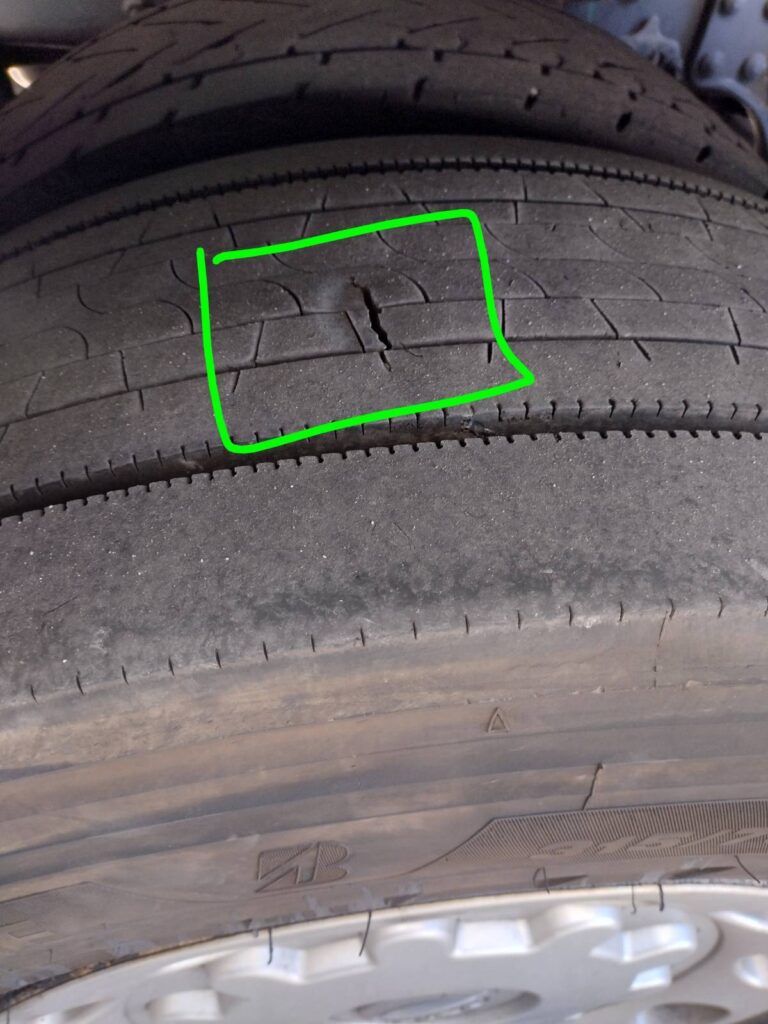
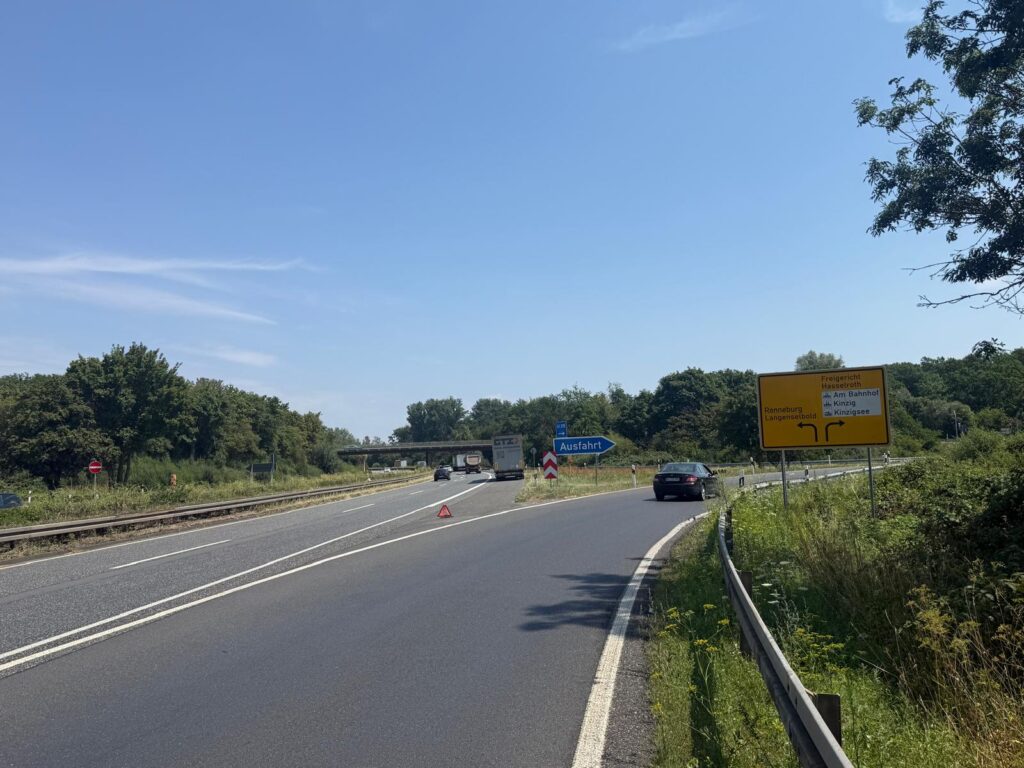
A hole in the tread is usually an inconvenience. A cut in the sidewall is a different story: it is a reason to stop immediately, and it can never be patched. That is exactly what happened on 3 August, during daylight hours, on the A81 near Singen, heading towards Stuttgart, on an articulated lorry running a 385/65 R22.5 tyre.
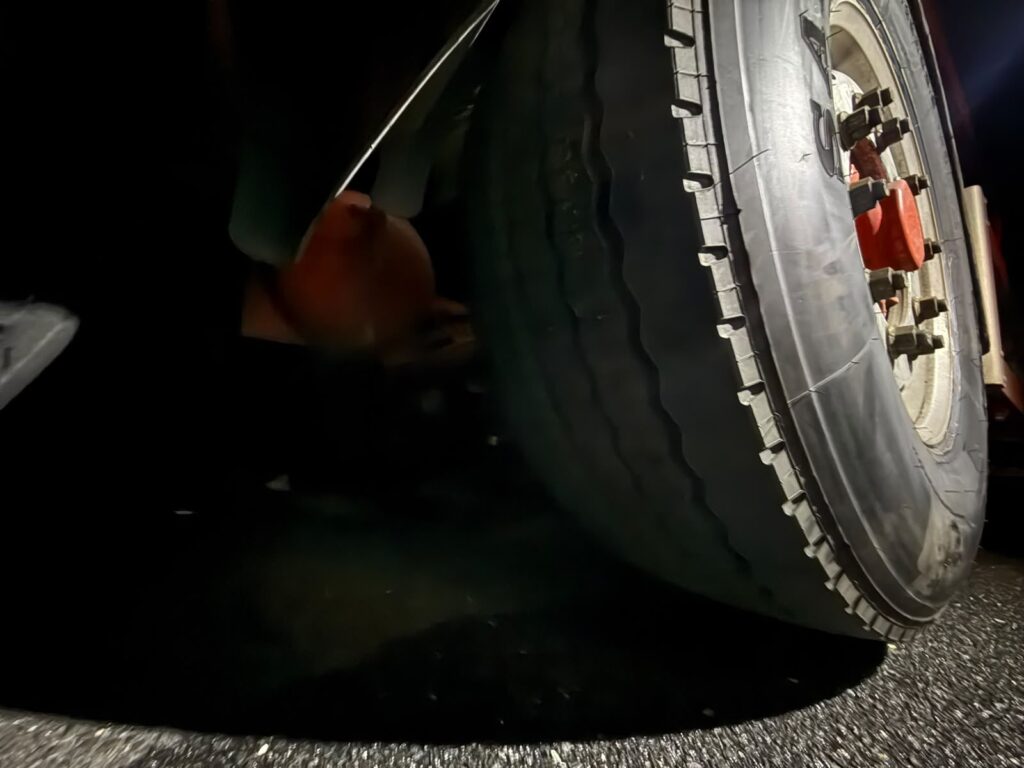
The driver had clipped a kerb during a manoeuvring turn, most likely in a tight yard shortly before joining the motorway. Once on the autobahn he noticed a faint vibration, pulled over at the first safe opportunity, and found a clean cut running roughly the length of a finger along the tyre’s flank. No blowout, no immediate pressure loss — but enough to stop the journey and call our emergency line.
What looks at first glance like a minor scrape is, on a lorry tyre, a safety risk that cannot wait. In this article we explain why the sidewall is the most vulnerable part of a tyre, why a sidewall cut can never be repaired the way a tread puncture can, and how our team got the articulated lorry safely back on the road in under two and a half hours.
The incident: A81 near Singen, direction Stuttgart
The articulated lorry was en route with a load when the driver caught the kerb while manoeuvring on a tight yard. Contact like this happens more often than people assume, particularly on loading ramps, docking areas and yards that simply were not designed with an articulated lorry’s turning circle in mind. The 385/65 R22.5 size is typical for trailer axles and, at full load, carries substantial weight through every rotation.
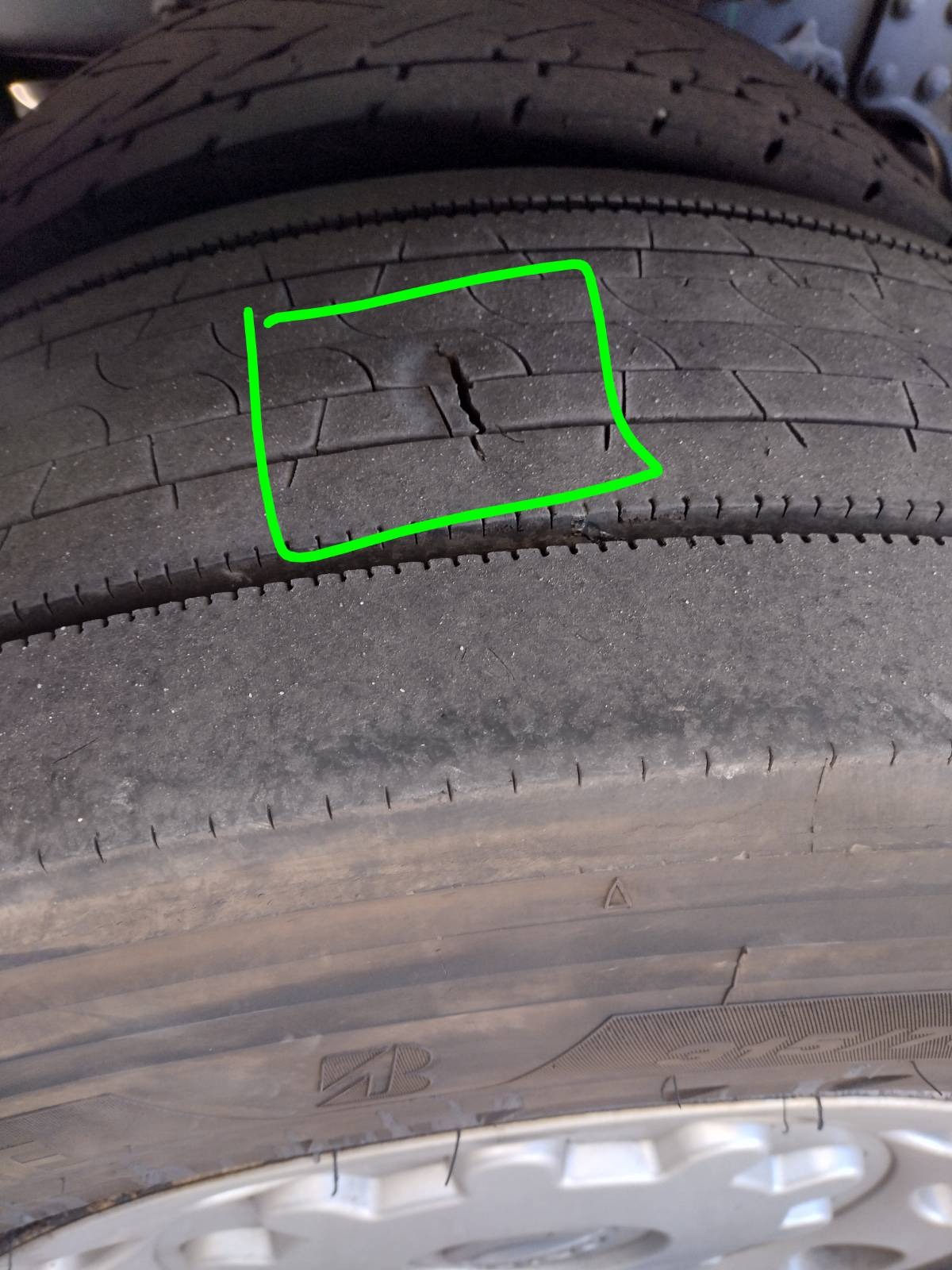
At first, the driver noticed nothing unusual. Only after a few kilometres on the motorway did he register a slight irregularity in how the lorry handled. He did the right thing: pulled over, got out, and checked the tyres. On the outer sidewall, a cut was visible where the rubber had already been sliced through. The spot was marked in chalk for documentation — a standard step in any roadside tyre inspection, so that technicians, and an insurer if needed, know exactly where the damage sits and how it changes from the moment it was first spotted.
How we organised the response
Our dispatch team works multilingually, around the clock. The sequence for this callout:
- Emergency call logged, location confirmed via GPS coordinates and motorway marker post.
- Tyre specification checked (385/65 R22.5) and a matching tyre reserved from our partner network’s regional stock.
- Nearest available service vehicle equipped for articulated lorry tyres dispatched.
- Driver instructed to pull fully onto the hard shoulder, activate hazard lights, place the warning triangle, and put on a hi-vis vest.
- Live location tracking, so the driver knew the estimated arrival time rather than waiting in uncertainty.
These steps sound basic, but in practice they save time and, more importantly, prevent secondary damage. A driver who knows help arrives in 50 minutes stays put behind the crash barrier instead of risking a longer journey to find a garage.
Why the sidewall is the most vulnerable part of a tyre
A lorry tyre is not a uniform slab of rubber. It is a layered composite of rubber, textile and steel cord. Three zones matter for understanding this case:
- Tread: The thickest layer, reinforced by a stiff steel belt that usually stops cuts and road debris before they reach the deeper layers.
- Carcass: The load-bearing framework of steel or textile cord that gives the tyre its shape and load capacity.
- Sidewall (flank): Thinner, flexible, without a continuous steel belt. It has to flex and spring back with every wheel rotation — hundreds of times per minute at motorway speed.
That constant flexing is precisely what makes the sidewall structurally weaker by design. While the tread is shielded by the steel belt, the carcass cord in the flank sits almost unprotected beneath a thin rubber layer. A cut here reaches straight into the load-bearing fibres, which are continuously stressed by bending. Every further kilometre driven deepens the damage, because the cord at the weakened point keeps moving instead of staying rigid.
Why a sidewall cut is never repaired
With tread damage — a nail or a clean puncture in the tread pattern — a proper mushroom-plug repair is often possible, because the steel belt holds that zone stable and the repair barely experiences flex. The sidewall is different:
- Any patch would sit in a zone under constant bending stress and would eventually fail through fatigue.
- Tyre manufacturers such as Continental and Michelin rule out sidewall repairs entirely in their technical guidelines.
- Periodic technical inspection bodies treat a repaired sidewall as unroadworthy, failing the vehicle outright.
- German tyre and roadworthiness regulations under StVZO §36 leave no interpretive room for structural damage of this kind.
A tyre with a sidewall cut is replaced without exception, regardless of remaining tread depth or age. This is not caution for its own sake — it is a fixed technical boundary.
How the depth of damage gets assessed
Not every surface scrape means an immediate tyre change, but the margin is narrow:
- Cord visible: If the textile or steel cord of the carcass is exposed, the tyre is replaced immediately, no discussion. The load-bearing structure is already open and mechanically stressed.
- Rubber only: If the cut has not reached the cord, the remaining rubber thickness at the damage site is measured. In the sidewall, tolerance is slim, because the remaining layer can tear through quickly under load.
- Chalk marking: The technician circles the damage clearly before dismounting the tyre. That keeps the exact location traceable for photo documentation, insurance purposes, and — if requested — for the fleet manager.
In this case, the cut ran deep enough that the remaining rubber thickness fell well under the safe minimum. The decision for an immediate replacement was clear-cut.
The hidden danger: why the tyre still held pressure
One detail surprises many drivers: the tyre did not lose air immediately after the kerb contact. The inner liner stayed sealed, so the tyre held pressure and the lorry continued driving without any obvious warning sign. That is exactly what makes sidewall damage so treacherous.
Tyre pressure on lorry tyres runs between 8.5 and 9.5 bar depending on the axle. That pressure keeps pushing the already-damaged carcass apart with every rotation, while the cord at the cut is already severed. If a vehicle continues for another 100 to 200 kilometres in this state, particularly at motorway speed with a heavy axle load, the likelihood of a sudden blowout rises sharply. A blowout at 80 km/h or more can cause loss of control, especially if it happens on a drive axle or a trailer axle.
That is why the rule holds: visible sidewall damage is always a reason to stop, even if the tyre still appears to hold pressure. The driver in this case did exactly the right thing — he did not wait for a warning sign that might never have come, and instead took the visible damage seriously.
The roadside tyre change, step by step
- Securing the scene. Warning triangle at a safe distance, hazard lights on, hi-vis vest worn. With live traffic on the motorway, securing the site takes priority over any technical work.
- Assessment and sign-off. The technician confirms the diagnosis, measures the remaining rubber thickness, and finalises the chalk marking for documentation.
- Removal. The vehicle is stabilised with the mobile lifting system, wheel nuts loosened, and the damaged tyre taken off the rim.
- Fitting the replacement. A new tyre in the 385/65 R22.5 specification is mounted, balanced and fitted.
- Final check. Wheel nut torque is verified in a star pattern with a calibrated torque wrench, tyre pressure set to the correct value, and a visual check made of the neighbouring tyres.
That last step is often underestimated: an incorrectly torqued wheel can work loose within a few kilometres. Star-pattern torque verification is part of every callout, without exception.
Full timeline
| Time | Phase | Action |
|---|---|---|
| 12:05 | Emergency call | Driver calls in, reports the damage and location |
| 12:05–12:20 | Dispatch | Tyre reserved, service vehicle assigned |
| 12:20–13:10 | Travel to site | 50 minutes to reach the location on the A81 |
| 13:10–13:25 | Assessment | Damage confirmed, scene secured, chalk marking |
| 13:25–14:15 | Tyre change | Removal, fitting, balancing |
| 14:15–14:25 | Final check | Star-pattern torque, tyre pressure, visual check |
Total time from emergency call to departure: 2 hours 20 minutes.
Cost of the callout
| Item | Price (EUR) |
|---|---|
| Callout fee | 220 |
| Labour (1 hour) | 120 |
| Tyre 385/65 R22.5 | 480 |
| Old tyre disposal | 20 |
| Total (net, excl. VAT) | 840 |
The price factors are straightforward: distance to the site, time of day (daytime, no night surcharge), tyre availability from the regional stock, and the on-site labour required. For comparison, a stranded articulated lorry typically costs a haulier between 800 and 1,200 euros per day in downtime, purely through lost freight, contractual penalties and shifted driving hours. An 840-euro professional tyre replacement pays for itself the same day.
Why a professional should handle the tyre change
Attempting to change or patch a lorry tyre with sidewall damage yourself carries several risks:
- Without a hydraulic lifting system rated for heavy axle loads, lifting the vehicle poses an injury risk.
- Incorrect torque on the wheel bolts causes wheel loss, one of the most common causes of commercial vehicle accidents.
- An improvised sidewall repair can blow out without warning at motorway speed.
- Liability after a DIY repair typically falls back on the driver and the operator, including under insurance terms.
- Poorly calibrated balancing leads to vibration that puts extra strain on steering, axles and bearings.
Changing a wheel looks simple, but a 22.5-inch lorry wheel weighing several hundred kilograms under high operating pressure is technically demanding.
There is also a duty of care towards other road users to consider. An articulated lorry parked on the hard shoulder of a motorway is itself a hazard. Attempting the job yourself extends the time spent in that danger zone rather than shortening it through a technician’s practised routine. Our service vehicles carry hydraulic lifting systems, calibrated torque wrenches and balancing weights sized for common lorry dimensions — equipment that simply is not in a lorry’s onboard toolbox.
Typical callouts across Germany
Besides sidewall damage from kerb contact, our day-to-day work across the country includes:
- Tyre blowouts on the motorway caused by material fatigue or overloading.
- Slow air loss from nails or screws lodged in the tread.
- Wheel loss from loosened wheel bolts, often after incorrect fitting.
- Rim damage after contact with kerbs, potholes or crash barriers.
- Complete tyre failures on car transporters and articulated lorries carrying unusual axle loads.
Each of these situations demands a different diagnosis, but always the same basic approach: stop safely, assess the damage properly, avoid improvised fixes.
It is striking how often drivers, faced with visible damage, decide to push on to the next rest stop or even the destination. Understandable when delivery deadlines are tight, but with sidewall damage this gamble is dangerous, because there is no way to predict when a blowout might occur. Our experience from similar callouts shows that pulling over at the first safe opportunity and checking the tyre after any kerb contact saves time, money and, in the worst case, avoids serious injury.
Prevention: what drivers and fleets can do
Manoeuvring in tight yards and during unloading is the most common cause of sidewall damage like this. A few practical pointers:
- When parking or manoeuvring on unfamiliar ground, use a second person as a spotter whenever possible.
- Check reversing cameras and side-warning systems regularly for dirt buildup — they matter most in rain or low light.
- After every delivery in a tight yard, walk around and check the tyres, especially the outer flanks.
- Check tyre pressure regularly; a correctly inflated tyre resists deformation from kerb contact better.
- Document any damage immediately, even if the tyre still appears to hold — a photo and a short note save time and argument later.
This routine takes only a few minutes but prevents exactly the situation that led to this callout.
Particularly during the warmer months, when yards and rest areas see heavier traffic, kerb contacts of this kind become more frequent. Tight turning radii on operating sites, temporary bollards and poorly lit loading zones all play a part. Fleet managers tell us repeatedly that newer drivers unfamiliar with a particular site are disproportionately affected. A short briefing before the first run to a new customer — ideally with a photo or sketch of the access route — meaningfully reduces this risk and costs a dispatcher only a few minutes.
Tyre strategy for fleets
For haulage companies, it is worth stepping back and looking at overall tyre procurement strategy. Branded tyres from Goodyear or Bridgestone differ in mileage, rolling resistance and sidewall stiffness. On trailer axles running 385/65 R22.5, choosing a tougher sidewall compound makes sense if the vehicle regularly operates in tight yards or on construction sites. Load index also plays a role in the selection process.
A well-planned fleet tyre programme reduces not just unplanned breakdowns but also total cost per kilometre driven. Regular visual checks, documented tread depths and a replacement schedule based on manufacturer guidance are baseline requirements for any professional fleet operation.
Why hauliers and drivers choose us
We are reachable 24 hours a day, seven days a week, across the whole of Germany. Our dispatch team works multilingually, so international drivers can describe their situation clearly. We work with a vetted partner network of workshops and mobile service vehicles specialising in lorry, articulated and trailer tyres — details of our truck tyre service and mobile truck service are on our site. Pricing is communicated transparently before work begins — no hidden line items, no surprises on the invoice. If a callout turns out to need a tow rather than a tyre change, the same team handles that through our towing service as well, and our truck workshop can pick up any follow-on repair.
Frequently asked questions
How much does a lorry tyre change cost on the motorway?
Depending on tyre size, distance travelled and time of day, a typical callout runs between 750 and 1,400 euros net. In this case, callout fee, labour, tyre and disposal added up to 840 euros.
How long does a mobile lorry tyre change take?
From the emergency call to departure, it usually takes between 1.5 and 3 hours. In this case it was 2 hours 20 minutes, including a 50-minute drive to the site.
Can a sidewall cut be repaired?
No. Tyre manufacturers and testing bodies rule out sidewall repairs entirely, because the zone is under constant bending stress. The tyre must be replaced.
Why doesn’t a sidewall cut cause immediate air loss?
The inner liner of the tyre can stay sealed even though the load-bearing structure is already damaged. That creates a false sense of safety, even though a blowout can happen at any time.
Who pays for the tyre change after a driver error?
That depends on the fleet’s insurance arrangement. We issue a transparent, itemised invoice suitable for direct use in internal or insurance accounting.
What happens if the exact tyre size, 385/65 R22.5, isn’t immediately available?
Our dispatch team checks regional stock across our partner network and arranges short-notice delivery if needed, so the driver never has to search for a tyre themselves.
Summary
- Specification: 385/65 R22.5, articulated lorry
- Location: A81 near Singen, direction Stuttgart
- Cause: Sidewall cut from kerb contact during a manoeuvring turn
- Response time: 15-minute dispatch, 50-minute travel to site
- Total time: 2 hours 20 minutes from call to departure
- Cost: 840 euros net
- Secondary damage: none, thanks to stopping in time and a proper replacement
Get help now
Sidewall damage does not wait, and improvisation is not an option on a 22.5-inch lorry tyre. Call us on +49 160 5753826 or visit www.lkwhelp24.com — we are available around the clock, anywhere in Germany.
Keywords: truck tyre service near me | sidewall damage lorry tyre | tyre change A81 Singen | 385/65 R22.5 | tyre breakdown motorway | truck roadside assistance Germany
Related articles
- Truck Tyre Service Near Me: Tyre Blowout and Rim Damage on the Motorway Near Trier
- Truck Tire Service Near Me: How LKWHelp24 Got a Semi-Truck Moving in 90 Minutes on the A43 Near Dortmund
- Truck Tire Service Near Me: HGV Tyre Blowout on the Motorway near Duisburg
- Mobile Truck Tire Service in Germany 24/7 – We Arrived and Helped
- Truck Tire Service Near Me