Skip to content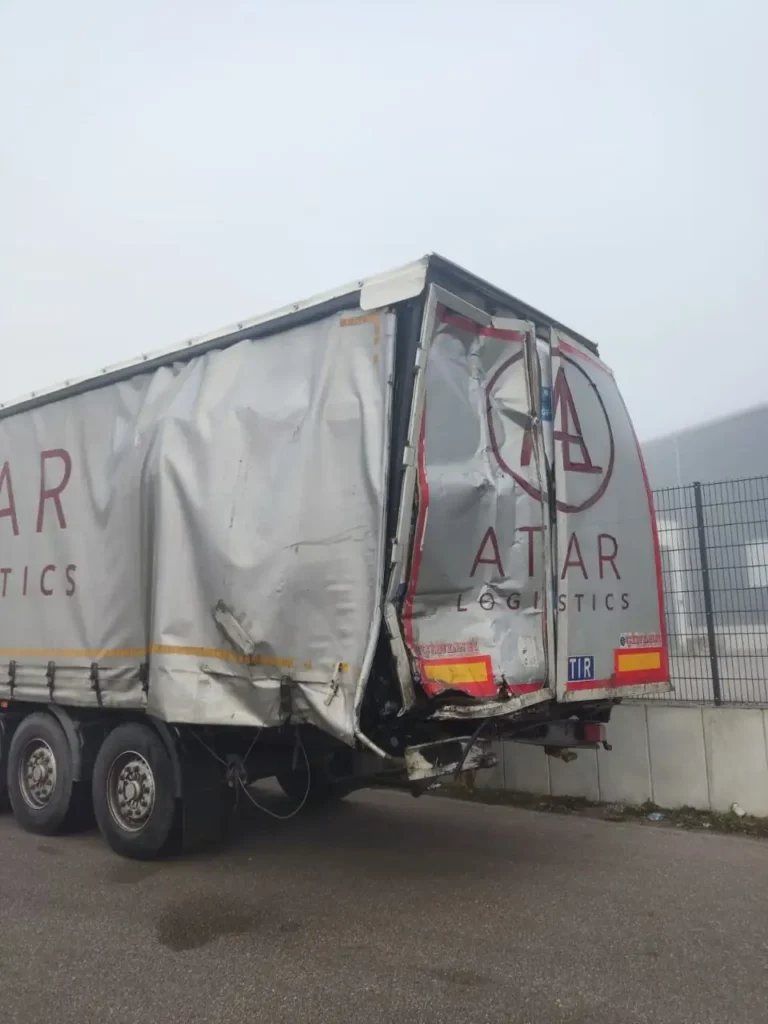
An articulated lorry carrying a full load of Geberit sanitaryware was involved in a collision on the A8 near Pforzheim, in thick fog on the northern edge of the Black Forest. The impact tore open the rear corner post and door frame of the curtainsider trailer, ripping the curtain and leaving part of the palletised load exposed. LKWHelp24 dispatched a mobile commercial-vehicle team, secured the load, temporarily repaired and lashed the damaged rear frame, and had the trailer back on the road within two hours and fifteen minutes of the first call.
Why an Exposed Load on a Damaged Trailer Is a Serious Road Hazard
A curtainsider trailer depends on its rear frame, corner posts and door structure to keep the load contained. When that structure is crushed or torn open in a collision, the curtain can no longer do its job, and palletised goods are held in place by little more than luck and friction. On a motorway travelling at speed, that is not a stable arrangement. A shifted pallet can fall through a gap in seconds, and a fifteen-hundred-kilogram load of sanitaryware landing on the carriageway behind a moving vehicle is a hazard to everyone on that stretch of road.
Fog makes the situation considerably worse. Visibility on the A8 near Pforzheim was reduced that morning, cutting reaction time for following traffic and making the damaged trailer harder to spot until vehicles were already close. A driver who accepts an unroadworthy trailer as \”probably fine for a few more kilometres\” is gambling with load securing, with other road users, and with their own liability if anything shifts or falls. This is precisely the situation load securing regulations and general road-traffic law are designed to prevent, and it is why organisations such as the ADAC consistently advise drivers to stop and call for professional accident assistance rather than continue on a compromised vehicle.
There is also the question of the goods themselves. Sanitaryware from a manufacturer such as Geberit (https://www.geberit.de/) is fragile, palletised, and expensive to replace if it breaks or is damaged in transit. A dropped standard pallet of ceramic basins or cisterns is not a minor loss for the shipper, and any damage in transit tends to trigger disputes over liability between carrier, insurer and consignee that can drag on for weeks. Getting the load secured properly, quickly, and without further movement was as important to the outcome of this case as making the trailer itself roadworthy again.
Every hour a fully loaded articulated lorry sits idle on a motorway hard shoulder is an hour of lost delivery time, a driver\’s schedule pushed back, and, in fog, an added risk simply from being a stationary obstacle. The faster a trailer can be assessed, its load stabilised, and its structure brought back to a roadworthy standard, the smaller all of those knock-on costs become. That is the entire logic behind calling a specialist accident and breakdown service rather than trying to patch a torn curtain with whatever happens to be in the cab.
![Unfallschaden am Heck eines Planenaufliegers (ATAR Logistics) – Ladungssicherung und Notsicherung durch LKWHelp24 auf der A8 bei Pforzheim.]
The Emergency
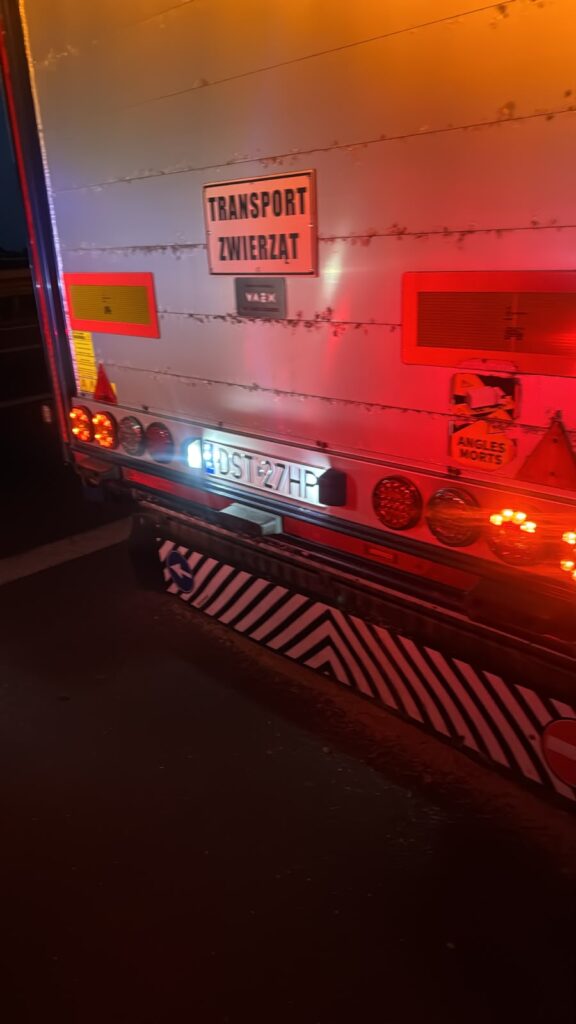
The driver of the ATAR Logistics articulated lorry called LKWHelp24 at 09:50. He explained that his trailer had been struck at the rear in an accident on the A8 near Pforzheim, that the impact had crushed and torn open part of the rear frame and door structure, and that the curtain was damaged with the load partly visible through the gap. The trailer was carrying palletised Geberit sanitaryware and was clearly no longer roadworthy in its current state. Fog was reducing visibility on the carriageway, and the driver had already pulled the vehicle as far onto the hard shoulder as the layout allowed.
This is exactly the kind of case that calls for accident assistance for HGVs rather than a standard mechanical breakdown callout: the priority is making the scene safe, checking the load has not shifted dangerously, and getting a damaged structure back into a condition where the vehicle can legally and safely continue.
How Help Was Organised
LKWHelp24 operates a nationwide partner network of workshops and mobile commercial-vehicle services, which means a suitably equipped team can usually be found close to the incident location rather than dispatched from far away. For this case, that meant:
● Locating a mobile commercial-vehicle service already active in the Pforzheim / northern Black Forest area, experienced in load securing and temporary structural repair
● Briefing the technician on the specific damage described by the driver (crushed rear corner post, torn curtain, partly exposed pallets) so the right tools and materials were loaded before departure
● Confirming the exact hard-shoulder position on the A8 and the reduced-visibility conditions, so the team could plan a safe approach in the fog
● Keeping the driver on the phone with clear instructions for making the immediate area safe until help arrived
● Dispatching the team at 10:05, fifteen minutes after the initial call
This is the core value of a 24 hour breakdown service built on local partners rather than a single central depot: the response time for mobile commercial vehicle assistance stays short even on a motorway a long way from any major hub. In this case, the fifteen minutes between the call and dispatch were used to make sure the right person, with the right equipment, was already on the way before any further time was lost trying to diagnose the problem over the phone.
The Situation On-Site
The technician arrived on the A8 at 10:50. The damage matched the driver\’s description and then some. The rear corner post and door frame of the curtainsider had been crushed and partially torn from the chassis in the collision, distorting the whole rear opening of the trailer. The curtain itself had been ripped along one side, and with the rear frame no longer holding its shape, several pallets of Geberit sanitaryware were visible and at risk of shifting further if the vehicle moved.
Fog was still limiting visibility along that stretch, so the first job, even before touching the trailer, was making the scene itself safe: warning triangles, hazard lighting and a clear view for approaching traffic, so nobody following behind would be caught out by a stationary vehicle appearing suddenly out of the fog. Only once the immediate area was secured did the technician turn to the trailer and its load.
Closer inspection showed the impact had struck the trailer at an angle, driving the corner post inward and twisting the door frame out of alignment with the chassis rail. That kind of asymmetric damage is deceptive: from a distance it can look like a simple dent, but it means the whole rear opening has lost its structural squareness, and any curtain or door fitted to it afterwards needs to be tensioned differently to compensate. Getting that judgement right on site, without the benefit of a workshop ramp or proper lighting, is exactly the kind of decision that separates an experienced mobile technician from a driver improvising with ratchet straps and hope.
Step-by-Step: How the Trailer Was Made Roadworthy Again
Step 1 – Secure the scene. Warning triangles, hazard lights and positioning were checked and adjusted for the fog before any work began, protecting both the crew and passing traffic.
Step 2 – Secure the load. The Geberit pallets nearest the damaged rear section were the immediate risk. The technician re-positioned and lashed them so nothing could shift or fall through the torn curtain or the crushed frame opening, using straps and edge protectors to prevent further movement or damage to the sanitaryware itself.
Step 3 – Temporarily repair the rear frame and curtain. With the load stable, work moved to the structure. The crushed corner post and door frame were pulled back into a workable shape and reinforced, and the torn curtain was patched and re-secured, closing off the gap that had exposed the load.
Step 4 – Lash and confirm roadworthiness. The repaired sections were lashed and load-checked to make sure the trailer would hold together and keep the load contained for the journey ahead, meeting the roadworthiness standard a body such as TÜV would expect to continue under its own power.
Step 5 – Handover and release. The driver was briefed on the temporary nature of the repair, told where the nearest suitable workshop or transhipment point was for a permanent fix, and the vehicle was released to continue.
By 11:10 the load was secured. By 11:50 the rear frame and curtain had been temporarily repaired. At 12:05 the trailer was confirmed roadworthy and handed back to the driver, who was released at the same time to carry on his journey.

Full Timeline
| Time | Phase | Action |
|---|---|---|
| 09:50 | Call | Driver reports accident damage to trailer rear, A8 near Pforzheim, fog, load exposed |
| 10:05 | Dispatched | Mobile commercial-vehicle team dispatched with ETA confirmed to the driver |
| 10:50 | On site | Team arrives on the A8, assesses damage and fog conditions |
| 11:10 | Load secured | Geberit pallets lashed and secured against shifting or falling |
| 11:50 | Rear frame and curtain secured | Rear corner post, door frame and curtain temporarily repaired |
| 12:05 | Roadworthy, handover | Trailer confirmed roadworthy, driver briefed, vehicle handed back |
| 12:05 | Released | Vehicle released to continue to nearest workshop or transhipment point |
Total time from call to release: approximately 2 hours 15 minutes. Time on site: approximately 1 hour 15 minutes.
Cost
| Item | Price (EUR) |
|---|---|
| Call-out / 24-7 service | 190 |
| Load securing (pallets) | 180 |
| Temporary rear/curtain securing | 260 |
| Materials (straps, edge protectors, curtain repair) | 150 |
| TOTAL | 780 |
Three factors shaped this price. First, the job required two distinct skill sets on site at once: load securing for the Geberit pallets and structural repair for the crushed rear frame, both handled by the same visit rather than two separate callouts. Second, materials mattered — straps, edge protectors and curtain-repair components are not optional extras on a job like this, they are what stops the temporary fix from failing on the way to the workshop. Third, the fog and motorway hard-shoulder location added a degree of complexity to making the scene safe before any technical work could start.
Set against the alternative, the figure looks modest. Without professional load securing and emergency trailer securing, the driver\’s choices were limited to waiting for a flatbed recovery and transhipment of the entire load, or risking a police-ordered vehicle stop for an unroadworthy trailer with exposed cargo. Either route would have meant far longer downtime, a transhipment bill for the sanitaryware pallets, and a real risk of damage to the Geberit goods during an improvised transfer. £780 to keep the vehicle moving, the load intact, and the road safe compares well with any of those outcomes.
Why a Professional Service Is Essential
Load securing after an accident is not a job for guesswork. German road-traffic law places clear responsibility on the driver and operator for ensuring cargo cannot shift or fall while the vehicle is in motion, and that responsibility does not pause just because the trailer has been in a collision. A driver who continues with a damaged rear frame and an untethered load is exposed to liability for anything that happens next, from a fallen pallet to a follow-on accident caused by debris on the carriageway.
A trained technician from our mobile truck service brings the right straps, edge protectors and repair materials, along with the judgement to assess whether a temporary fix is sufficient to reach a workshop safely or whether the vehicle genuinely needs to be recovered on a flatbed instead. That judgement call, made correctly, is what separates a trailer that reaches its destination from one that causes a second incident further down the A8.
There is a broader point here too. Insurers and consignees increasingly expect a documented, professional response to accident damage in transit, not an improvised fix carried out by the driver alone. A properly secured load and a competently repaired trailer, backed by a clear record of what was done and when, makes any subsequent insurance claim or delivery dispute far easier to resolve. Cutting corners at the roadside, even with the best of intentions, tends to create more problems than it solves once the paperwork starts.
Typical Breakdown & Accident Situations We Handle
LKWHelp24 supports commercial vehicles across Germany with a wide range of accident and breakdown situations, including:
- Accident damage to trailer rear frames, corner posts and door structures
- Torn or damaged curtains on curtainsider semi-trailers
- Load shifted or partly exposed after a collision
- Coupling and fifth-wheel faults following minor impacts
- Tyre blowouts and wheel damage on the motorway
- Recovery and transport for vans and light commercial vehicles
- Heavy haulage and low-loader breakdowns
Whatever the cause, the priorities are always the same: make the scene safe, secure the load, and restore roadworthiness or arrange recovery as quickly as possible.

Prevention Tips
- Check load-securing straps and edge protectors regularly, not only before departure but at rest stops on long journeys
- Inspect curtain fastenings and rear frame fittings during routine servicing, since minor wear can turn a small knock into major damage
- After any accident, however minor, stop and visually check the rear structure and curtain before continuing, rather than assuming everything is intact
- Keep hazard triangles and lighting easily accessible, particularly for journeys through regions prone to fog such as the northern Black Forest
- Know in advance who to call for accident assistance HGV support — the same principle that got a Scania steer-axle blowout near Bielefeld resolved quickly — so the response time from first call to dispatch stays as short as possible
Mobile Commercial Vehicle Assistance and Fleet Service
Cases like this one show why mobile curtain repair and emergency trailer securing capability matters as part of any serious breakdown A8 Pforzheim response network. A fleet operator running curtainsider trailers across Germany benefits from a partner who can handle load securing motorway incidents, rear damage semi-trailer repairs, and making a trailer roadworthy again, all from one dispatched visit. For fleet managers coordinating multiple vehicles, having a single point of contact for truck breakdown assistance and accident recovery across the country removes a significant amount of operational risk from every journey.
Why LKWHelp24
- Nationwide partner network able to reach accident and breakdown sites quickly, including motorway hard shoulders in reduced-visibility conditions
- Combined load-securing and structural-repair capability in a single callout
- Clear, itemised pricing agreed before work begins
- Round-the-clock dispatch, seven days a week, across all of Germany
- Direct handover briefing so drivers know exactly what was done and where to go next
Summary
- Vehicle: articulated lorry, curtainsider semi-trailer, ATAR Logistics, loaded with Geberit sanitaryware
- Damage: accident damage to rear corner post, door frame and curtain, load partly exposed
- Location: A8 near Pforzheim, Baden-Württemberg, in fog
- Total time: 2 hours 15 minutes from call to release
- On-site time: 1 hour 15 minutes
- Total cost: 780 EUR
- Outcome: load secured undamaged, trailer made roadworthy, driver released to continue
Request Emergency Assistance Now
Call +49 160 5753826, see our contact details, or visit lkwhelp24.com. Available 24/7 across all of Germany.
You might also be interested in:
– Truck Tyre Blowout on the A10 at Michendorf
– Truck Breakdown in Wismar: Car Transporter Coupling Fault
– Van Recovery on the A4 at Bautzen: Flatbed Transport
– Heavy Haulage Breakdown on the A7 at Göttingen: Low-Loader Recovery