Skip to content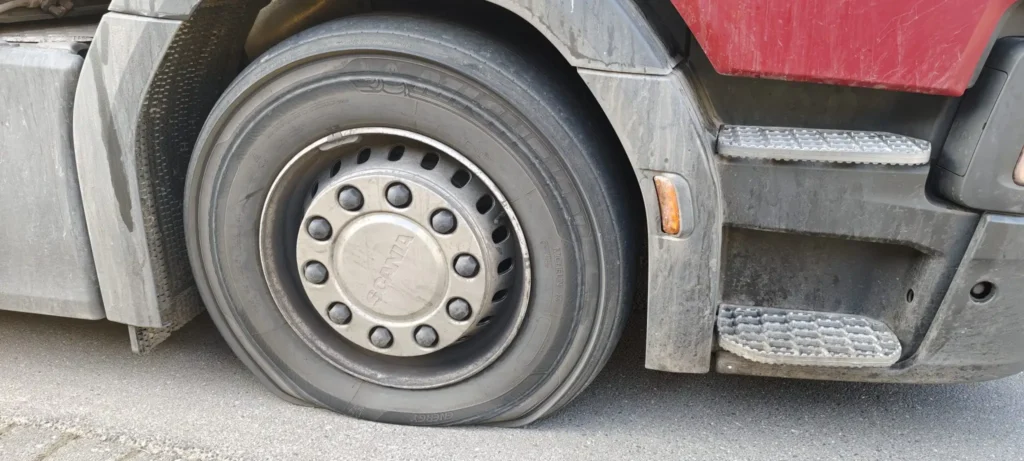
A tyre blowout on a lorry is never a minor inconvenience. When it happens on the steer axle, it stops being an inconvenience and becomes a genuine safety emergency. The front tyres carry the load that keeps a forty-tonne combination pointed in the right direction, and losing one at speed, at night, on the A2, is about as bad as roadside trouble gets for a professional driver.
That\’s exactly what happened to a Polish long-haul driver working for AUTO-BOGMAR Sp. z o.o. His Scania tractor unit, running international freight through Germany, suffered a sudden pressure loss on the front-left steer tyre near Bielefeld, in the East Westphalia-Lippe region of North Rhine-Westphalia. No warning, no slow leak building over days. Just a bang, a pull on the wheel, and a driver fighting to keep 40 tonnes in a straight line on a dark motorway.
This case study walks through exactly what happened, how LKWHelp24\’s partner network responded, and why steer-axle failures demand a completely different level of urgency than a blown tyre on a trailer axle. We\’ll cover the timeline minute by minute, the actual costs involved, and what any driver or fleet manager should take away from an incident like this.
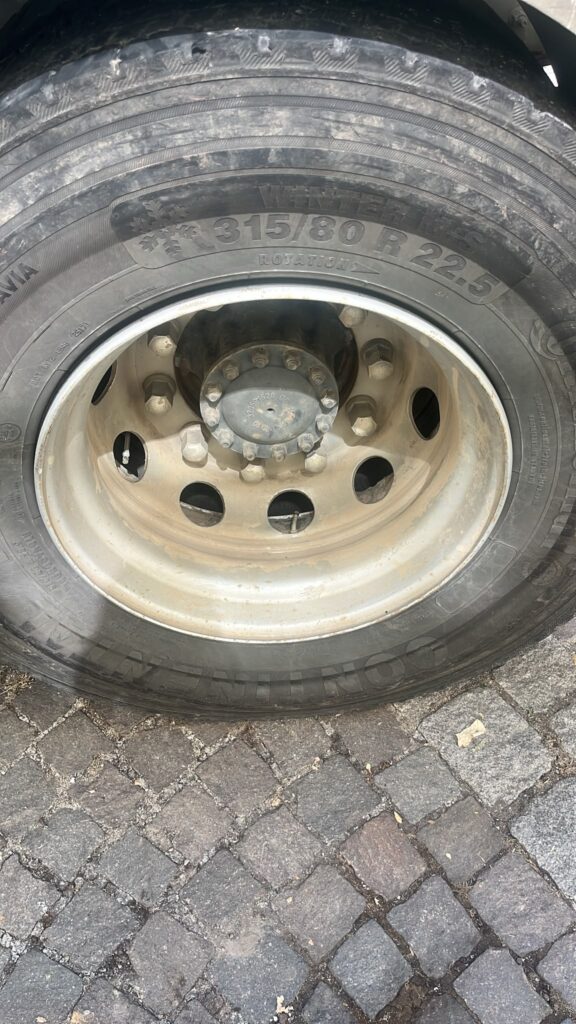
Photo caption (German): „LKW Reifenservice bei Reifenplatzer an der Lenkachse eines Scania auf der A2 bei Bielefeld – mobiler Reifenwechsel durch LKWHelp24.\”
The Emergency
It was 21:10 when the call came through to LKWHelp24\’s dispatch line. The driver\’s voice had that particular edge you learn to recognise after enough of these calls, the mix of adrenaline and controlled panic that comes from having just wrestled a heavy vehicle to a stop after a front tyre let go without warning.
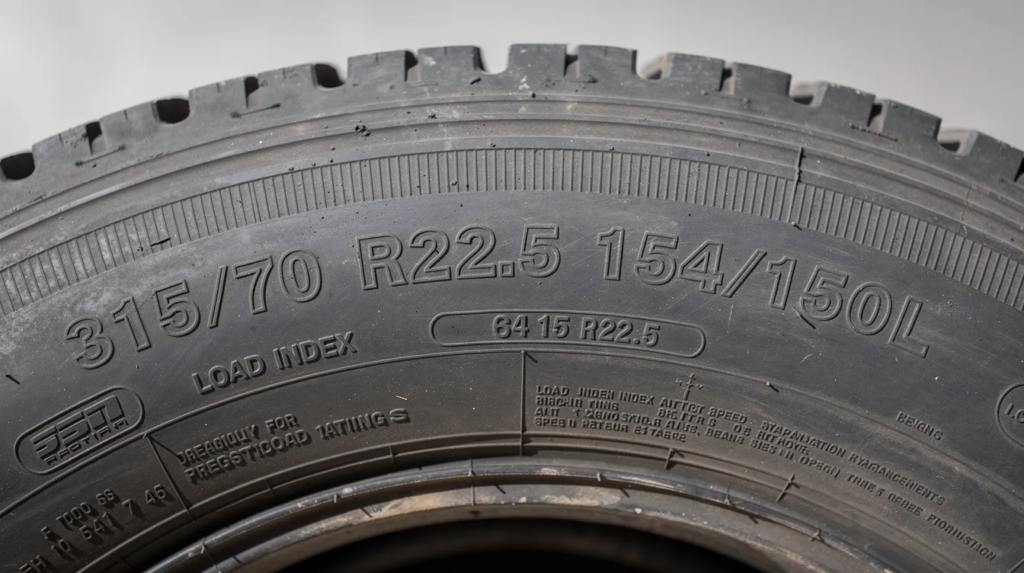
He\’d managed to bring the Scania to a safe halt on the hard shoulder of the A2, one of Germany\’s busiest east-west arteries, carrying freight traffic through the night in both directions. The steer-axle tyre, a Michelin X Multi Energy Z in 385/55 R22.5 with a 158 L load rating, had suffered a sudden loss of pressure. There was no slow deflation to warn him. It went from fully inflated to flat in the time it takes to blink, and on a steer axle that means an immediate and violent change in how the vehicle handles.
For a driver hauling international freight for a Polish haulage company, stranded on a foreign motorway at night with a wrecked front tyre, the priorities are simple: get the vehicle stopped safely, get help moving, and don\’t attempt anything heroic with a steer-axle wheel in the dark on the hard shoulder of a motorway.
How Help Was Organised
LKWHelp24 operates a nationwide partner network built specifically for this kind of call. Once the driver\’s location and the nature of the fault were confirmed, dispatch didn\’t waste time searching for options. The nearest available mobile commercial-vehicle tyre service covering the Bielefeld/OWL area was already known, already vetted, and already reachable at that hour.
The dispatch sequence looked like this:
● Driver\’s call logged, vehicle secured on the hard shoulder, hazard lights and warning triangle confirmed
● Location pinned precisely on the A2 near Bielefeld
● Nearest certified mobile tyre partner for the region contacted directly
● Tyre specification confirmed in advance (385/55 R22.5, steer axle, Michelin preferred) so the technician could load the correct replacement before leaving base
● ETA communicated back to the driver so he knew exactly how long he\’d be waiting
By 21:25, the partner technician was on the road, van loaded with the right tyre for a steer-axle job on a Scania. This is the part of the process that most drivers never see, but it\’s the difference between a technician arriving with the wrong equipment and having to drive back, and a technician arriving ready to work.

The Situation On-Site
The technician reached the vehicle at 22:20. Fifty-five minutes from the initial call to boots on the tarmac, on a motorway, at night, is a solid response time, and it reflects the value of dispatching a partner who already knows the OWL region rather than sending someone from further afield.
The damage was consistent with a sudden blowout rather than a slow puncture: a sharp pressure loss with no gradual warning. On inspection, the rim itself was intact, no secondary damage to the wheel, hub, or surrounding bodywork. That\’s a relatively fortunate outcome for a steer-axle failure at speed, where the forces involved can sometimes bend a rim or damage the hub assembly.
The tyre in question, a Michelin X Multi Energy Z 385/55 R22.5 with a 158 L load index and a maximum pressure rating of 130 PSI, is a standard fitment for long-haul steer axles, chosen for fuel efficiency and mileage on international routes. Getting the pressure and torque exactly right on replacement matters more here than almost anywhere else on the vehicle, because the steer axle is what keeps the driver in control.
Step-by-Step
Step 1: Secure the vehicle. Before any tool touched the wheel, the technician confirmed the Scania was properly secured on the hard shoulder, hazards on, warning triangle placed, and the area checked for passing traffic risk. On a motorway at night, this step isn\’t optional paperwork. It\’s what keeps the technician and the driver alive while the work happens.
Step 2: Jack and support the steer axle. The front axle was lifted and properly supported using the correct jacking points for a Scania tractor unit. Steer axles carry different weight distribution to drive or trailer axles, and using the wrong lift point risks damage to the axle housing or steering components.
Step 3: Remove the damaged wheel. The blown Michelin was removed and inspected alongside the rim. As noted, the rim showed no cracking, bending, or bead-seat damage, meaning the wheel itself could be reused with the new tyre.
Step 4: Fit the new Michelin X Multi Energy Z 385/55 R22.5. The replacement tyre, matching the original specification exactly, was mounted and seated on the rim.
Step 5: Torque, pressure, and final check. The wheel nuts were torqued in a star pattern, alternating across the hub rather than working round in sequence, to roughly 600–650 Nm. This crosswise pattern is essential on a steer axle: tightening nuts in the wrong order can seat the wheel unevenly, leading to vibration or, worse, a nut working loose at speed. Pressure was then set to the correct running figure, a full visual check carried out on the tyre, valve, and surrounding wheel arch, and the vehicle released back onto the road.
Full Timeline
| Time | Phase | Action |
|---|---|---|
| 21:10 | Call received | Driver reports steer-axle blowout on A2 near Bielefeld |
| 21:25 | Partner dispatched | Mobile tyre technician despatched with correct Michelin 385/55 R22.5 loaded, ETA given |
| 22:20 | On site | Technician arrives, assesses vehicle and rim condition |
| 22:35 | Wheel removed | Damaged tyre and wheel taken off steer axle |
| 23:00 | New tyre fitted | Michelin X Multi Energy Z 385/55 R22.5 mounted |
| 23:05 | Torque + pressure check | Wheel nuts torqued crosswise to ~600–650 Nm, pressure set, visual check |
| 23:05 | Released | Vehicle cleared to continue its journey |
Total time from call to release: approximately 1 hour 55 minutes. Time spent actually working on the vehicle at the roadside: around 45 minutes.

Cost
| Item | Price (EUR) |
|---|---|
| Call-out / 24-7 night service | 220 |
| Labour / on-site fitting | 260 |
| New Michelin X Multi Energy Z 385/55 R22.5 158L tyre | 720 |
| Old-tyre disposal + valve | 40 |
| Sundries / balancing | 110 |
| TOTAL | 1350 |
A few things drive the price on a job like this. The night-time and weekend surcharge built into the call-out fee reflects the reality of running a 24/7 mobile network, technicians on standby past 21:00 on a Friday night cost more to have available than a daytime slot booked a week in advance. The tyre itself is the largest single line item: a premium 385/55 R22.5 steer-axle tyre from a brand like Michelin, built for the specific demands of a loaded front axle on long-haul routes, isn\’t a budget item, and it shouldn\’t be treated as one given what\’s riding on it. Disposal, balancing, and valve replacement are small individual costs but they add up, and skipping them isn\’t a real saving, it\’s a false economy that shows up later as vibration or an unbalanced wheel.
Compare that 1,350 euros against the alternative: a driver attempting a roadside change alone, on a motorway hard shoulder, at night, on a wheel that weighs the best part of 90 kilograms and sits under a load-bearing axle he has no proper equipment to support safely. Even setting aside the obvious injury risk, an improperly torqued or incorrectly seated steer-axle wheel can lead to far greater costs down the line: a wheel coming loose at speed, a blown replacement tyre because the pressure wasn\’t checked properly, or a written-off vehicle and cargo if things go seriously wrong. Against that, 1,350 euros for a professional, torque-verified repair inside two hours looks like exactly what it is: cheap insurance.
This particular job also benefited from a piece of good fortune that isn\’t always present: the rim came through undamaged. A steer-axle blowout at motorway speed puts enormous stress through the wheel in the split second the tyre fails, and it\’s common for the rim to pick up bead damage, cracking, or distortion in the process. Had that happened here, the job would have taken longer and cost more, since a damaged rim has to be replaced rather than reused, and sourcing a matching Scania steer-axle rim at short notice overnight is a different proposition entirely to sourcing a tyre. The technician\’s inspection at Step 3 exists precisely to catch that kind of hidden damage before a new tyre goes anywhere near a compromised wheel.
Why a Professional Service Is Essential
Steer-axle work isn\’t a job for a driver with a bottle jack and a torque wrench borrowed from the cab toolkit, and it\’s worth being blunt about why. The steer axle is the one part of the vehicle that determines whether the driver has any control at all. Get the torque wrong, whether too loose or unevenly applied, and the wheel can work loose within a few kilometres. Get the tyre pressure wrong and the handling characteristics change in ways that aren\’t obvious until the driver is already in a manoeuvre they can\’t safely complete.
There\’s also the practical matter of jacking a heavy tractor unit safely on a motorway hard shoulder at night, in traffic, without the right lifting points, stands, and lighting. It\’s not something to attempt without the right training and equipment, full stop. A mobile HGV tyre technician carries jacks rated for the vehicle, knows the correct lift points for a Scania steer axle specifically, and has the torque equipment calibrated to hit 600–650 Nm accurately, not by feel.

Typical Breakdown Situations We Handle
LKWHelp24\’s partner network deals with this type of call regularly across Germany, and the pattern of what goes wrong on the motorway is fairly consistent:
- Steer-axle and drive-axle tyre blowouts on motorways and autobahns
- Sudden pressure loss from road debris, kerb strikes, or tyre ageing
- Night-time and weekend breakdowns where standard tyre depots are closed
- International hauliers needing rapid support in an unfamiliar region
- Fleet vehicles requiring matched tyre brands and specifications for consistency across the fleet
- Rim or wheel damage assessment following a blowout, to confirm whether the wheel itself is safe to reuse
- Cross-border hauliers on international routes through Germany who need a provider that can communicate clearly in their own language at short notice
- Fleet call-outs where multiple axle positions need checking after one tyre has already failed, since a single blowout is sometimes a symptom of a wider pressure or alignment problem across the fleet
Prevention Tips
Steer-axle tyres take a disproportionate share of load and stress compared with other positions on the vehicle, and a few habits reduce the risk of a repeat incident considerably. Check tyre pressure regularly, ideally before every long trip, since steer-axle tyres run closer to their pressure limits than trailer tyres and are less forgiving of under-inflation. Watch for uneven wear patterns, which often signal alignment or suspension issues rather than a tyre defect, and get them checked before they cause a failure rather than after. Replace tyres proactively as they approach the end of their safe tread life rather than pushing for one more trip. And choose steer-axle tyres from established manufacturers, Michelin, Continental, and Goodyear all produce dedicated long-haul steer-axle patterns designed specifically for the load and heat demands of the front axle position, rather than fitting a generic tyre that isn\’t rated for the job.
For fleet operators running multiple vehicles across Germany and internationally, standardising on a known steer-axle tyre brand and keeping a record of fitment dates and torque specifications across the fleet makes it considerably easier to diagnose a fault quickly when a driver calls in from the road at night. It also means your emergency provider, whoever that is, already knows what to load onto the van before they even leave base.
Why LKWHelp24
A blowout on the steer axle at 21:10 on a Friday night could easily have turned into a stranded vehicle sitting on the hard shoulder until morning, or worse. Instead, the driver was back on the road by 23:05, less than two hours after making the call. That kind of turnaround isn\’t luck. It\’s the result of a genuinely nationwide network of certified commercial-vehicle tyre partners, available around the clock, every day of the year, with dispatch teams who know which partner to call in every region of Germany without having to search.
LKWHelp24 works with drivers and fleets from Poland, Germany, and right across Europe, and the dispatch team operates multilingually, because a driver stranded on a foreign motorway at night shouldn\’t have to fight a language barrier on top of everything else. Every job comes with a transparent cost breakdown before work begins, no surprise call-out charges, no vague \”we\’ll sort it out and tell you later\” pricing. Just a clear quote, a certified technician, and a vehicle back on the road as fast as it can safely be done.

Summary
- Tyre: Michelin X Multi Energy Z 385/55 R22.5, load index 158 L, max 130 PSI, steer axle
- Location: A2 near Bielefeld, East Westphalia (NRW)
- Response time: 55 minutes from call to on-site arrival
- Total time: 1 hour 55 minutes, call to release
- On-site work: approximately 45 minutes
- Total cost: 1,350 EUR
- Secondary damage: none, rim intact
Request Emergency Assistance Now
If you\’re stranded with a blown tyre anywhere on Germany\’s motorway network, day or night, call LKWHelp24 on +49 160 5753826 or visit lkwhelp24.com. Available 24/7 across all of Germany.
For steer-axle tyres built for long-haul demands, see Michelin Truck, and for Scania vehicle specifications relevant to this case, see Scania Germany.
You might also be interested in:
– Scania 385/55 Tyre Replacement on the A6 near Mannheim
– Scania Tyre Blowout on the A4 near Dresden
– Steer-Axle Blowout on the A5 near Baden-Baden
– Steer-Axle Blowout on the A14 near Leipzig