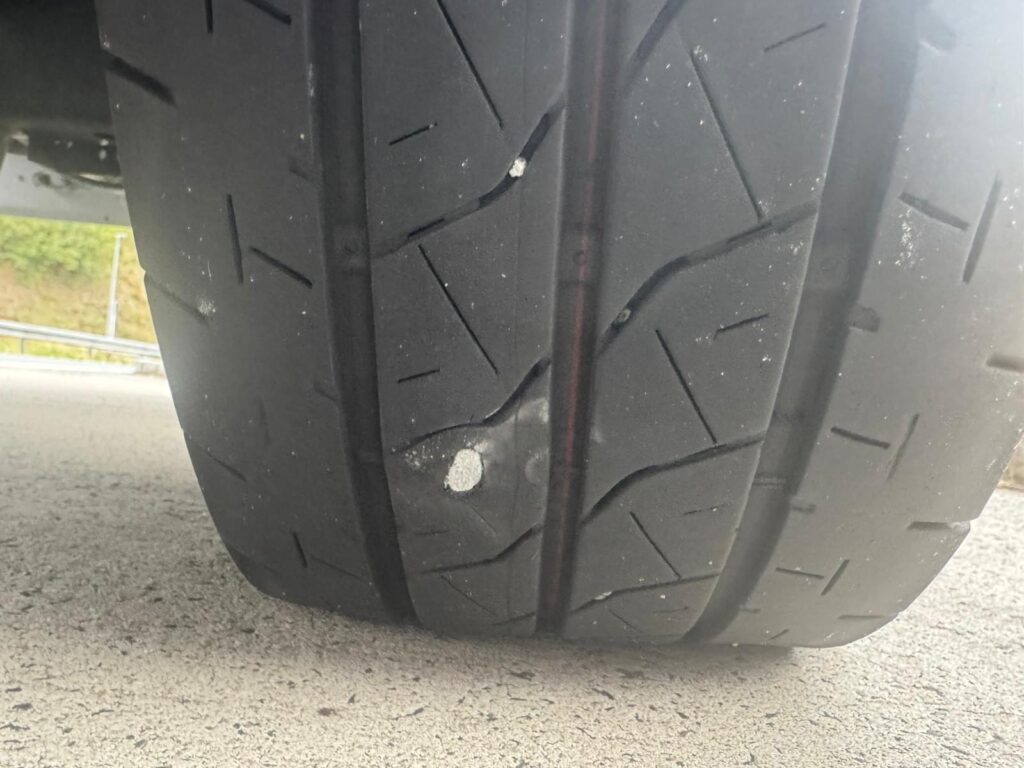
A car transporter trailer with a torn sidewall was stranded at a lay-by on the A5 near Alsfeld in Hesse, heading towards Kassel. Our truck tyre service took the call at 13:35, the fitting crew arrived 67 minutes later, and the rig left at 15:50. Total time from call to departure: 135 minutes. Total cost: €905 net, including call-out, labour, a new 385/65 R22.5 tyre and disposal of the old one.
A tyre that has split at the bead is not a nuisance you can drive away from. The sidewall carries the load of the whole axle, and once it has opened up near the rim, the casing no longer holds air or weight reliably. Anyone who has watched a damaged lorry tyre let go at motorway speed knows how quickly a “limp to the next services” plan can turn into a wrecked wheel arch, a damaged air line or worse.
This write-up walks through the job as it happened: what the driver saw, how our dispatch desk organised the callout, what the crew did on the spot, what it cost and why. If you run a fleet, drive a trailer yourself or dispatch for a haulier, you will find the numbers and the reasoning here useful the next time a truck tyre breakdown catches you between two junctions.
The emergency: torn sidewall on a car transporter trailer
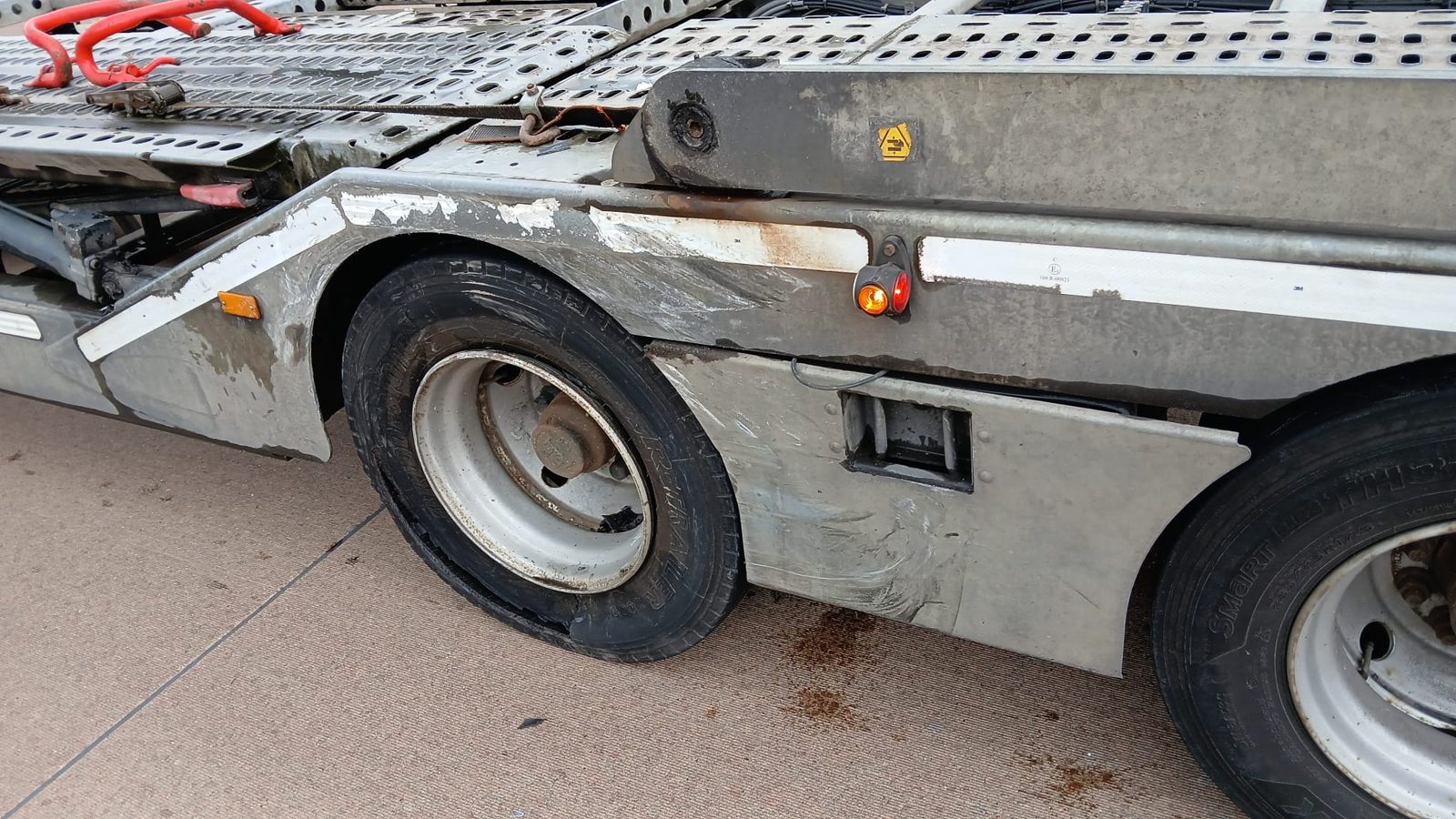
The vehicle was a car transporter trailer, the kind with open grid loading decks, red ratchet straps and a galvanised mudguard that has seen plenty of scuffs. The driver had pulled into a car park beside the A5 after feeling the trailer pull and hearing a flapping noise from the rear axle area. When he got out, the picture was clear: the sidewall of one tyre had split in the bead area, right where the rubber meets the rim flange, and the tyre was sitting down on the rim. There were dark rubber marks on the concrete beside the wheel.
The weather was dry and overcast, so at least nobody had to work in the rain. The driver did the right thing: he stopped as soon as he noticed the problem, did not drive on the damaged tyre, put on his hazard lights and called us. That decision probably saved the rim and the mudguard.
The tyre size was not legible in the photo, so for this job we worked with the size typical for a trailer axle of this class: 385/65 R22.5. The estimate below uses this size. If you want to know what the numbers on a tyre mean, our guide to 385/65 R22.5 truck tyres explains size, load index and typical use.
What a bead-area failure means in practice
Bead area (Wulstbereich) – the reinforced edge of the tyre that seats on the rim flange and keeps the tyre airtight. Damage here is rarely repairable.
A puncture in the tread can sometimes be repaired, if it is small and the casing is intact. A split sidewall near the bead is a different category. The steel and textile cords in the casing carry the load there, and no patch or plug restores that strength. In our experience, a torn flank means replacement, every time. That is why this call was a truck tyre replacement, not a repair, and why we asked for the load index and the position of the wheel before sending anyone out.
How we organised help: dispatch, tyre selection, crew
The call came in at 13:35. The driver described a destroyed sidewall on one axle of the trailer, said the rig was parked safely, and gave us his location on the A5. Our dispatcher asked five things: which axle, whether the tyre was single or twin-fitted, the tyre size and load index if he could read them, whether the wheel was still turning freely, and exactly where the vehicle was standing.
By 13:48, thirteen minutes after the call, the job was dispatched. In practice, those thirteen minutes cover a lot of small steps:
- Confirming the location and whether the car park was safe for work.
- Checking the axle configuration, because a car transporter trailer is often built with lighter axles than a standard curtainsider.
- Selecting a crew from our partner network that was close enough to reach the A5 within the hour.
- Telling the partner which tyre to prepare and asking for the load index and DOT date to be checked before loading.
- Giving the driver an arrival estimate and a short list of things to do while waiting.
The driver was told to keep clear of the wheel, to place a warning triangle if the car park allowed it, to leave the straps and the load alone, and to stay in the cab or behind the barrier. That sounds obvious. On a busy day, however, a driver who is worried about a delivery slot will sometimes start loosening wheel nuts himself, and that is where injuries happen.
Choosing the right replacement tyre
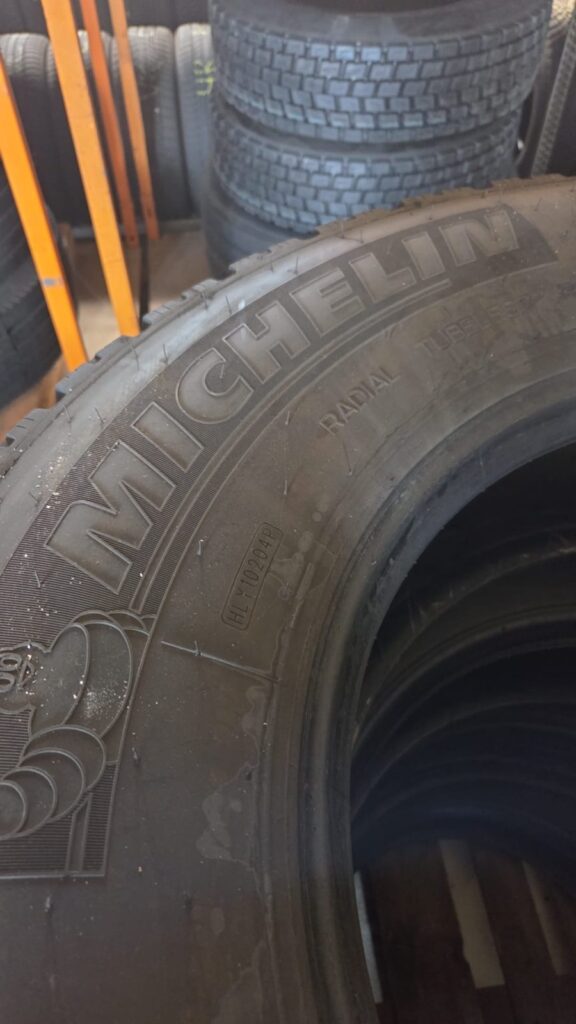
Between 14:11 and 14:30, the crew chose the tyre at the warehouse of our service partner. The warehouse holds a mix of new tyres and used ones with good tread, as you can see in the second photo of the job. For a trailer axle that carries the load of a fully loaded car transporter, we only fitted a new tyre. Used casings have their place, but not on a loaded transporter at motorway speed.
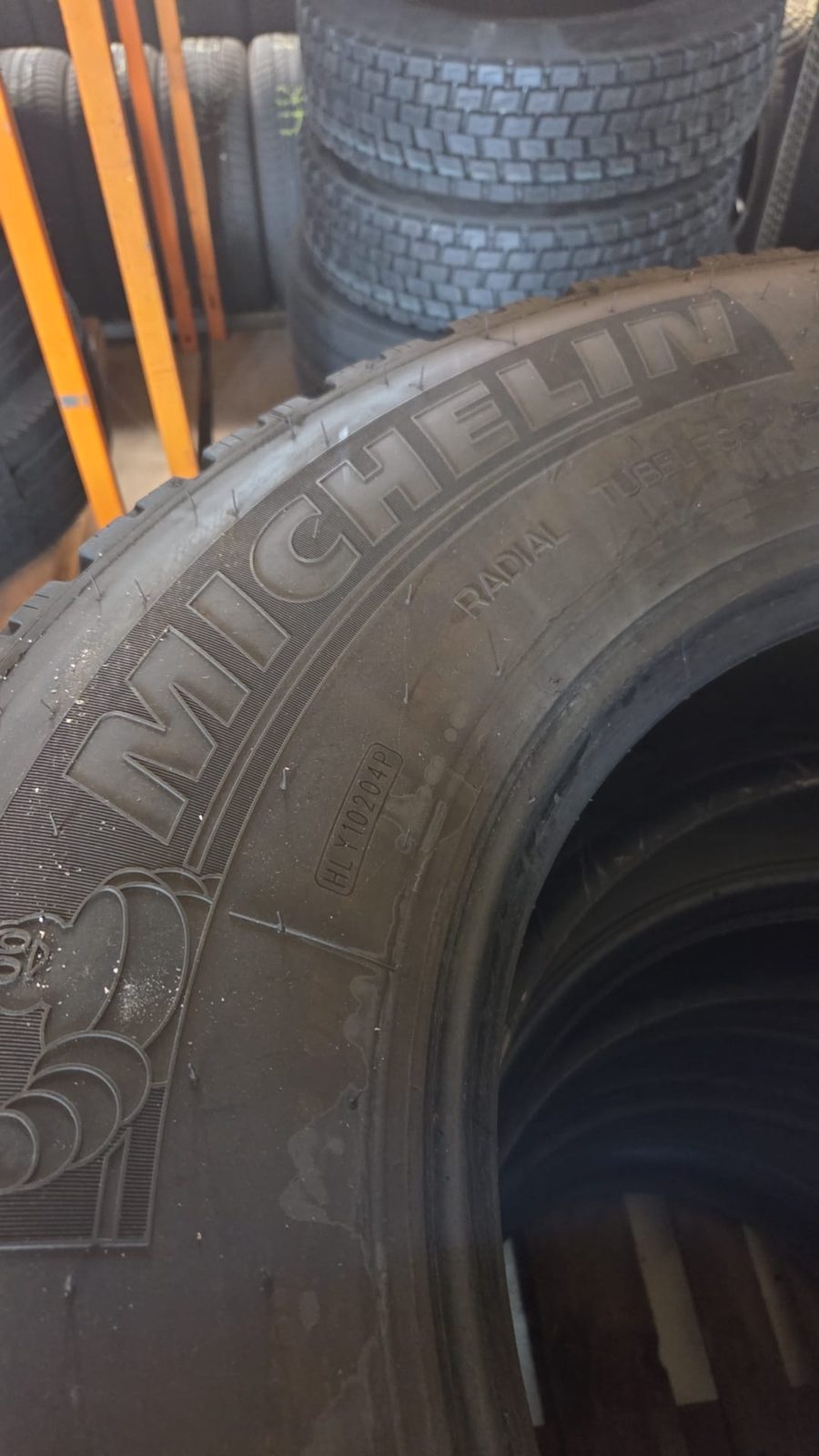
The crew checked three things before loading the tyre: the DOT code (manufacturing week and year, so the rubber is not sitting in a warehouse for years), the load index (it must at least match what is on the vehicle registration) and the speed rating. The replacement was a new Michelin 385/65 R22.5 with the manufacturer’s markings on the flank, bought for the job and mounted the same afternoon. If you are curious about how those codes are read, we have a separate article on reading truck tyre markings.
Matching the tyre to the rest of the axle matters. On a single-wheel trailer position there is less to worry about than with twin tyres, where mixed diameters make one tyre carry more than its share. Here the wheel was a single fitment, so the main concern was the correct load index and the absence of any damage to the rim.
On site: why you cannot just drive on
A split sidewall at the bead leaves the tyre unable to hold the working pressure. Truck tyres are typically inflated to around 8.5 to 9.5 bar, roughly nine times the pressure in a car tyre. At that pressure, any weakness in the casing is a risk, and a tyre on the edge of failing can release its air violently. Compressed air in a 22.5-inch tyre stores a surprising amount of energy.
The reasons not to move the trailer, even a few hundred metres, are practical:
- The rim. A deflated tyre lets the rim run on the damaged rubber and the road surface. A steel rim can be bent, and an aluminium one can crack. A new tyre on a damaged rim is no solution.
- The axle load. The load is then shifted onto the other tyres on the axle or the neighbouring axle, which are not designed for it, particularly on a loaded car transporter.
- The brake and air lines. Shreds of rubber can wrap around the hub and tear the ABS cable or the brake line.
- The fine. Under § 36 StVZO, tyres must be suitable for the vehicle and in a safe condition. A trailer running on a torn tyre will not pass a roadside inspection.
For all these reasons, the right decision is the one the driver made: stop, secure the vehicle, call a specialist. Our truck tyre roadside assistance exists for exactly this moment, and it works anywhere in Germany, day or night.
Step by step: how the tyre was changed
The crew arrived at 14:42, 67 minutes after the call. The tyre change then followed the sequence we use for any mobile truck tyre service job on a trailer.
Step 1: Inspection and securing the work area (14:42-14:52)
The first ten minutes are not spent on the tyre at all. The technician walked around the trailer, checked the damaged wheel and the neighbouring tyres, and looked for oil, air leaks and damage to the brake chamber. He set up a warning triangle, put wheel chocks under the other axle’s wheels, and placed an axle stand under the trailer so that the load never rested on the jack alone. With a car transporter, the load changes with the position of the decks, so the crew checked that the trailer was level and stable before lifting anything.
Step 2: Removing the wheel and tyre (14:52-15:20)
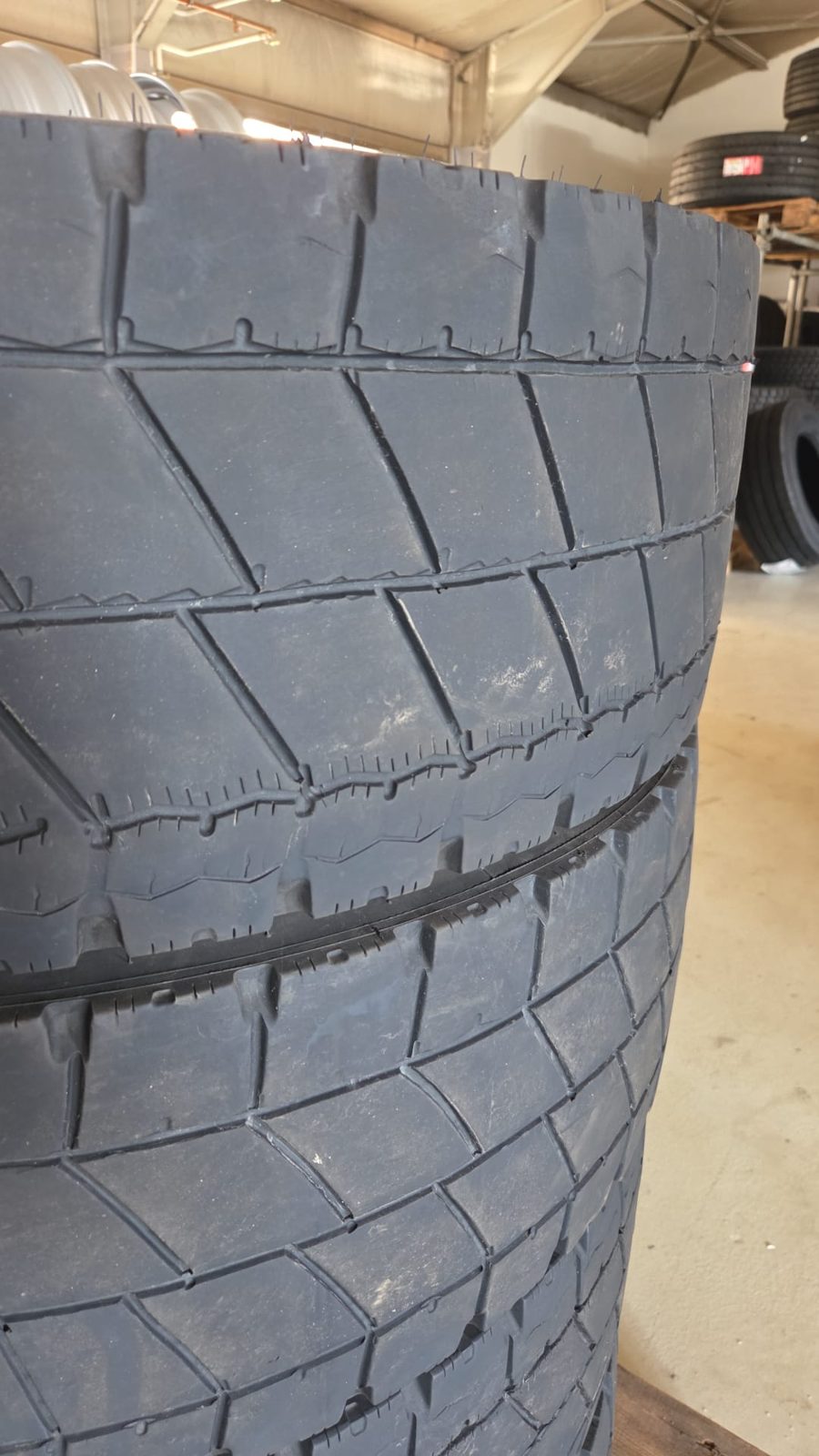
Next the crew loosened the wheel nuts, lifted the axle, and took off the wheel. At the wheel, they separated the ruined tyre from the rim. This took about 28 minutes in total, including a careful look at the rim and the bead seat. Technicians look for bends in the rim flange, cracks around the valve hole, rust that has crept under the bead and any damage to the retaining ring on multi-piece rims. In this case the rim was usable. If the rim had been bent, the job would have become more expensive, because a replacement rim adds cost and a new quote.
Step 3: Fitting the new tyre (15:20-15:42)
The new tyre was mounted on the cleaned rim, seated and inflated to the pressure specified by the tyre and axle manufacturer. Technicians work with a safety cage or a restraint for inflation because a bead that seats badly can launch with force. Balancing was done where the setup allowed it. On a trailer axle at lower speeds, balance is less critical than on a steering axle, but a well-balanced wheel still extends the life of the tyre and the wheel bearing. This step took 22 minutes.
Step 4: Refitting the wheel and torquing the nuts (15:42-15:50)
The wheel went back onto the hub, and the nuts were tightened in a star (cross) pattern with a calibrated torque wrench to the value specified for the axle. Skipping the star pattern leads to uneven seating, and an under-tightened wheel can work loose within a few hundred kilometres. We have published a full wheel nut torque table for trucks with typical values and the correct procedure.
Step 5: Final check and handover (15:50)
The crew checked the tyre pressure once more, looked at the valve and cap, and walked the driver around the trailer. They advised him to re-check the wheel nuts after the first 50 to 100 kilometres. At 15:50 the car transporter pulled out of the car park and continued its route. The whole job took 135 minutes from the first call.
Complete timeline of the callout
The following table shows the real times of the job on the A5 near Alsfeld.
| Time | Phase | Action |
|---|---|---|
| 13:35 | Call | The driver reports a destroyed sidewall on an axle of the car transporter trailer; the rig is parked at a lay-by next to the motorway |
| 13:48 | Dispatch | Size, load and location confirmed; crew from the partner network assigned |
| 14:11-14:30 | Tyre selection | A suitable tyre is chosen at the partner’s warehouse, DOT code and load index checked, tyre loaded |
| 14:30-14:42 | Journey to site | Crew on the road; arrival 67 minutes after the call |
| 14:42-14:52 | Inspection and safety | Damage assessed, warning triangle, wheel chocks and axle stand set up |
| 14:52-15:20 | Removal | Wheel and tyre removed; rim and bead seat checked for deformation |
| 15:20-15:42 | Fitting | New tyre mounted and seated, inflated to the manufacturer’s pressure, balanced where possible |
| 15:42-15:50 | Final check | Nuts tightened in a star pattern with a torque wrench, pressure re-checked, vehicle handed back to the driver |
| 15:50 | Result | The car transporter drives off. Total: 135 minutes |
Two things stand out in this timeline. First, the largest block is not the wheel work but the 31 minutes it took to select a tyre and get the crew on the road. That is the part that depends on the quality of the partner network: the closer the warehouse and the crew, the shorter the wait. Second, the actual fitting of the new tyre took 22 minutes, which shows how fast a well-equipped crew can work when everything is in the van.
In worse conditions the times grow. Rain, darkness, a busy Friday afternoon or a roadside position on a narrow hard shoulder can add 30 minutes or more. We tell drivers this honestly on the phone, because a realistic estimate is more useful than an optimistic one.
What does a truck tyre change on the motorway cost?
For this job, the invoice came to €905 net. The table shows every position.
| Item | Price (EUR, net) |
|---|---|
| Call-out (Anfahrt) | 240 |
| Labour, 1.5 h at €110 per hour | 165 |
| Tyre 385/65 R22.5 (trailer), new | 480 |
| Disposal of the old tyre | 20 |
| TOTAL | 905 |
All amounts are net, plus VAT (zzgl. MwSt.). The call-out charge covers the journey of the crew and the vehicle, including the tools and the lifting equipment. Labour covers the removal, fitting, inflation, torquing and the final checks. The tyre price is for a new tyre of a premium brand, and the disposal fee covers the legal recycling of the old casing.
What changes the price
Time of day. Nights, Sundays and public holidays carry a surcharge of 25 to 50 per cent on the call-out and labour. This job took place on a weekday afternoon, so no surcharge applied.
Distance. A remote location in Brandenburg or the Bavarian Forest costs more than a stretch of the A5 where several partners are within reach.
Tyre size and brand. A trailer tyre in 385/65 R22.5 usually costs between €420 and €540. A drive-axle tyre in 315/80 R22.5 is dearer, and a van tyre like 235/65 R16C is much cheaper. If you want to see how prices compare across sizes, read our overview of truck tyre change cost.
Damage to the rim. If the rim turns out to be bent or cracked, the replacement adds to the bill. We tell the driver this as soon as we see it.
Extra work. Replacing a valve, fitting a second tyre on the same axle or balancing a full set takes extra time and is invoiced by the hour.
Compared with a standstill
A car transporter that stands still does not earn money. Depending on the contract, the idle time of a rig like this is worth €800 to €1,200 per day, before you count missed delivery slots, late fees and the knock-on effect on the driver’s working time. A job that returns the rig to the road within about two hours is cheaper than a night in the car park, and it costs less than a recovery truck, which for a heavy transporter would add €850 to €1,600 depending on distance.
Why you need a professional for a truck tyre change
Some drivers carry the tools and have changed a wheel many times. Even so, a wheel on a 40-tonne combination is not a job for the side of the road with a bottle jack.
- Weight. A fitted 22.5-inch wheel weighs around 70 to 90 kg. Lifting it without equipment is a back injury waiting to happen.
- Pressure. Inflating a truck tyre to 9 bar without a restraint is dangerous. A badly seated bead can explode and injure anyone close to it.
- Torque. Wheel nuts need the exact torque, applied in the right sequence. A cheap wrench or “by feel” tightening leads to loosened wheels.
- Liability. A wheel that comes off on the autobahn endangers other road users and can void your insurance cover.
- Hidden damage. A trained technician sees a cracked rim, a damaged valve or a worn bearing that the driver would not notice.
- Time. Many drivers have no suitable jack for a loaded trailer. Waiting for the right equipment takes longer than calling a specialist at the start.
Our crews work with calibrated torque wrenches, safety cages for inflation, hydraulic jacks and axle stands. That is also why we say clearly: if you are in doubt, do not touch the wheel. Call us.
Typical situations where we are called out in Germany
The A5 job is one of many. Typical callouts for our truck tyre service in Germany include:
- a truck tyre burst on the drive axle of a tractor unit, often at night or in heavy traffic;
- a trailer flat tyre discovered at a rest stop during the mandatory break;
- a slow puncture from a nail or screw that the driver notices on the pre-trip check;
- sidewall damage from kerbs, potholes or a hard impact at a loading yard;
- tyre damage after gravel or stones at a rest area, a case we describe in this report from the A31;
- rim damage on car transporters, such as the job on the A31 near Dorsten;
- the seasonal wheel change on a distribution truck at the customer’s yard;
- a spare-wheel swap when the driver has a usable wheel but not the tools or the strength to fit it.
Each of these needs a slightly different approach, but the basic principle is the same: quick triage on the phone, the right tyre in the van, a crew that knows the axle type.
Prevention: how fleets avoid roadside tyre problems
Not every failure can be avoided, but many can. The most common advice we give to drivers and fleet managers is quite basic.
- Check the pressure monthly, and always when cold. Even a loss of 1 bar raises heat build-up and damages the casing. Our guide to truck tyre pressure lists correct values and how to measure them.
- Walk around the vehicle before every trip. Look at the flanks, not just the tread. Cuts, bulges and scuffs near the bead are the early signs of the kind of failure described above.
- Watch the tread depth. The legal minimum is set in § 36 StVZO, but a tyre becomes unsafe in wet conditions well before it reaches that limit.
- Avoid kerbs and loading-yard edges. Many sidewall injuries begin with a hard contact that the driver barely noticed.
- Keep records. Tyre age, DOT date, retread history and positions on the vehicle help you to spot patterns, such as one axle that keeps losing tyres.
- Have the alignment checked. A trailer axle that is slightly out of line will wear the shoulders of the tyre unevenly and fatigue the casing.
- Store the number of a reliable tyre emergency service in the phone and on a card in the cab.
For fleets it is also worth agreeing in advance who is allowed to authorise a callout, so that nobody waits for approval from a dispatcher who is off shift.
Truck tyres and fleet maintenance: a wider view
A tyre is the only part of a truck that touches the road, and for a haulier it is also one of the biggest running costs after fuel and driver wages. Spending time on the right tyre strategy pays back.
Large manufacturers such as Michelin, Continental, Goodyear and Bridgestone offer tyre ranges for steer, drive and trailer positions, each with a different compound and carcass. Steer tyres need precise handling and even wear. Drive tyres need traction and long mileage. Trailer tyres are built for load and low rolling resistance. Mixing these roles, for instance by putting a drive tyre on a trailer axle, may save money in the short term but changes the way the combination behaves.
Retreading is another option for casings that are still sound. A good premium casing can be retreaded once or twice, which lowers the cost per kilometre, but a casing with a damaged flank like the one in this job cannot be retreaded. The cords have lost their integrity.
Size standards are set by the ETRTO, which defines the dimensions, load capacity and permitted rims for each size. When you buy a replacement, check that load index and speed rating match the original or exceed it. Fitting a tyre with a lower load index than the vehicle registration demands is an offence and a safety risk.
Fleet managers who run many trailers should also consider scheduled inspections. A routine check, either in the yard or via our mobile team, finds slow punctures and worn tyres before they become breakdowns. The same applies to the wheel hub and the wheel bearing: a bearing that runs hot damages the tyre next to it.
For a deeper look into the repair-or-replace decision, see our article on truck tyre repair, which explains when a repair is possible and when only a new tyre will do.
Why drivers and hauliers choose Lkwhelp24
We run a dispatch desk that works around the clock, every day of the year. When you call, a person answers who understands trucks, trailers and tyre sizes, not a call centre that only takes your name. Our partner network covers the German motorway system, so the nearest crew is rarely far away.
- 24/7 availability. Nights, weekends and public holidays are normal working time for us.
- A tested partner network. Each crew works with a fully equipped van, proper lifting gear and calibrated torque wrenches.
- Transparent prices. You get a clear estimate on the phone and an itemised invoice afterwards, net of VAT.
- Multilingual dispatch. We speak German, English, Polish and Russian, which matters when the driver is Polish and the haulier is Dutch.
- Documented work. Photos, times and invoice are available for insurance, fleet records and claims against third parties.
Our mobile tyre service for trucks and the mobile truck service cover all common tyre jobs as well as small repairs on the spot. For work that cannot be done at the roadside, we also arrange a place in a partner workshop through our truck service pages.
FAQ: truck tyre change on the autobahn
How long does a truck tyre change on the autobahn take?
Plan for about two to three hours from the call to departure. In the A5 job, it was 135 minutes: 67 minutes until the crew arrived and about 68 minutes on site. At night or in bad weather, it can take longer.
How much does a mobile truck tyre change cost?
For a trailer tyre in 385/65 R22.5, we typically invoice between €750 and €1,000 net for the call-out, labour, a new tyre and disposal. The A5 job cost €905 net. Night and weekend work adds a surcharge of 25 to 50 per cent.
Can a torn sidewall be repaired?
No. A tear in the sidewall or the bead area weakens the casing, and no patch can restore its strength. A tyre in this condition must be replaced. A small puncture in the tread, on the other hand, can often be repaired.
Should I keep driving to the next workshop on a damaged tyre?
No. Driving on a damaged or deflated tyre can destroy the rim, the brake lines and the axle, and it breaches the rules of the StVZO on road-worthy tyres. Stop safely, switch on the hazard lights, and call a truck tyre emergency service.
Which information should I have ready when I call?
Give us your exact location (motorway, direction, nearest junction or rest area), the type of vehicle, which axle and wheel is affected, and the tyre size if you can read it on the flank. A photo sent by WhatsApp speeds things up.
Do you also change tyres on trailers and vans?
Yes. We handle tractor units, trailers, rigid lorries, coaches and vans. Typical sizes include 315/80 R22.5, 385/65 R22.5, 245/70 R19.5 and 235/65 R16C.
Summary
| Parameter | Value |
|---|---|
| Vehicle | Car transporter trailer |
| Location | A5 near Alsfeld (Hesse), direction Kassel |
| Damage | Sidewall torn in the bead area, tyre sitting on the rim |
| Replacement tyre | 385/65 R22.5, new (Michelin) |
| Response time | 67 minutes from call to arrival |
| Total time | 135 minutes from call to departure |
| Cost | €905 net (zzgl. MwSt.) |
| Secondary damage | None; rim undamaged, no further repair needed |
The stranded car transporter was back on its route the same afternoon, without a recovery truck and without a night in the car park. That is the practical value of a fast, well-organised tyre callout.
Need a truck tyre service on the road?
If your truck or trailer has a damaged tyre on the autobahn, a rest area or a customer’s yard, call us now. We will tell you on the phone what to do, what it costs and when the crew will arrive.
Phone: +49 160 5753826
Website: www.lkwhelp24.com
24/7 across Germany
You can also find all the ways to reach us on our contact page.
Keywords: truck tyre service | mobile reifenservice | truck tyre replacement | truck tyre change | truck tyre callout | truck tyre roadside assistance | truck tyre repair | trailer tyre service | truck tyre germany | truck tyre burst | mobile truck tyre service | trailer flat tyre | truck tyre emergency | A5 Alsfeld
Related articles
- Tire Blowout on the Autobahn: The Immediate Action Checklist for Truck Drivers
- Emergency Wheel Change on a Truck: What to Do After a Tyre Blowout on the Motorway
- Mobile Truck Tyre Service on the A19 near Malchin: Scania Artic Back on the Road in 2 Hours 16 Minutes After a Blowout
- Truck Tyre Mounting and Balancing Near Essen: A Full Wheel Set Done Right in 3 Hours