Skip to content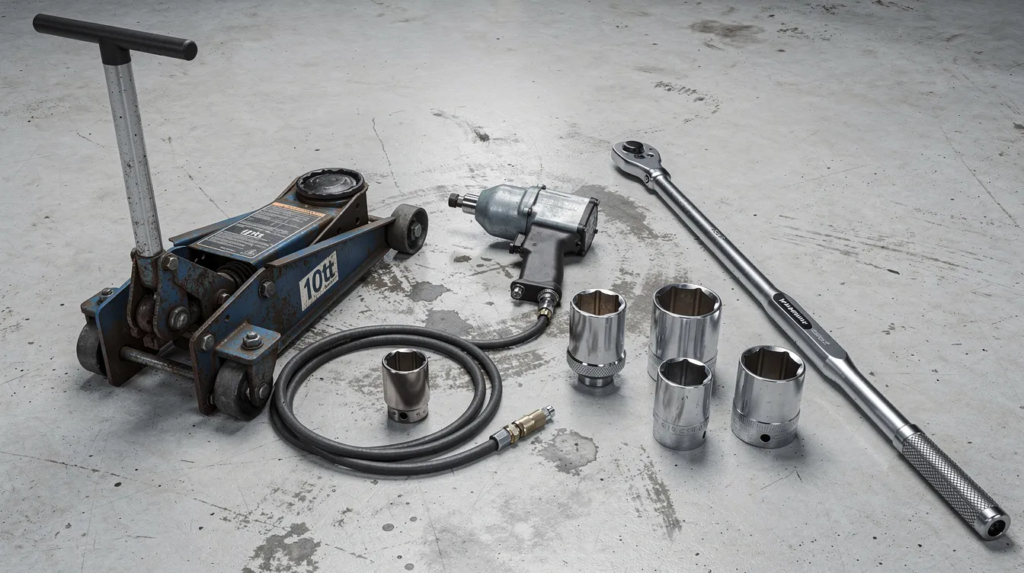
A flat tire in the middle of the motorway is rarely a small problem. On a semi-trailer truck, the cargo weighs several tonnes, braking distance gets longer, and continuing on a damaged tire can put the whole trailer at risk. Anyone searching for “tire breakdown service near me” usually doesn’t need general information. They need a fast decision: who do I call right now, and what do I do until help arrives?
This guide answers exactly that, with clear steps, realistic prices, and an honest view of when a mobile service actually makes sense.
What a tire breakdown service actually does

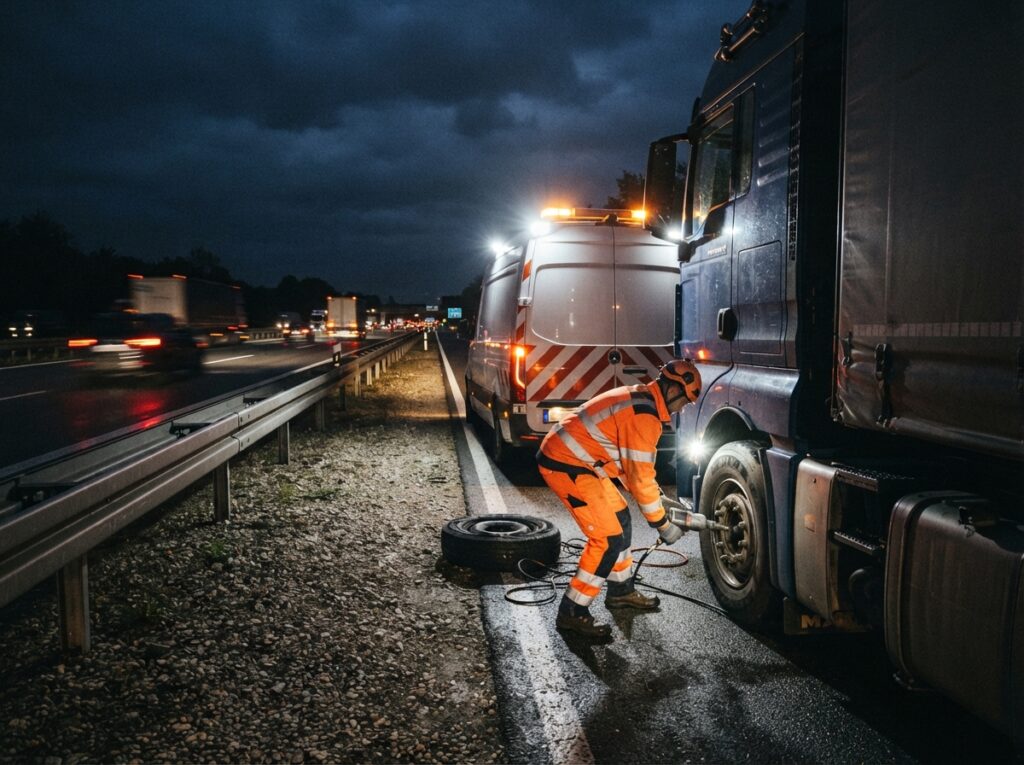
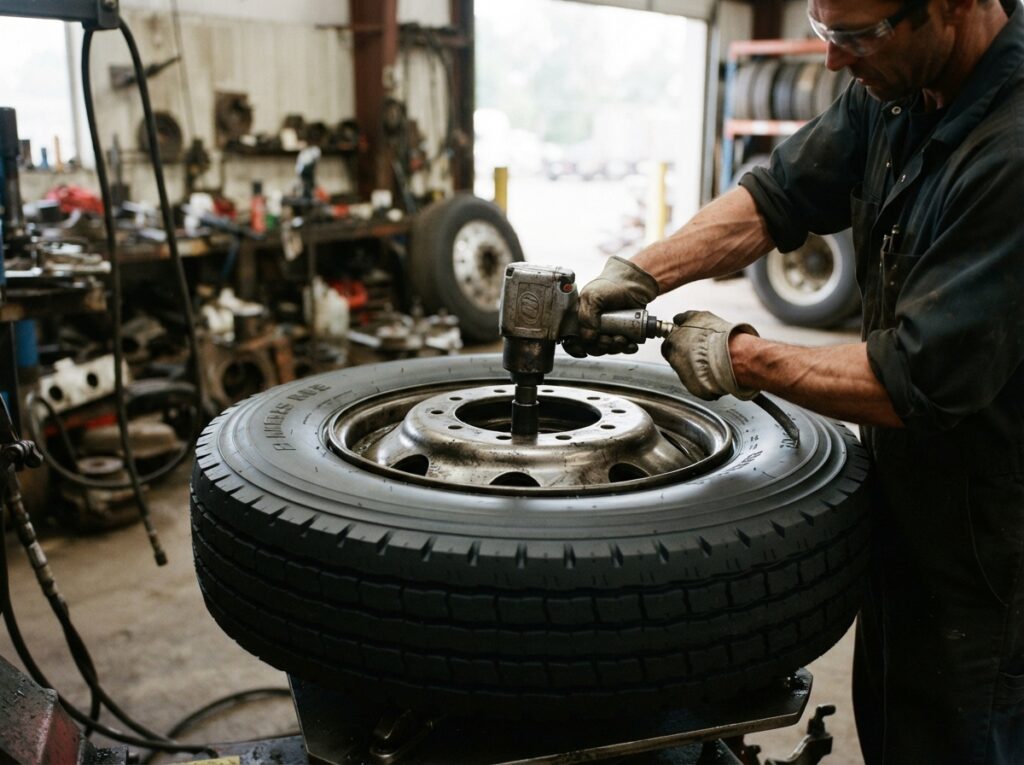
A tire breakdown service isn’t a substitute for a workshop. It’s a mobile unit that comes to your vehicle with a compressor, jack, torque wrench, and a range of tires. For trucks and trailers, it almost always comes down to one of three things: a blown tire, a slow leak, or a faulty valve. All three can be fixed on site, as long as the right tire is either carried along or organized on short notice.
The difference from a regular workshop is where the repair happens: the technician comes to the vehicle, not the other way around. That saves time but also costs more, since travel and on-site work are priced in. At LKWHelp24, this service covers commercial vehicles from 7.5 tonnes only. Cars, vans, and motorhomes fall outside the scope and should contact a regular passenger vehicle breakdown service.
Finding the right service in an urgent situation
A Google search for “tire breakdown service near me” often returns a mix of local workshops, national chains, and mobile services. For drivers stuck on the motorway, the distinction matters. Local tire shops keep fixed hours and are usually reachable only during the day. National breakdown services like ADAC mainly cover cars; for heavy commercial vehicles they often run separate, slower processes. Specialized mobile truck tire services, on the other hand, are reachable around the clock and built for vehicles over 7.5 t.
Anyone who needs help fast should contact a specialized provider directly instead of trying several numbers. At LKWHelp24, first contact usually happens over WhatsApp: a short message with a location pin, license plate, and vehicle type is enough to get the technician on the way. For a step-by-step look at how the first assessment works and which details actually matter, see the guide to emergency wheel changes for trucks.
The first five minutes after a breakdown

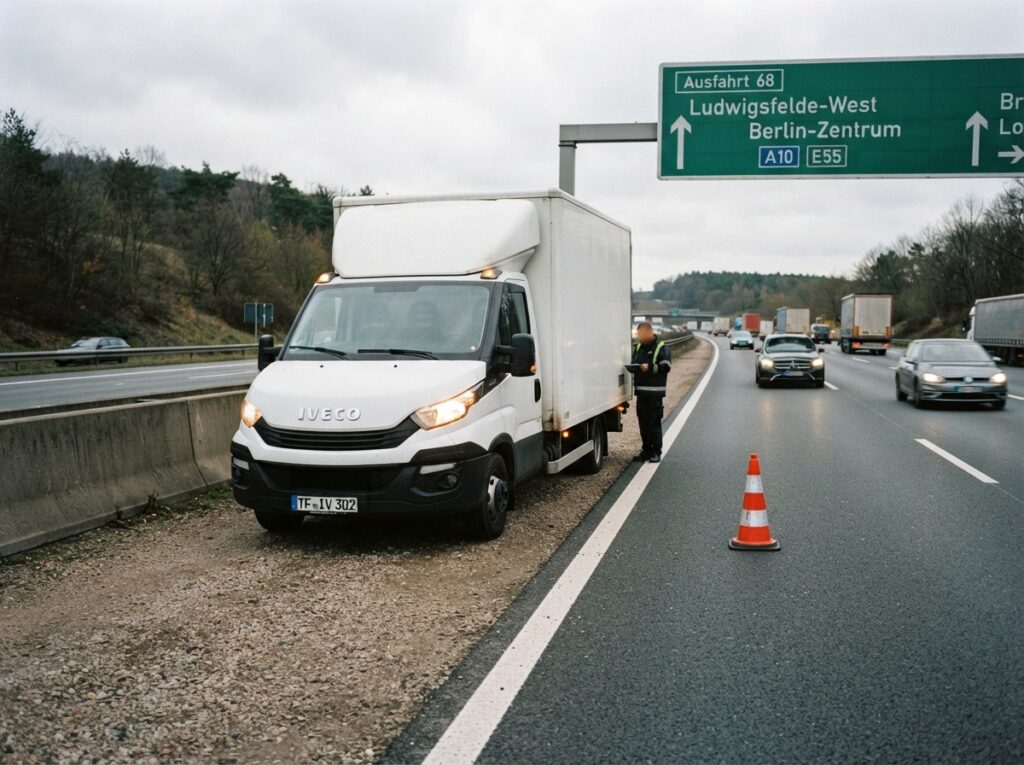
Before you even pick up the phone, the situation needs to be safe. The order is always the same, whether it’s a semi-trailer, an articulated truck, or a construction vehicle:
- Turn on the hazard lights immediately.
- Pull onto the hard shoulder or a safe area, never repair on the driving lane.
- Put on a hi-vis vest before opening the door.
- Set up a warning triangle, well behind the vehicle on the motorway.
- Only then contact the tire breakdown service.
This order sounds obvious, but under stress it often gets reversed. Whoever calls first and sets up safety measures second loses precious seconds in a situation where oncoming traffic is the biggest risk.
What the service needs to know over the phone or on WhatsApp
Response time depends heavily on how precise the first information is. Five details noticeably speed up the response: the exact location, including motorway number, direction of travel, last exit, or the kilometer marker from the nearest post; the vehicle type and axle configuration, such as a tractor unit with a semi-trailer or a three-axle rigid; the affected axle and position, meaning steer axle, drive axle, or which trailer tire; the approximate tire size if known, a glance at the sidewall is enough; and a photo of the damage, if possible.
With this information, the technician can often already decide which tire to bring along while still on the way. Without it, the actual work only starts after arrival, which extends the total downtime.
What a tire breakdown service really costs
Prices for mobile tire services are noticeably higher than at a fixed workshop, because travel, standby, and time-pressured labor are all priced in. Realistic reference prices for truck tires from R17.5:
| Item | Price from (net) |
|---|---|
| Call-out and base service | €290 |
| Tire including mounting (standard size) | €315 |
| Night or holiday surcharge | calculated individually, stated upfront |
The distinction between a fixed price and an hourly rate matters. Reputable providers state the total price before the technician sets off, not only after the repair. If your first inquiry only gets you a vague hourly rate, ask what you’ll actually owe at the end. Details on exact pricing and tire sizes are in the overview of mobile truck tire service.
Truck tire breakdown service isn’t the same as for cars
Many searches for “tire breakdown service near me” come from car drivers who just click the first result. That regularly leads to misunderstandings. A provider specialized in commercial vehicles typically doesn’t stock car tires and is set up, technically, for different wheel sizes, rims, and mounting equipment.
The reason lies in the equipment. A truck wheel often weighs over 80 kilograms, mounting requires a crane or a hydraulic lift, and the torque wrench has to be calibrated for values far higher than for a car. LKWHelp24 only serves vehicles from 7.5 tonnes; for cars, van-class vehicles, and motorhomes, ADAC or a regular breakdown service is the right address.
How different the requirements for commercial vehicles look in detail is covered in the overview of truck models, drivetrains, and breakdown assistance from 7.5 tonnes, from tractor units to distribution trucks.
Typical tire damage that calls for a breakdown service
Not every failure happens suddenly. Field experience from mobile call-outs shows a few recurring patterns.
Blowouts from overload or heat happen mostly in summer, on long motorway runs with a full load, as internal pressure climbs from the rubber heating up. A tire that’s already weakened often can’t withstand that pressure.
A slow leak from a faulty valve sometimes gives warning hours in advance: a TPMS system, the tire pressure monitor, sounds an alert before the tire is fully flat. Ignoring that warning risks a total loss instead of a simple valve repair.
Foreign objects in the tread, meaning nails, metal shards, or broken glass at rest stops and construction sites, are a common cause. A quick visual check before setting off again, especially after a break in an unpaved lot, often catches this kind of damage before it becomes a real problem.
Curb damage happens while maneuvering in the city or on tight construction site access roads, when a tire gets pressed against an edge. The effects sometimes only show up kilometers later as a bulge or bump on the sidewall.
Tire pressure as the most important prevention factor
A large share of truck tire emergencies traces back to incorrect air pressure. Pressure too low causes excessive heat buildup and eventually a blowout; pressure too high reduces the contact patch and increases wear in the center of the tread.
A weekly check, ideally when the tires are cold, is the simplest way to avoid expensive failures. With dual tires, each one has to be checked individually, since a pressure loss in the inner tire is barely visible from outside. A detailed guide with concrete reference values by axle position is available in the article on truck tire pressure.
Reading tire size and markings correctly
If you want to order the right replacement tire in an emergency, you need to be able to read the marking on the sidewall correctly. A designation like 385/65 R22.5 describes width, aspect ratio, and rim diameter, the values the technician asks for on the phone so as not to show up with the wrong tire. A detailed explanation of how to read these numbers, and what matters in a breakdown involving this specific size, is in the article on tire size 385/65 R22.5.
Season and weather: winter tires change the picture
In winter, the most common causes of failure shift. On wet or icy roads, the risk of aquaplaning-related damage rises, and the rubber compound behaves differently at low temperatures than in summer. Trucks over 3.5 tonnes are subject to specific winter tire regulations in Germany, which can vary by axle.
A tire breakdown service in winter works under harder conditions: cold hands, an icy road at the call-out location, shorter daylight hours. Knowing which rules apply to your vehicle class in advance meaningfully reduces the risk of a breakdown. Details are in the article on winter tires for trucks in Germany.
When the tire isn’t the actual problem
Sometimes it only becomes clear on site that the tire damage is a symptom, not the cause. A faulty brake overheating one side of the tire, or a misaligned axle causing uneven wear, are examples. A good mobile service recognizes these connections and points them out instead of only fixing the immediate damage.
In cases where the vehicle can no longer be made safely roadworthy, for example with additional axle damage or an overturned trailer, a tire service alone isn’t enough. That’s when a towing service comes in. What matters there, legally and practically, is covered in the article what to watch out for when towing.
Tire dealer or mobile service: making the right choice
Not every situation calls for a breakdown call-out. If you plan your fleet and replace tires on a regular schedule, a classic tire dealer or wholesaler is often the better and cheaper option. The mobile breakdown service is built for the unplanned case, not for routine maintenance.
A comparison of when each route pays off is in the article tire dealer or mobile truck tire service. Fleet managers who want to combine both options will also find notes there on cost planning.
Case study: a blowout at night on the A4
A Polish driver with a refrigerated trailer broke down around half past two in the morning on the A4 near Dresden with a blown tire on the drive axle. He didn’t speak German but reached the service over WhatsApp in Polish, sent the location pin and a photo of the damage. The technician identified the tire size from the photo right away, loaded the matching replacement, and was on site within 50 minutes. The refrigerated cargo stayed inside the closed trailer the whole time and reached its destination without any loss of quality.
This case shows how much a precise first message matters. Language isn’t a barrier here, as long as the location and the damage are clearly documented.
Regional availability: why proximity matters
A tire breakdown service is only as good as its response time, and that depends heavily on geographic coverage. Providers active in several regions at once can react to unexpected traffic jams or full closures by sending the nearest available technician. Call-out reports from different regions show what that looks like in practice, for example from Mannheim, Berlin, or Neubrandenburg.
Frequently asked questions
How fast does a tire breakdown service arrive?
The typical response time is between 30 and 60 minutes, depending on traffic, time of day, and location. In very remote areas or extreme weather, it can take longer; a realistic estimate is always communicated in advance.
Do I need to provide the tire myself, or is it supplied?
A specialized tire breakdown service carries common sizes or organizes them from its own stock on short notice. Knowing the tire size in advance speeds this process up considerably.
Is the old tire disposed of?
Usually yes, for a small extra fee that’s stated upfront. If you’d rather keep the damaged tire, mention that during the first contact.
What happens if no matching tire is available?
The vehicle is either secured on a temporary basis or fitted with a spare wheel if one is available, then escorted to the nearest workshop or towed. An overview of towing cases in winter, when icy conditions add another factor, is in the article on truck towing in winter.
Does the service also cover trailers and semi-trailers, not just the tractor unit?
Yes. Most emergencies involve the trailer or semi-trailer anyway, since it has more axles, and therefore more tires, than the tractor unit itself.
Emergency contact: WhatsApp wa.me/491605753826, phone +49 160 5753826, available around the clock. The LKWHelp24 team communicates in German, English, Polish, and Russian.