Skip to content
TL;DR: On 14 July, during daylight hours on the A61 near Meckenheim, direction Koblenz, the tread of a retreaded 315/80 R22.5 tyre separated from the carcass on the drive axle of a Renault Trucks tractor unit with semi-trailer. From emergency call to departure took 2 hours 20 minutes, and the total bill came to €970 net. The case is a useful lesson in where retreading saves fleets real money — and where it turns into a liability.
A tyre failure on the motorway is unpleasant under any circumstances. But when only the tread lifts off rather than the whole tyre exploding, many drivers assume the situation is manageable — the carcass, after all, is still holding air. That assumption is exactly what makes tread separation on retreaded tyres so dangerous: metre-long rubber strips whip against the road, strike wheel arches or brake lines, and the artic often continues unnoticed for several kilometres on a damaged tread before the driver feels the vibration.
For fleet operators the case raises a question rarely discussed openly: is retreading worth it at all, and if so, where on the vehicle? The short answer is yes, but not on every axle and not with every supplier. What follows is the real sequence of events, the technical background, and an honest cost breakdown.
What happened on the A61 near Meckenheim?
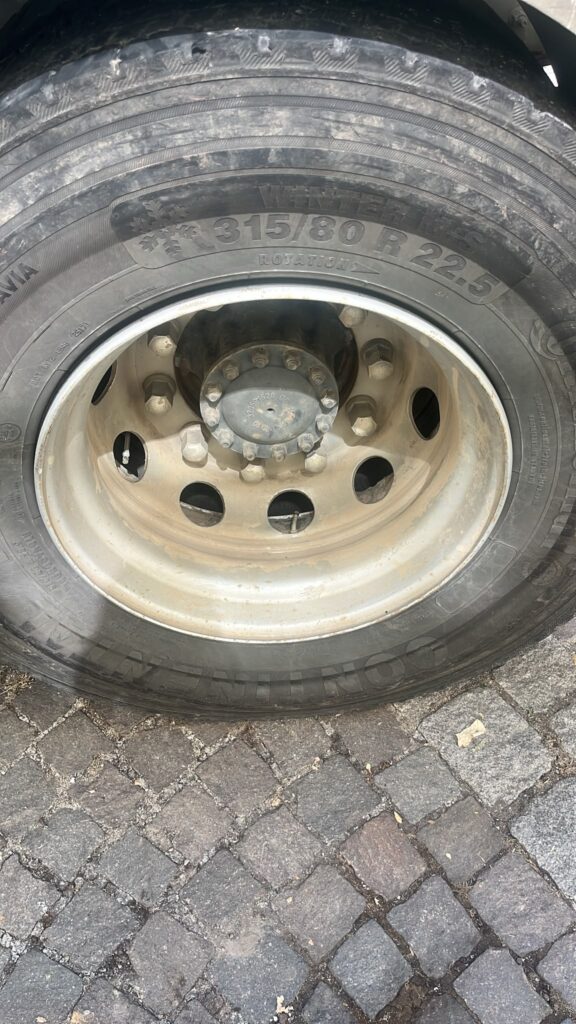
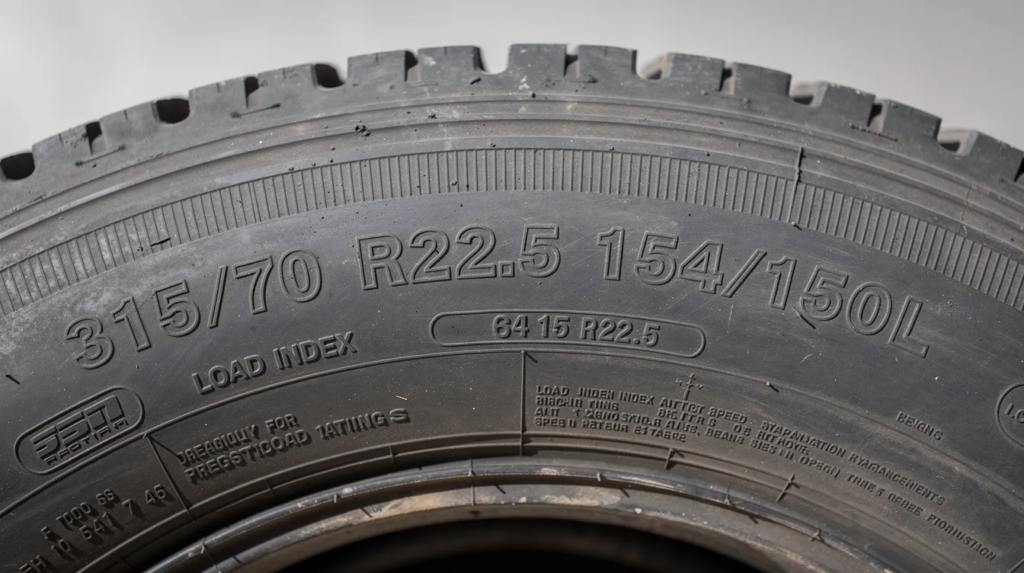
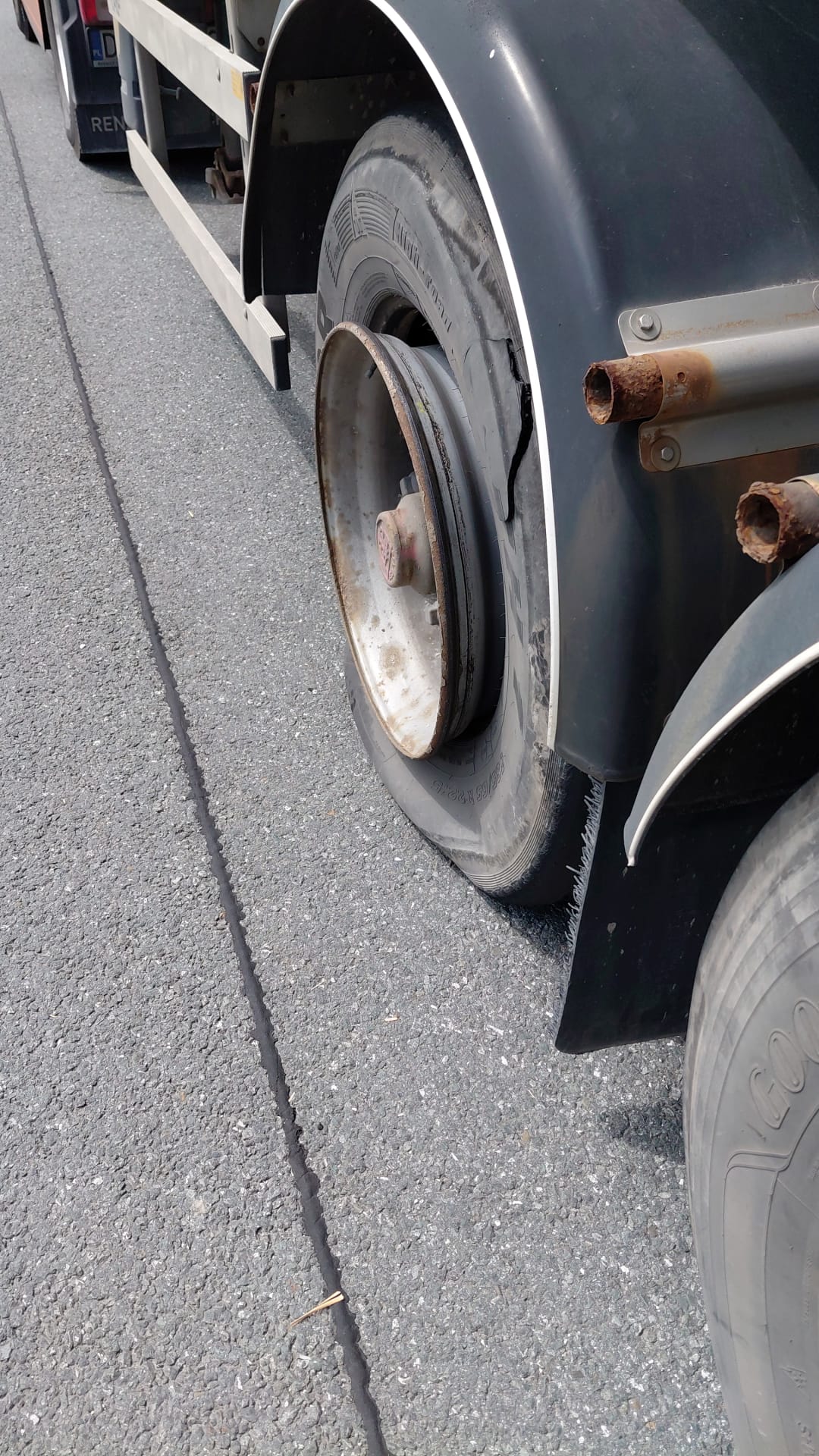
A Renault Trucks tractor unit with a semi-trailer was travelling on the A61 near Meckenheim, heading towards Koblenz in daylight, when the tread separated on one of the twin tyres on the drive axle. The affected tyre was a retreaded 315/80 R22.5 — the standard dimension for articulated lorries across Europe.
The driver felt a thumping sensation through the drivetrain and pulled onto the hard shoulder in a controlled manner. A visual check revealed the classic pattern: the bonded tread layer had peeled away from the underlying carcass in metre-long strips, while the carcass itself was still holding pressure. This exact failure mode — the tyre technically intact, the tread gone — is the most common cause of failure in retreaded commercial vehicle tyres.
The dual-wheel setup on the drive axle absorbs some of the load spike, but stopping was still necessary: a damaged neighbouring tyre carries substantially more load and heat, which can trigger a secondary failure within a short distance.
What is a retread tyre?
Retreading is the process of bonding a new tread layer onto a tested, still-sound tyre carcass. In Europe the practice is legally approved for commercial vehicle tyres and widely used across the haulage industry, because the carcass — the most expensive component of a tyre — gets a second life.
Before retreading, every carcass is X-rayed, checked for damage, and either approved to spec or rejected. The worn tread is then buffed off, the carcass surface is roughened, and a new rubber compound is bonded under heat and pressure. The end result looks almost identical to a new tyre, but technically it remains a composite of an old core and a new skin — and that bond is exactly where the weakness lies.
The economics: what does retreading actually save?
A retreaded 315/80 R22.5 costs 30–50% less than a new tyre of the same dimension. Against a new-tyre price of €480–620 net, a retreaded equivalent realistically comes in at €280–380 net.
For a fleet running 20 tractor units with roughly 10 drive and trailer tyres per vehicle, that adds up to a five-figure saving per year. But the sum only works if three conditions are met: verified carcass provenance, correct axle position, and a supplier with traceable quality control. Miss any one of these and a single roadside failure — downtime, recovery, lost hours, in the worst case vehicle damage — wipes out the saving from several retreads at once.
Fleets that want a predictable tyre strategy get their axle tyres checked through our Truck Tire Service rather than waiting for a roadside failure to react. It’s also worth pairing that with a fixed maintenance relationship with a Truck Service workshop, which can inspect carcass condition and axle geometry during a routine inspection.
Where are retreads legal, and where aren’t they?
Retreaded tyres must never be fitted to the steer axle on a lorry. That is the central safety rule around retreading. Drive and trailer axles, by contrast, are approved fitting positions and standard practice across the industry.
The reasoning is load distribution: the steer axle carries direct control load, so a sudden pressure loss or a tread that lifts under hard braking is an immediate loss-of-control risk. On the drive axle, dual tyres at least partially compensate for a defect in the short term; on a trailer, axle load still matters but steering control isn’t directly at stake. This distinction — steer axle off-limits, drive and trailer axles permitted under conditions — is enshrined in commercial vehicle tyre regulation and checked during the periodic roadworthiness inspection carried out by bodies such as TÜV.
How many times can a carcass be retreaded?
A commercial vehicle carcass can, in practice, be retreaded once or twice and still make economic sense, provided it was never run overloaded or significantly underinflated. Beyond that, the failure risk outweighs the cost benefit.
The tricky part: a carcass that has spent time running underinflated often looks unremarkable from the outside. Internally, though, constant flexing has produced micro-cracks in the fabric structure, which only surface as tread separation under load and heat — often after a long, hot motorway stretch. That’s exactly why a reputable retreader checks the history and condition of each carcass individually rather than accepting every old core wholesale. Buying from the cheapest supplier without traceability means, in effect, buying a carcass with an unknown past.
Why does the tread separate? The typical failure cause
Tread separation is the most common failure mode for retreaded tyres — the newly bonded rubber lifting away from the carcass. Two causes dominate: overheating from underinflation or overload during operation, and bonding defects introduced during manufacture.
With overheating, stress builds up between carcass and tread, gradually weakening the bond until it gives way under a further load spike — often not immediately, but after hundreds of kilometres of otherwise normal driving. With a bonding defect, the weak point exists from day one but often only shows up weeks into service, once centrifugal force and heat combine. For the driver, the two are indistinguishable from outside: the vehicle suddenly thumps, and a glance in the mirror shows rubber debris on the carriageway.
How do you spot good retreading — and why is cheap expensive?
Certification, marking, and manufacturer reputation are the three signals of trustworthy retreading. Recognised processes use tested raw rubber compounds, document each carcass with full traceability, and back the tread with a warranty.
A tyre with no traceable carcass history, no warranty, and a price well below market rate is, more often than not, the most expensive option — the cost is simply deferred to the day of failure. The maths is straightforward: a stationary tractor unit costs €800–1,200 per day in lost freight revenue, before recovery or repair costs. A single premature failure erases the saving from five or more cheaply sourced retreads. Paying somewhat more upfront for a supplier with documented quality control is, in practice, the cheaper long-term choice.
How was the response organised?
Once the emergency call came in, our 24/7 control room worked through a clear sequence:
- Log the call, capture location (A61 near Meckenheim, direction Koblenz) and failure type (tread separation, drive axle).
- Confirm tyre dimension, 315/80 R22.5, and vehicle type (tractor unit with semi-trailer).
- Dispatch an available technician from the regional service network and calculate travel time.
- Instruct the driver to keep hazard lights on, deploy the warning triangle and hi-vis vest, and stand behind the crash barrier.
- Send the technician with a matching replacement tyre and tools, maintaining live phone contact for location updates.
That sequence — pinpoint the location, identify the failure, match the right part, issue an immediate safety instruction — is identical on every tyre callout and is what keeps response times short.
Why the hard-shoulder situation can’t be ignored
An artic with a burst tread on the drive axle must never simply continue driving. Truck tyre pressure typically runs at 8.5–9.5 bar, and the neighbouring tyre in a dual setup immediately absorbs a large share of the axle load once its partner fails.
That overload sharply increases heat build-up in the remaining tyre, raising the risk of a secondary blowout. There’s also a risk to the rim: continuing on a damaged tyre can damage the rim flange, turning a straightforward tyre change into a costlier rim repair or replacement. The hard shoulder itself is one of the most dangerous places on a motorway — ADAC figures show a disproportionate share of rear-end collisions occur there, which is exactly why the warning triangle, hi-vis vest, and adequate distance from the vehicle are mandatory.
The tyre change, step by step
- Visual inspection. The technician checks the tread, carcass and rim to rule out secondary damage.
- Securing the site. A warning triangle, extra hazard lighting and a hi-vis vest secure the working area on the hard shoulder.
- Removal. The damaged wheel is loosened with a wheel-bolt wrench and taken off; the hub is checked for damage.
- Fitting the new tyre. The new 315/80 R22.5 is mounted, balanced, and fitted onto the hub.
- Final check. Wheel bolts are torqued in a star pattern, tyre pressure is verified, followed by a quick visual check of the whole axle.
The star-pattern torquing isn’t a formality — it prevents uneven clamping of the rim, which would otherwise show up as vibration within a few kilometres.
Full timeline
| Time | Phase | Action |
|---|---|---|
| 09:40 | Emergency call | Call received via 24/7 hotline, failure reported |
| 09:55 | Dispatch | Technician confirmed, route calculated |
| 10:50 | Arrival | Technician on site on the A61 near Meckenheim |
| 11:05 | Securing the scene | Warning triangle, hi-vis vest, work area secured |
| 11:15 | Diagnosis | Tread separation and carcass condition assessed |
| 11:30 | Removal | Damaged wheel taken off |
| 11:50 | Fitting | New tyre mounted and balanced |
| 12:00 | Completion | Bolts torqued in star pattern, cleared to continue |
Total time from emergency call to departure: 2 hours 20 minutes (140 minutes).
What did the callout cost?
| Item | Price (EUR, net) |
|---|---|
| Callout | €260 |
| Labour (75 min at €120/h) | €150 |
| Tyre 315/80 R22.5 (new) | €540 |
| Old tyre disposal | €20 |
| Total (net, plus VAT) | €970 |
What does a truck tyre change cost on the motorway? A mobile tyre change with a new tyre typically costs €750–1,400 net, depending on tyre dimension, time of day, and distance to the site. With a retreaded tyre the bill comes in lower: a retreaded 315/80 R22.5 at €280–380 net instead of €540 brings this job down to roughly €730–830, since only the tyre price changes — callout and labour stay the same.
Price drivers include time of day (night/weekend surcharge 25–50%), distance to the site, tyre dimension, and how accessible the breakdown location is. For comparison: a tractor unit stuck on a yard for a whole day because mobile help wasn’t available costs €800–1,200 in lost freight revenue alone — before recovery or workshop costs.
Cost methodology for fleets: price per kilometre, not price per tyre
For a haulage company, purchase price is the wrong metric to judge a tyre by. What matters is the price per kilometre driven until replacement, because it captures service life, failure risk, and downtime cost in one figure.
A new tyre at €540 with a 120,000 km service life works out to roughly €0.0045 per kilometre. A retreaded tyre at €320 with a 90,000 km service life (typically shorter, since the carcass already has mileage behind it) comes to around €0.0036 per kilometre — cheaper, but with a wider risk spread if the retread quality is poor. If that retreaded tyre fails prematurely at 40,000 km, the maths flips: €0.008 per kilometre plus downtime costs. This is exactly why retread quality matters more than the sticker price.
Why DIY repair isn’t worth it here
- Without a hydraulic jack and a torque wrench in the correct range, a safe wheel change on a tractor unit is practically impossible to carry out.
- An incorrectly fitted or improperly torqued rim can work loose within a few kilometres.
- Without properly securing the hard shoulder, the driver faces a significant personal accident risk.
- Misjudging the condition of the neighbouring dual tyre can cause a second failure shortly after setting off again.
- Improvised repairs to the tyre itself are not permitted on commercial vehicles in Germany and create insurance risk if something goes wrong later.
Typical callouts we handle
- Tyre blowouts and tread separation on retreaded and new tyres on motorways and trunk roads.
- Tyre damage on articulated lorries, road trains, and swap-body vehicles.
- Tyre damage on vans and light commercials in the 235/65 R16C size.
- Breakdown assistance for engine faults, CAN-bus errors, and electrical failures.
- Recovery and towing after a collision or brake-related immobilisation, handled through our Towing Service.
- On-site mobile repairs via our Mobile Truck Service when returning to a workshop isn’t practical.
Prevention advice for drivers and fleets
Regular visual checks of tread depth and sidewall condition before setting off significantly reduce the risk of unnoticed tread separation. Commercial vehicle tyres are subject to minimum tread depth requirements under German § 36 StVZO, and compliance is also a good proxy for overall carcass condition.
Fleets should also keep a documented tyre history per vehicle: when each tyre was fitted, how many times it has been retreaded, and what mileage it has covered. That record is the basis for resolving warranty questions with the retreader if something fails. Checking tyre pressure before every longer journey remains the single most effective safeguard against tread separation, since underinflation is the most common root cause of the overheating that leads to it.
Extended SEO section: tyres and fleet maintenance
Beyond retreading, the underlying tyre choice shapes downtime and fuel consumption. Major manufacturers such as Continental offer tractor-unit-specific tyre lines tuned separately for steer, drive, and trailer axles, differing in tread pattern and compound. For fleets, a mixed strategy makes sense: new tyres on the steer axle, verified retreads on drive and trailer axles for short-to-medium routes.
Terms every fleet manager should know: tread depth (minimum under StVZO), load index (maximum load rating per tyre), balancing (prevents uneven wear), and downtime as a cost factor in every tyre failure. Factoring these into a tyre strategy lowers total cost per kilometre regardless of whether new tyres or retreads are in use.
Overloading is an underrated factor too: a persistently overloaded axle pushes the carcass beyond the manufacturer’s rated limit, further weakening the tread bond. Fleets that regularly run close to the maximum permitted gross weight should avoid retreads on that axle and stick to new tyres. For short-haul distribution work with consistent, moderate loads, the picture is far more favourable — retreads on drive and trailer axles typically pay for themselves there.
Why choose LKWHelp24?
- Available 24/7 across Germany, with multilingual dispatch for international drivers.
- A vetted partner network of technicians stocking both retreaded and new tyres in all common dimensions.
- Transparent pricing with no hidden items, and a cost estimate before work begins.
- Experience across all commercial vehicle brands, including Renault Trucks, MAN, Scania, Volvo, DAF, Iveco, and Mercedes-Benz.
Frequently Asked Questions
What does a truck tyre change cost on the motorway?
A mobile tyre change with a new tyre costs €750–1,400 net, depending on dimension, time of day, and distance. With a retreaded tyre, the bill is usually €150–200 lower, since only the tyre price changes.
How long does a tyre callout take on the motorway?
From emergency call to departure typically takes 1.5 to 3 hours. In this case it was 2 hours 20 minutes: 15 minutes dispatch, 55 minutes travel, 65 minutes on-site work.
Can retreaded tyres be fitted to the steer axle?
No. Retreaded tyres are not permitted on the steer axle of a lorry. They are allowed on drive and trailer axles.
How many times can a carcass be retreaded?
In practice, once or twice, provided it was never run overloaded or underinflated. Beyond that, failure risk rises sharply.
Who pays for a roadside tyre change?
Usually the fleet operator or haulage company, often via a stored payment method or an invoice to the business. Drivers rarely need to pay out of pocket.
How can you spot an impending tread separation early?
Look for visible bulges or ripples in the tread, unusual vibration through the steering wheel or cab, and abnormal wear patterns during the pre-trip visual check.
Summary
- Tyre: 315/80 R22.5, retreaded, tread separation on the drive axle
- Location: A61 near Meckenheim, direction Koblenz
- Response time: 55 minutes travel after 15 minutes dispatch
- Total duration: 2 hours 20 minutes from emergency call to departure
- Cost: €970 net (with new tyre), approximately €730–830 with a retreaded replacement
- Secondary damage: none, rim and neighbouring tyre undamaged
Get help now
Tyre failure on the motorway, whether on a new tyre or a retread: call us any time on +49 160 5753826 or visit www.lkwhelp24.com. We’re available 24/7 across Germany — with verified tyre stock, transparent pricing, and fast response times.
Keywords: mobile truck tyre service | retread truck tyres | tyre blowout motorway | tread separation | truck tyre change cost | 315/80 R22.5 | tyre service A61 Meckenheim | truck breakdown assistance 24/7
Related articles
- Truck Tire Service Near Me: How We Got a DAF Artic Back on the Road in 2 Hours After a Tyre Blowout Near Hof
- Truck Tire Service Near Me: Professional Recovery of a 40-Tonner After a Blowout on Soft Terrain in Landsberg am Lech
- Winter Tyres for HGVs in Germany – Legal Requirements, Safety & Service by LKWHelp24
- Truck Tire Service Near Me: Handling Trailer Tyre Blowout Near Berlin
- Trucks Towing Service on the A14 Near Leipzig – Engine Failure and Transport to Renault Truck Service