Skip to content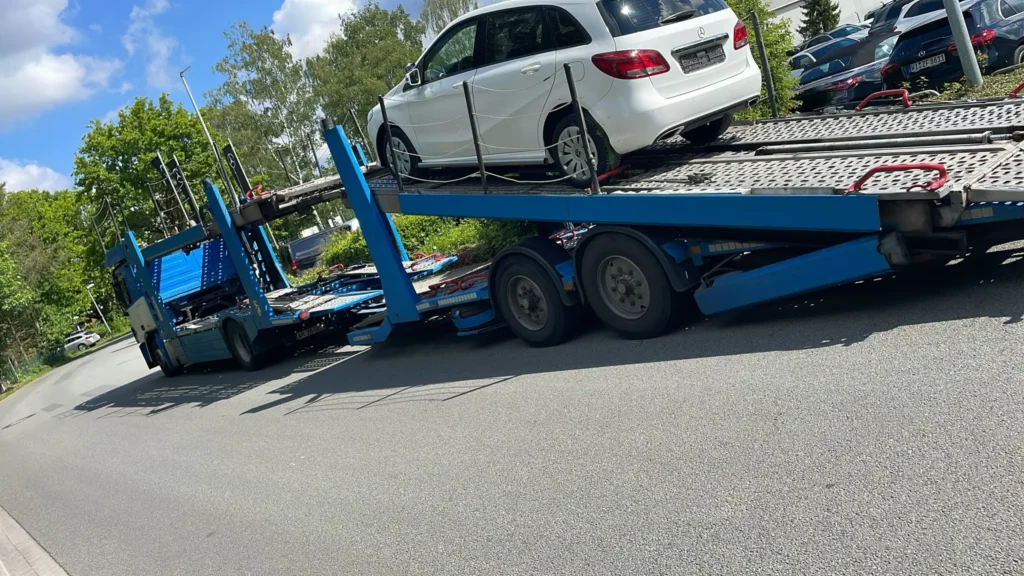
Vehicle logistics rarely make headlines, and that is exactly the point. A car transporter job only becomes newsworthy when something goes wrong: a strap fails, a car arrives with a scuff on the bumper, or a dealership is left waiting on a forecourt with a sales event starting in an hour and no stock to show for it. The best transport jobs are the ones nobody talks about afterwards, because everything simply worked. This is the story of one of those jobs.
In late spring this year, a Mercedes-Benz dealer in the Wiesbaden area needed several brand-new B-Class vehicles moved from a loading point to their showroom forecourt. No breakdown, no accident, no drama — just a straightforward transport order that had to be handled by people who understand what “fachgerecht”, or professional-grade, actually means when the cargo is a set of factory-fresh cars worth tens of thousands of euros apiece. LKWHelp24 was called in to organise and execute the job through our car transporter partner network, and the whole operation, from arrival at the loading site to signed handover paperwork at the dealership, took roughly five hours.
That might sound unremarkable. It is meant to. But behind an unremarkable five-hour job sits a set of decisions about wheel strap tension, axle loading on a double-decker trailer, weather checks, route planning around lorry driving bans, and a condition report that protects both the sender and the buyer if a dispute ever arises. This article walks through exactly how that job was planned, executed and priced, and why treating car transport as a specialist discipline — rather than “just driving cars from A to B” — is what keeps dealerships, fleet operators and private sellers coming back to the same provider.
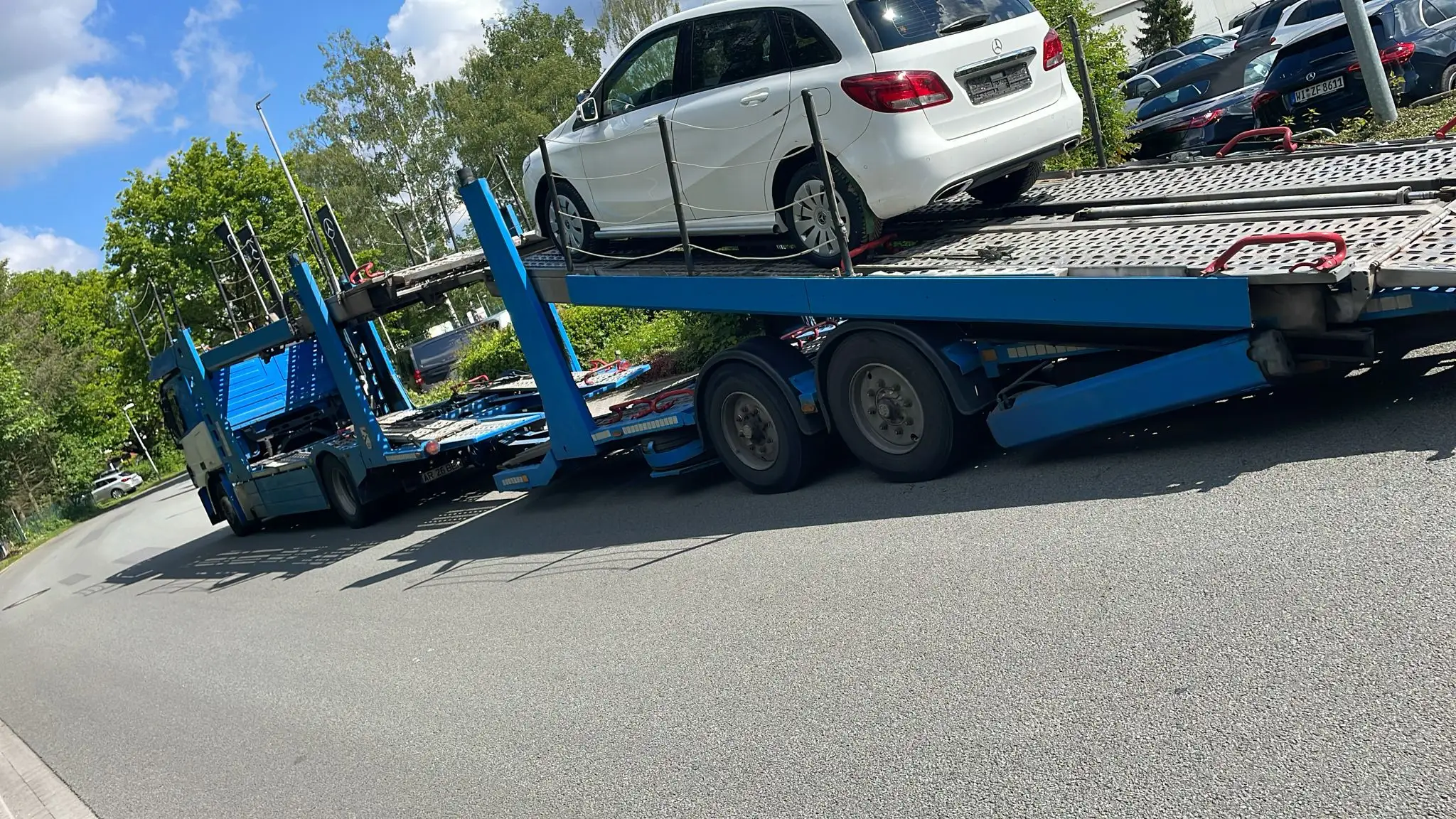
Mercedes-Benz B-Class on the car transporter – vehicle logistics and delivery by LKWHelp24.
The Assignment: Multiple Mercedes-Benz B-Class Units, One Tight Delivery Window
The client was a Mercedes-Benz dealer group with a forecourt in the Wiesbaden region. Several new and pre-registered Mercedes-Benz B-Class hatchbacks needed to move from a central loading point to the dealership before the day’s business began. This is a routine but demanding category of work known in the trade as vehicle overführung, or car transfer: moving finished vehicles from a factory compound, port, or regional depot into the retail network.
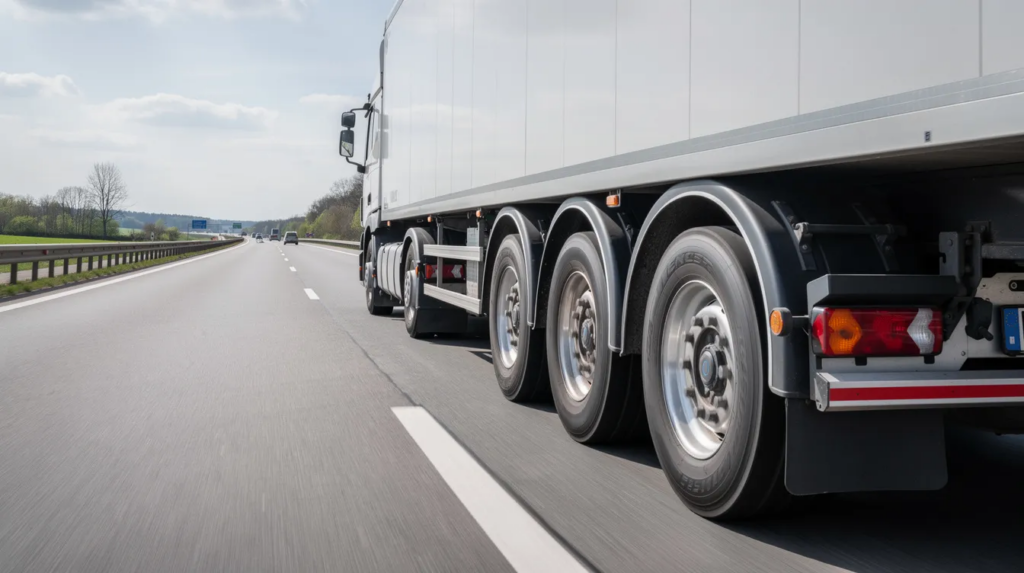
The vehicle used for the job was a double-decker car transporter — an articulated lorry with a two-tier trailer capable of carrying multiple passenger cars stacked on upper and lower decks. This is standard equipment for dealer-to-dealer and factory-to-dealer transfers across Germany, and it is a completely different piece of kit from a flatbed recovery truck or a low-loader. Loading several Mercedes-Benz B-Class cars onto a double-decker trailer requires:
- Precise ramp angles so the underside of each car clears the loading ramp without scraping.
- Careful sequencing — which car goes on first, which sits where — because unloading order at the dealership has to match loading order in reverse.
- Wheel-strap or chassis-strap securing at four points per vehicle, tensioned to hold the car rigid under braking, cornering and motorway vibration without marking the alloy wheels or bodywork.
- A pre-transport condition check on every vehicle: paintwork, glass, wheels, interior, mileage, fuel level, all documented before the wheels ever touch the ramp.
None of this is exotic. It is standard practice for a professional car transporter crew. But it is precisely the kind of routine that separates a transport operator who treats every car like cargo that must arrive in showroom condition from one who treats it like freight.
How Help Was Organised: LKWHelp24’s Dispatch Process
LKWHelp24 operates a nationwide partner network of car transporter operators, recovery specialists and heavy-haulage crews across Germany. For a planned transfer job like this one — as opposed to an emergency breakdown recovery — our dispatch process follows a structured sequence rather than a race against the clock, though speed and reliability still matter enormously to a dealership working to a delivery schedule.
● The dealer contacted LKWHelp24 with the pickup location, delivery address, number of vehicles, and required delivery window.
● Our dispatch team identified the nearest available double-decker car transporter partner with capacity for the full load and confirmed vehicle dimensions matched trailer specifications.
● The partner crew was briefed on vehicle count, model (Mercedes-Benz B-Class), loading sequence, and any special handling notes — in this case, new and near-new vehicles requiring extra care around wheels and bodywork.
● A confirmed time slot was agreed with both the loading point and the receiving dealership, so neither side was left waiting.
● The crew departed for the loading site with the trailer already inspected and straps, chocks and protective sleeves ready to go.
This is the same partner-network model we use for roadside assistance and heavy recovery jobs across the country, just applied to planned logistics rather than a reactive callout. Whether it is a car transporter, a low-loader, or a mobile tyre service, the principle is identical: match the right equipment and the right crew to the job, confirm capacity before committing, and keep both ends of the job — pickup and delivery — informed throughout.
The Situation On-Site: Why Loading a Car Transporter Is Not “Just Driving Cars On”
To anyone who has not stood next to a double-decker car transporter during loading, it can look almost casual — a driver eases a car up a ramp, someone waves them into position, straps go on, next car. In reality, every stage carries a real risk if it is rushed or handled by an inexperienced crew.
Ramp angle is the first concern. A B-Class, like most modern hatchbacks, has a relatively low front overhang, but the transition from ground to ramp and ramp to deck still needs to be taken at the correct angle and speed. Too fast, and the front splitter or undertray can catch. Too slow with the wrong approach angle, and the driver risks stalling the manoeuvre halfway up an inclined ramp — not a position anyone wants a car to be in.
Weight distribution across the trailer’s two decks matters for the transporter’s own road-handling and axle-load compliance. German road regulations set strict axle weight limits, and a transporter carrying multiple vehicles has to be loaded so that no axle is overloaded and the overall combination remains stable at motorway speeds. This is planned before the crew even arrives, based on the known weight of a Mercedes-Benz B-Class (in the region of 1,400 to 1,500 kg depending on trim and equipment) and the trailer’s deck-by-deck capacity.
Securing is where most preventable transport damage actually happens if it is done poorly. Chassis or wheel straps are set at four points per vehicle and tensioned firmly enough to eliminate movement without over-compressing suspension components. Straps are routed to avoid contact with painted surfaces or trim, and where contact is unavoidable, protective sleeves or felt padding are used. A car that arrives with a strap-mark on a sill or a scuffed alloy is a car the dealership cannot sell as new — which is precisely the outcome a professional crew is trained to prevent.
Finally, every vehicle gets a documented condition check before departure: exterior panels, glass, wheels and tyres, interior condition, odometer reading. This protects everyone involved. If a dispute ever arose about a mark or a mileage discrepancy, the pre-transport report settles it in minutes rather than becoming a drawn-out argument between dealer and haulier.
Step-by-Step: How the Team Handled the Job
Step 1 — Arrival and site assessment. The crew arrived at the loading point at 08:15, assessed ground conditions, confirmed there was adequate space to manoeuvre the articulated combination, and positioned the trailer for ramp deployment.
Step 2 — Pre-loading condition check. Each Mercedes-Benz B-Class was walked around and photographed: bodywork, glass, wheels, interior, fuel level and mileage recorded on the condition sheet before a single vehicle moved.
Step 3 — Loading sequence. Vehicles were driven up the ramps one at a time in a pre-agreed order, starting with the units destined for the upper deck. Each car was positioned precisely to leave clearance for the next vehicle and to keep the trailer’s weight balanced front to rear.
Step 4 — Securing. Once every vehicle was in position, the crew fitted four-point wheel straps to each car, tensioning them evenly and checking for any contact points that needed protective padding. Handbrakes were set, wheels chocked where required by the trailer’s design.
Step 5 — Final check and departure. A last walk-round confirmed all straps were tight, all ramps stowed, lights and indicators functional, and the load compliant with axle-weight limits before the transporter pulled away at 09:15.
Step 6 — Delivery and handover. On arrival at the dealership, the sequence reversed: vehicles were unstrapped and driven off the trailer in reverse loading order, each one re-inspected against the original condition report, and the paperwork signed off with the receiving dealer.
Full Timeline
| Time | Phase | Action |
|---|---|---|
| 07:30 | Job assigned | Crew departs for the loading point |
| 08:15 | On site | Arrival, site check, loading begins |
| 09:00 | Vehicles secured | All B-Class units strapped and checked |
| 09:15 | Departure | Transporter leaves for Wiesbaden dealership |
| 12:00 | Arrival | Transporter reaches the dealership |
| 12:30 | Handover complete | Vehicles unloaded, condition report signed off |
Total time: approximately 5 hours from job assignment to signed handover, with the loading phase itself taking around 45 minutes.
Cost Breakdown
| Item | Price (EUR) |
|---|---|
| Callout & dispatch of car transporter | 180 |
| Loading & load securing (multiple vehicles) | 240 |
| Transport (car transporter, distance-based) | 480 |
| TOTAL | 900 EUR |
The final figure on any car transporter job depends on three main variables: the number of vehicles being moved, the distance between pickup and delivery, and how tight the delivery deadline is. A single-vehicle transfer over a short distance costs considerably less than a multi-car load travelling further; conversely, a same-day or urgent slot naturally carries a premium over a job booked with a week’s notice.
It is worth comparing this against the alternative most dealers default to without thinking: driving each car individually with a delivery driver. On paper it looks cheaper — no transporter, no strapping, just a driver and fuel. In practice, individual road delivery of new or near-new stock means real mileage accumulating on cars sold as “delivery mileage only” vehicles, stone chips and windscreen damage from live traffic exposure, and a driver tied up for the entire round trip rather than a single crew moving several vehicles in one pass. For a batch of new Mercedes-Benz B-Class units, a professional car transporter is very often the more economical choice once mileage, wear and driver time are factored in — not just the safer one.
Why a Professional Transport Service Is Essential
Moving several brand-new vehicles is not a job for whoever happens to be free that morning. The risks of cutting corners are real and, in the world of dealer stock, expensive:
- Incorrect strap tension or placement can leave visible marks on paint, sills or alloy wheels — instantly turning a “new” car into a car that needs bodywork before it can be sold at full price.
- Poor axle-load planning on a double-decker trailer risks non-compliance with German road weight regulations, which can mean fines, delays at roadside checks, or in the worst case a genuine stability hazard on the motorway.
- A rushed or badly sequenced loading process increases the chance of a ramp mishap, particularly with low-slung modern hatchbacks like the B-Class.
- Without a documented pre-transport condition report, any dispute over a mark, scratch or mileage discrepancy becomes he-said-she-said between dealer and transporter — costly and time-consuming to resolve.
- Missed delivery windows disrupt dealership sales events, forecourt display schedules and customer handover appointments booked around expected stock arrival.
A specialist crew working for an established partner network eliminates these risks because the process — condition checks, correct strap technique, load planning, documented handover — is built into every job rather than left to individual judgement on the day.
Typical Vehicle Transport Situations We Handle
LKWHelp24’s partner network covers the full range of vehicle logistics and breakdown scenarios across Germany, not just dealer-to-dealer transfers:
- New and pre-registered vehicle delivery from factory or port to dealership forecourts
- Multi-vehicle transfers on double-decker car transporters for dealer groups and fleet operators
- Cross-border vehicle transport within Europe, including customs and documentation support
- Low-loader transport for oversized or non-runner vehicles, tankers and specialist trailers
- Heavy recovery of lorries, coaches and commercial vehicles following breakdown or accident
- Emergency roadside assistance for trucks and vans, including tyre failures and mechanical faults
- Auction and private-sale vehicle collection and delivery anywhere in the country
Whatever the scenario, the underlying commitment is the same: the right equipment, a briefed and experienced crew, and clear communication with everyone waiting on the other end of the job.
Prevention Tips for Dealers and Fleet Operators
A few habits reduce risk and cost on every future transport job:
- Book car transporter capacity as early as possible, especially around new-model launch periods when transporter demand across the industry spikes.
- Insist on a documented condition report at both pickup and delivery — it protects your business, not just the haulier’s.
- Group deliveries where practical. Moving four vehicles on one double-decker trailer is almost always more cost-effective per unit than four separate single-car deliveries.
- Share exact vehicle specifications (ride height, ground clearance, any aftermarket modifications) with the transporter in advance so loading can be planned correctly rather than improvised on the ramp.
- Keep a record of preferred, vetted transport partners rather than defaulting to whoever answers the phone first when a slot is tight — consistency in the crew handling your stock reduces variance in outcomes.
Fleet Logistics and Multi-Brand Transport Capability
Beyond single dealership transfers, LKWHelp24’s partner network regularly supports fleet operators and multi-brand dealer groups that need coordinated transport across several locations at once. This includes staggered deliveries timed to match showroom refurbishment schedules, batch transfers ahead of registration-plate change periods when new-vehicle volumes spike nationwide, and combined loads mixing Mercedes-Benz, Volkswagen, BMW and other marques on a single trailer run when routing allows it. Coordinating this kind of volume requires transporter partners who can scale capacity at short notice and communicate clearly with multiple receiving sites on the same day — exactly the network model LKWHelp24 was built around.
For operators managing larger vehicle pools, we also coordinate with our heavy recovery and low-loader partners when a transport job overlaps with a breakdown situation — for example, a fleet transfer that also needs to collect a non-runner vehicle from a service centre en route. Rather than booking two separate providers, a single point of contact through LKWHelp24 can often combine both requirements into one planned run, saving time and reducing the number of parties involved in coordinating a delivery date.
LKWHelp24: Your Vehicle Transport and Roadside Partner
LKWHelp24 exists to take the coordination burden off dealers, fleet managers and hauliers who need vehicles moved, recovered or repaired anywhere in Germany. What that means in practice:
- 24/7 availability across the entire country, for both planned logistics jobs and genuine roadside emergencies.
- A vetted partner network of car transporter, low-loader and heavy recovery specialists, matched to each job by vehicle type and load requirement.
- Transparent, itemised pricing agreed before work begins, with no surprise charges once the job is under way.
- Multilingual dispatch and communication, supporting international hauliers and cross-border transport arrangements.
- Documented handovers with condition reports, so every party has a clear record of the vehicle’s state at pickup and delivery.
Summary
- Vehicle involved: Mercedes-Benz B-Class (multiple units, new/pre-registered stock)
- Job type: Planned vehicle logistics via double-decker car transporter, no breakdown or damage
- Location: Loading point to Mercedes-Benz dealership, Wiesbaden area
- Response time: Crew on site 45 minutes after job assignment
- Total job duration: Approximately 5 hours, loading start to signed handover
- Total cost: 900 EUR
- Secondary damage: None
Request Vehicle Transport or Emergency Assistance Now
Whether you need a planned car transporter run, a multi-vehicle dealer transfer, or genuine roadside recovery anywhere in Germany, LKWHelp24 coordinates the right partner for the job.
Call +49 160 5753826
lkwhelp24.com
Available 24/7 across all of Germany.