A tractor unit stopped on the hard shoulder of the A3 near Limburg an der Lahn at 17:36 on 3 September 2026 with a fully deflated tyre. Our truck tyre service had a crew on site after 58 minutes, and the lorry was ready to roll again at 19:26, exactly 110 minutes after the first call. The total bill was €990 net, and the rim did not have to be replaced.
This case is a good example of what a mobile truck tyre service does when a driver is stuck between a motorway junction and a delivery slot. Below you will find the full timeline, the itemised cost, the repair steps and some practical advice for drivers and fleet managers. If you only need help right now, call +49 160 5753826. We answer around the clock.
What happened on the A3 near Limburg
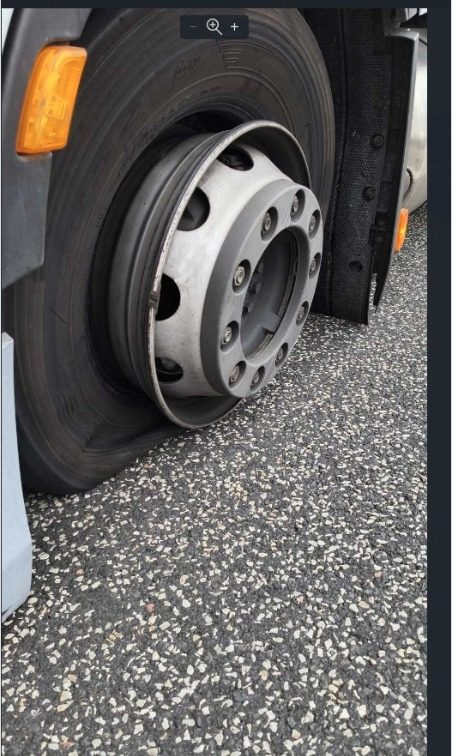
The driver of a semi-trailer tractor unit noticed a pulling sensation and a dull thumping from the cab side of the vehicle shortly before the junction. He slowed down, switched on the hazard lights and brought the rig onto the hard shoulder before the slip road. When he got out, the picture was clear: the tyre was completely flat, the bead had slipped off the rim seat and the tyre lay on the tarmac.
The weather was dry and overcast, the traffic heavy with the usual Thursday evening flow towards Frankfurt. The driver still had a load on board and a delivery window to keep. He phoned us at 17:36 and sent two photos over WhatsApp while we were still on the line.
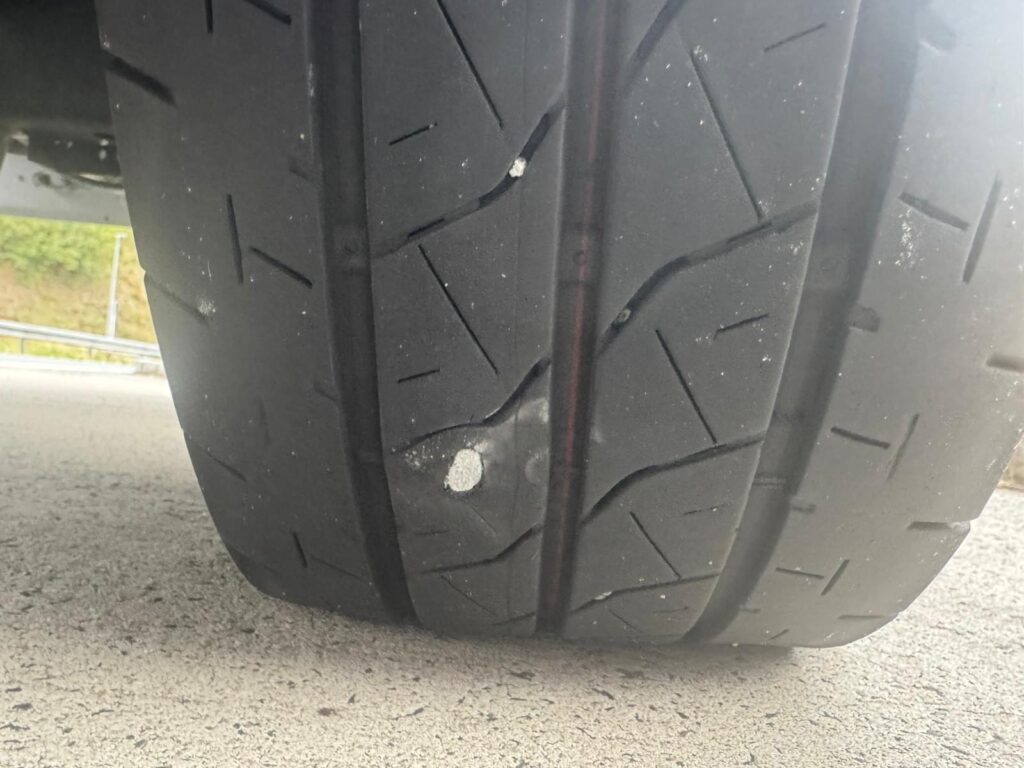
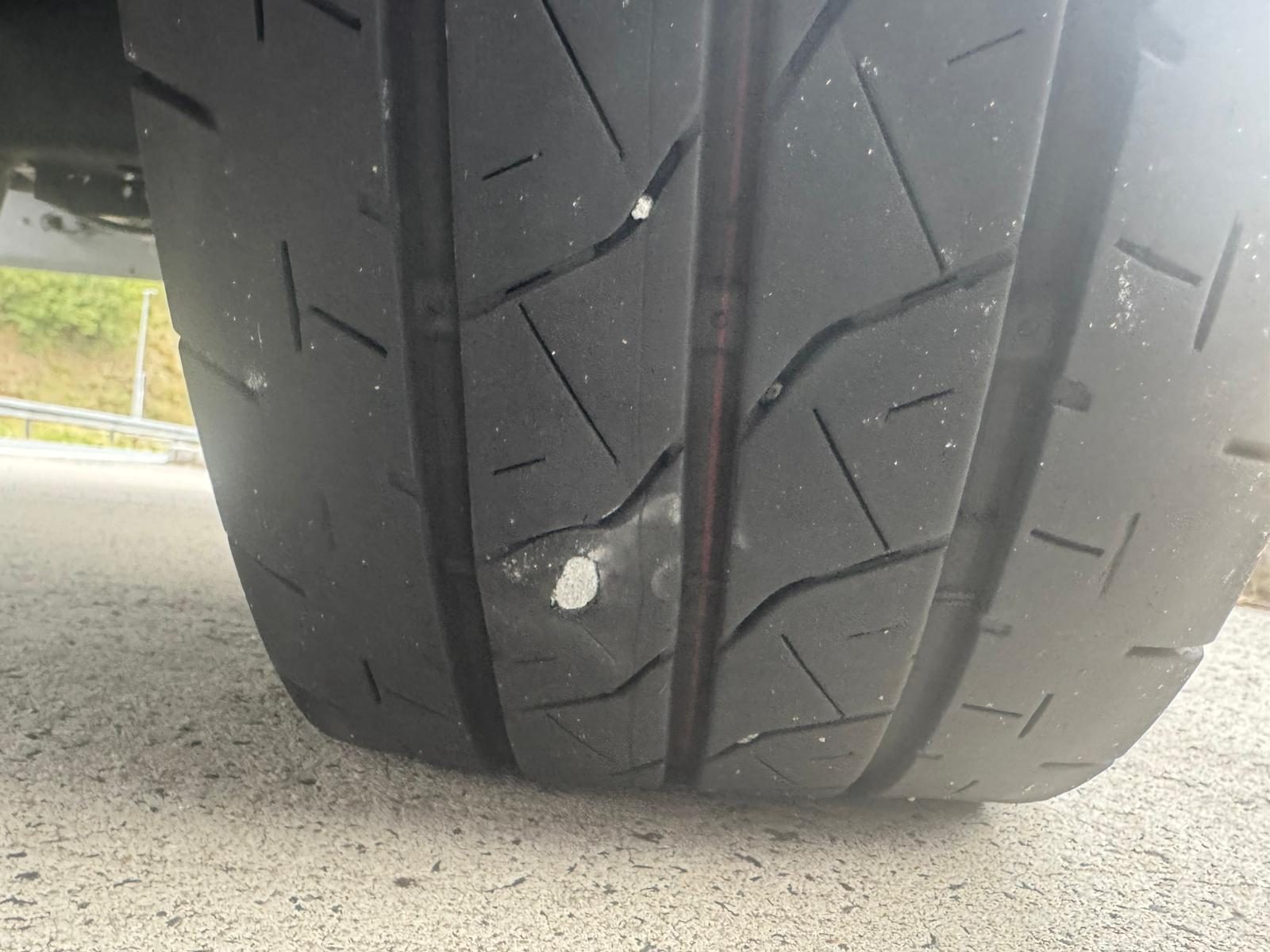
The photos showed two things. The first was the steel rim, with its edge visibly deformed from rolling on a deflated tyre for a stretch of road. The second was a close-up of a tyre tread with a foreign object lodged in the central groove. Whether that exact object caused the loss of pressure or was simply found during the inspection is something we cannot prove from a photograph. What we can say is that a lodged object is a classic cause of slow pressure loss, and a slow leak that nobody notices turns into a flat tyre within a few kilometres.
Vehicle and tyre in short
- Vehicle: articulated tractor unit with a semi-trailer, motorway A3, hard shoulder before a junction
- Fault: fully deflated tyre, bead off the rim seat, rim edge deformed
- Replacement tyre: 315/80 R22.5, the standard dimension for steer and drive axles on heavy tractor units
- Operating pressure: 8.5 to 9.5 bar after fitting
How we organised the help in 16 minutes
The first sixteen minutes of any breakdown are decisive, because this is where location, tyre data and prices are settled. Our dispatch desk works in German, English, Polish and Russian, which matters on the A3, where drivers from half of Europe are on the road.
- Location and safety. We asked the driver to stay behind the guardrail, wear the high-visibility vest and place the warning triangle far enough back.
- Tyre data. From the photos and the driver’s description we confirmed the dimension and the condition of the rim.
- Nearest crew. Dispatch picked the closest mobile crew from our partner network in the region, based on position, stock of 315/80 R22.5 tyres and actual availability.
- Fixed price. Before the van left the depot, the driver received the price in writing, so there was no discussion at the roadside.
- Confirmation. The driver got a call back at 17:52 with the arrival estimate and the name of the technician.
The crew left the yard at 17:52. A 42-minute drive followed. It sounds long, but it was a Thursday evening on one of the busiest motorway corridors in Hesse, and the van moved through slow-moving traffic. We always tell drivers an honest arrival time rather than a comfortable one.
Why a flat truck tyre on the hard shoulder is never a “wait and see” problem
A deflated heavy-goods tyre is a safety problem within seconds and a financial problem within hours. Truck tyres run at 8.5 to 9.5 bar, roughly four times the pressure of a car tyre, and they carry a load of several tonnes per axle. Once the pressure is gone, the sidewall folds under the load, the carcass overheats and the rim edge starts to grind on the road surface.
On this tractor unit the damage had already started. The rim edge was bent, and that is exactly why our technician measured it before deciding to fit a new tyre. A rim with a deformed flange cannot seat a bead properly. If the deformation is too deep, the new tyre will not hold pressure and the whole job has to be repeated with a new rim.
There are three more reasons why waiting is a bad idea:
- Driving on a flat tyre destroys the carcass and often the rim, so a €540 tyre job becomes a much larger one.
- A flat steer or drive tyre changes the handling of the whole combination and can cause the trailer to swing.
- The hard shoulder is dangerous. Every minute spent beside live traffic carries risk for the driver, which is why we dispatch first and talk about details later.
On the legal side, § 36 of the StVZO tyre regulation requires tyres to be suitable for the vehicle and in a safe condition. A tyre that has run flat does not meet that requirement, and it must not be refitted.
Step-by-step: how the tyre was replaced on the hard shoulder
The crew arrived at 18:34 and followed a routine that we use for every truck tyre change on a motorway.
Step 1: Inspection and first assessment (18:34 to 18:42)
The technician first looked at the whole wheel, not just the tyre. He checked the tyre sidewall, the condition of the rim edge, the hub, the wheel studs and the nuts. Then he measured how badly the flange was deformed. The finding: the rim edge was bent, but within a tolerance that allowed straightening and refitting.
Step 2: Securing the working area
Before any tool touched the vehicle, the crew placed a warning sign in the direction of oncoming traffic, put on high-visibility clothing and secured the tractor unit with wheel chocks. The van was parked so that the technician worked on the side facing the guardrail, not the lane. Working on the traffic side of a truck on a hard shoulder is the most common way for a roadside job to go wrong.
Step 3: Removing the wheel (from 18:42)
The technician loosened the ten wheel nuts, raised the axle with a hydraulic jack and took the wheel off the hub. The ten stud holes were intact, which is not always the case after riding on a deflated tyre. He then removed the old tyre from the rim, checked the bead seat and cleaned off corrosion and rubber residue.
Step 4: Mounting and inflating
A new 315/80 R22.5 tyre went on the straightened rim, with a new valve and balance weights. The tyre was inflated in stages to 8.5 to 9.5 bar, with the technician checking the bead seating at each step. Then the wheel was balanced and refitted to the hub. This phase of the job took from 18:42 to 19:20, so 38 minutes in total including the rim check.
Step 5: Final tightening and handover (19:20 to 19:26)
Wheel nuts were tightened in a star pattern with a torque wrench, in two stages, to the value specified by the vehicle manufacturer. Pressure was measured again after the tyre had settled. The driver confirmed the work, signed off the job and left. For details on the correct tightening sequence, our guide to the truck wheel nut torque table explains the figures and the procedure.
Complete timeline: 110 minutes from call to departure
The following table shows the real times of this job on 3 September 2026.
| Time | Phase | Action |
|---|---|---|
| 17:36 | Call | Driver reports a flat tyre on the tractor unit; we record the location, load and tyre type; photos arrive via WhatsApp |
| 17:36 to 17:52 | Dispatch | Nearest crew of our partner network is selected, the price is agreed, the driver gets confirmation |
| 17:52 to 18:34 | Crew on the way | 42 minutes by motorway in evening traffic |
| 18:34 to 18:42 | Inspection and securing | Warning sign, high-visibility vest, wheel chocks, check of tyre and rim, measurement of the rim edge |
| 18:42 to 19:20 | Work | Wheel off, new tyre fitted, rim checked, tyre mounted and inflated to 8.5 to 9.5 bar |
| 19:20 to 19:26 | Finish | Wheel nuts tightened in a star pattern with a torque wrench, pressure checked again, handover to the driver |
Result: the crew arrived 58 minutes after the call, and the vehicle was ready 110 minutes after the call (1 hour 50 minutes).
What does a truck tyre replacement on the motorway cost?
A truck tyre replacement on this job cost €990 net, including call-out, labour, a new 315/80 R22.5 tyre and disposal of the old one. Prices are quoted before the crew leaves, and all amounts below exclude VAT (zzgl. MwSt.).
| Item | Price (EUR) |
|---|---|
| Call-out / Anfahrt (motorway, evening) | 240 |
| Labour, 1.5 hours at €110 | 165 |
| Truck tyre 315/80 R22.5 | 540 |
| Valve and balance weights | 25 |
| Disposal of the old tyre | 20 |
| TOTAL | 990 |
What drives the price of a truck tyre callout
The price depends on a handful of factors, and none of them is a mystery:
- Distance and time. The call-out fee covers the drive of the crew. At night or at weekends a surcharge of 25 to 50 per cent is usual in the industry.
- Tyre dimension and brand. A 315/80 R22.5 sits in a different price bracket from a 385/65 R22.5 trailer tyre or a van tyre.
- Labour time. The hourly rate is paid for the time actually worked, here 1.5 hours.
- Condition of the rim. The rim was straightened and passed inspection. If the rim edge had been too deformed, a replacement would have cost more.
- Condition of the old tyre. A tyre that has run flat cannot be repaired and is disposed of.
For a broader look at prices, our article on what a truck tyre change really costs goes through typical bills for steer, drive and trailer tyres.
Is it worth it compared with the alternative?
Almost always, yes. A tractor unit that stands still earns nothing, and a day of downtime for a truck with a semi-trailer typically costs between €800 and €1,200, counting driver wages, missed slots and possible penalties from the consignee. Here the downtime was under two hours. The alternative, towing the whole combination to a workshop, would have cost €900 to €1,800 plus a night in a queue at the garage, and the tyre would still have needed replacing.
Why a professional truck tyre fitting is worth it
Changing a heavy truck wheel by the roadside looks simple until you try it. A wheel for a 315/80 R22.5 tyre weighs well over 100 kilograms, and an inflated tyre stores a lot of energy.
These are the typical risks when a driver or an untrained helper tries to do the job alone:
- Wrong torque. Under-tightened nuts loosen on the road; over-tightened ones stretch the studs.
- Seating the bead without proper equipment. A bead that jumps into place under high pressure can injure the person standing nearby.
- Missing the hidden damage. A cracked rim or damaged stud is easy to overlook without the right tools.
- Jacks on soft ground. A wheel changed on a gravel verge or at the edge of the road can end with the vehicle slipping off the jack.
- Wrong tyre type. A tyre meant for the trailer axle is not automatically suitable for a driven axle.
An experienced crew solves this with the right equipment: hydraulic jacks, a calibrated torque wrench, a safety cage or restraining device for inflation, and spare tyres on the van. In our own words, it is the equipment and routine that save time, not speed.
Typical situations where we are called out in Germany
Truck tyre breakdown help covers more than a puncture on the A3. These are the situations our dispatch handles most often:
- Tyre burst on the motorway at speed, often on a steer axle or a drive axle.
- Slow puncture from a nail, screw or stone in the tread, found at a rest area or truck stop.
- Trailer tyre damage after kerb contact or an overloaded axle.
- Flat dual tyres on a drive axle where one of the pair has failed.
- Rim damage after driving on a deflated tyre, as in this case.
- Seasonal wheel change on a distribution truck or a fleet vehicle at the customer’s yard.
- Tyre inspection before a long-haul trip or after a long standstill.
If the tyre cannot be repaired on the spot or the vehicle has suffered additional damage, we also arrange towing and recovery from the same dispatch desk. For jobs that go beyond tyres, our mobile truck service brings the workshop to the vehicle.
Frequently asked questions
How long does a truck tyre replacement on the motorway take?
A typical callout takes between 1.5 and 3 hours from the first call to departure. In this case it was 110 minutes: 16 minutes of dispatch, 42 minutes of driving, and about 52 minutes of inspection and work. Rain, night and heavy traffic make it longer.
What does a truck tyre change cost on the hard shoulder?
For a heavy tyre such as 315/80 R22.5, expect €750 to €1,400 net, depending on distance, time of day and tyre brand. This job came to €990 net. A van tyre is cheaper, usually €350 to €600.
Can a flat truck tyre be repaired instead of replaced?
Only if the damage is a small puncture in the tread area and the tyre was not driven flat. A tyre that has run on a deflated carcass has structural damage inside the sidewall, and it has to be replaced. That is the rule of thumb we apply.
Should I keep driving to the next exit on a flat tyre?
No. Every additional metre on a flat tyre destroys the carcass and bends the rim further. Stop on the hard shoulder, switch on the hazard lights, put on a vest and call for a truck tyre service. The driver in this case did exactly that, which kept the rim repairable.
Do you work on trailer tyres too?
Yes. We handle trailer tyre service and replacement for 385/65 R22.5 and similar sizes, as well as tractor unit tyres, rigid lorries and vans. Tell the dispatcher the tyre size if you can read it from the sidewall.
Who pays for the tyre service?
The vehicle owner or the haulier pays the invoice, which is issued net plus VAT. Fleet cards, fuel cards and some insurance policies cover roadside tyre services, so check your contract before you call.
Prevention: how to avoid the next roadside flat
Most roadside tyre failures are visible weeks before they happen. The following habits cost little and prevent many callouts.
- Check pressure weekly, when the tyres are cold. Truck tyres lose pressure slowly, and under-inflation is the main cause of heat damage.
- Walk around the vehicle before each trip. Look for stones, screws and cuts in the tread, and check the sidewalls for bulges.
- Measure tread depth. The legal minimum for heavy goods vehicles is 1.6 millimetres, and most fleet managers replace tyres well before that.
- Check the dual tyres. The two tyres of a pair must have similar tread depth and the same pressure, otherwise the load shifts to one of them.
- Look at the rims. A bent flange, rust or cracks should be reported immediately.
- Carry a tyre pressure gauge that works to at least 10 bar, and a torch for evening inspections.
- Keep a service contact stored in the phone. When a tyre fails, nobody wants to search for a number.
Our guide to the immediate checklist after a tyre blowout on the autobahn lists what to do in the first ten minutes.
Tyres and maintenance for commercial vehicle fleets
Anyone managing a fleet of tractor units, rigid lorries and vans soon learns that tyres are one of the biggest running costs after fuel and drivers. A well-planned tyre programme reduces roadside callouts and extends the life of casings.
Premium manufacturers such as Michelin, Continental, Goodyear and Bridgestone sell dedicated lines for steer, drive and trailer axles, and many offer casings that can be regrooved or retreaded. A steer tyre carries the safety-critical load and deserves a first-line casing. Drive tyres see the highest wear and benefit from a pattern designed for traction and mileage. Trailer tyres are often overlooked but suffer from kerb contact and uneven loading.
The dimension printed on the sidewall follows an international standard that is maintained by ETRTO. For 315/80 R22.5, the first figure is the section width in millimetres, the second the aspect ratio in per cent, “R” stands for radial construction and 22.5 is the rim diameter in inches. It sounds trivial, yet mixing dimensions on the same axle is a frequent and expensive mistake.
Some practical points for fleet managers:
- Match tyres on dual axles. Different brands and tread depths on the same axle wear unevenly.
- Rotate and inspect at fixed intervals, and document the tread depth.
- Log every tyre event by vehicle, so patterns such as recurring punctures on one route become visible.
- Plan seasonal changes in advance. For winter rules and markings, see our overview of winter tyres for trucks.
- Use a mobile service for planned jobs as well. A crew visiting the yard avoids a trip to the workshop and keeps the vehicle available.
Our own tyre service works with all the major brands and can supply the common dimensions from stock, so the fleet is not tied to one manufacturer.
Why drivers and hauliers choose lkwhelp24
The case above is typical of our daily work, and it shows what matters when a lorry stops.
- Available 24 hours a day, 7 days a week, across all of Germany, including weekends and public holidays.
- A checked partner network. Crews are chosen by position, stock and experience, and they carry the tyres they will need.
- Prices before work starts. The driver sees the amount in writing and can approve it. No surprises on the invoice.
- A multilingual dispatch desk in German, English, Polish and Russian, so drivers describe their problem in their own language.
- Photos instead of guesswork. A WhatsApp picture of the tyre and rim helps us send the right dimension on the first trip.
- One contact for everything. Tyres, towing, mobile repair and diagnostics are handled by the same team, so a tyre job that turns into something larger does not mean starting again.
You can find more ways to reach us on the contact page.
Summary: key figures of the A3 case
| Parameter | Value |
|---|---|
| Location | A3 near Limburg an der Lahn, hard shoulder before a junction |
| Date and call | 3 September 2026, 17:36 |
| Vehicle | Articulated tractor unit with semi-trailer |
| Fault | Fully deflated tyre, bead off the rim, rim edge deformed |
| Replacement tyre | 315/80 R22.5 |
| Inflation pressure | 8.5 to 9.5 bar |
| Dispatch time | 16 minutes |
| Crew arrival | 58 minutes after the call (18:34) |
| Work time | 52 minutes on site, including inspection |
| Total time | 110 minutes (1 hour 50 minutes), ready at 19:26 |
| Cost | €990 net (zzgl. MwSt.) |
| Secondary damage | None; the rim was straightened and passed inspection |
Call for help: truck tyre service across Germany
If a tyre has failed, do not drive on. Stop safely, switch on the hazard lights and call us. A crew with the right tyre is closer than you think.
Phone: +49 160 5753826
Website: www.lkwhelp24.com
Round the clock across all of Germany.
Keywords: truck tyre service | truck tyre replacement | truck tyre change | truck tyre callout | truck tyre roadside assistance | truck tyre repair | truck tyre breakdown | truck tyre emergency | mobile truck tyre service | truck tyre fitting | truck tyre germany | trailer tyre service | truck wheel change | truck tyre burst | truck tyre blowout
Related articles
- Emergency tyre service for trucks: fast help around the clock
- Emergency wheel change on a truck: what to do after a tyre blowout on the motorway
- Tyre blowout on a mega-trailer on the A8 near Rosenheim
- Livestock lorry tyre blowout: A29 fixed in 2h 13min
- Car transporter rim damage on the A31 near Dorsten
