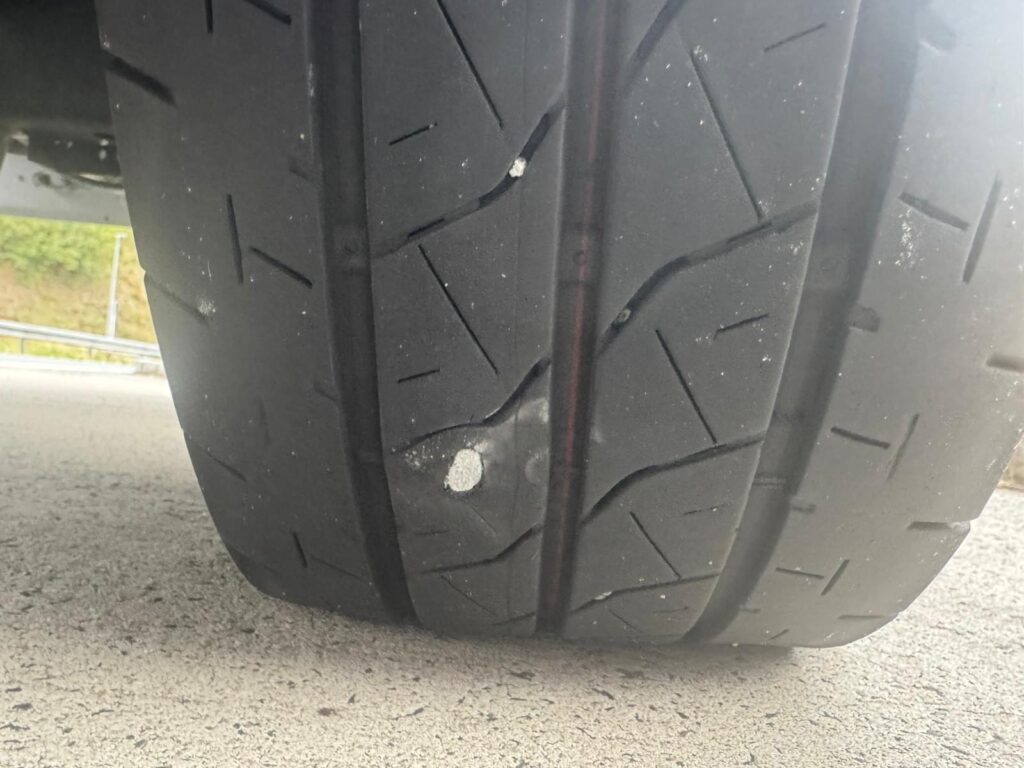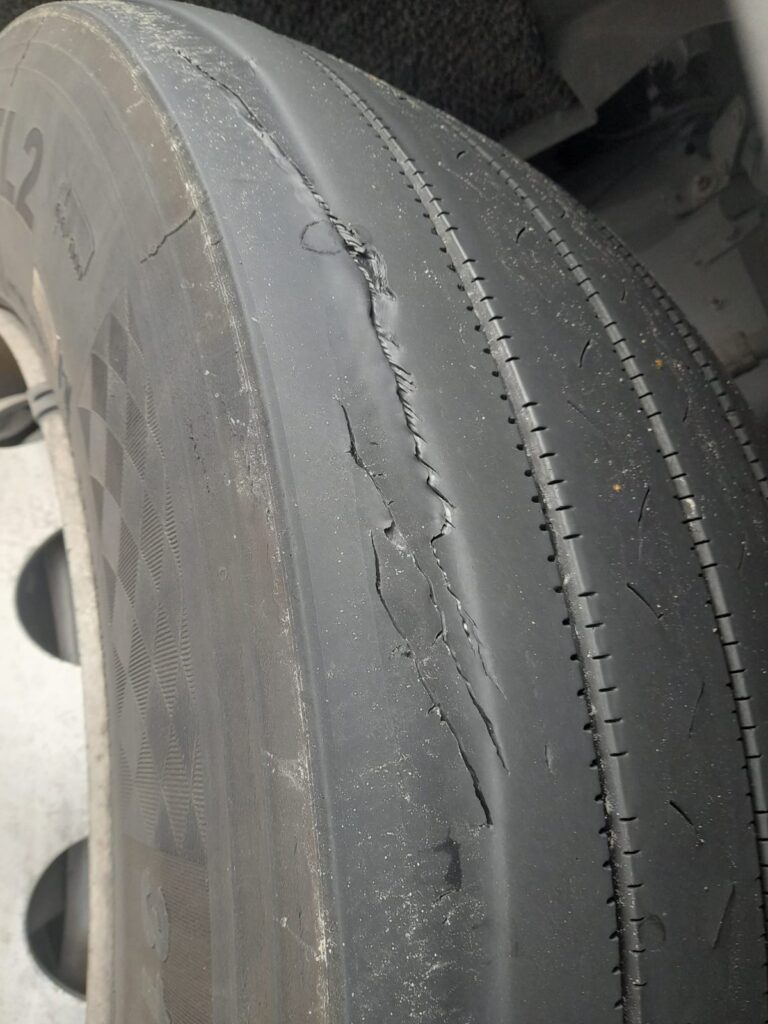
A steer-axle tyre with cracks across the shoulder and bare steel cord showing through the sidewall was replaced at a rest area on the A7 near Kassel, 125 minutes after the first call: 16 minutes of dispatch, 55 minutes of travel, 54 minutes on site. The bill came to €993 net, and nothing else on the lorry was damaged. This is how the job ran, minute by minute, and why a tyre in this condition has to be changed on the spot.
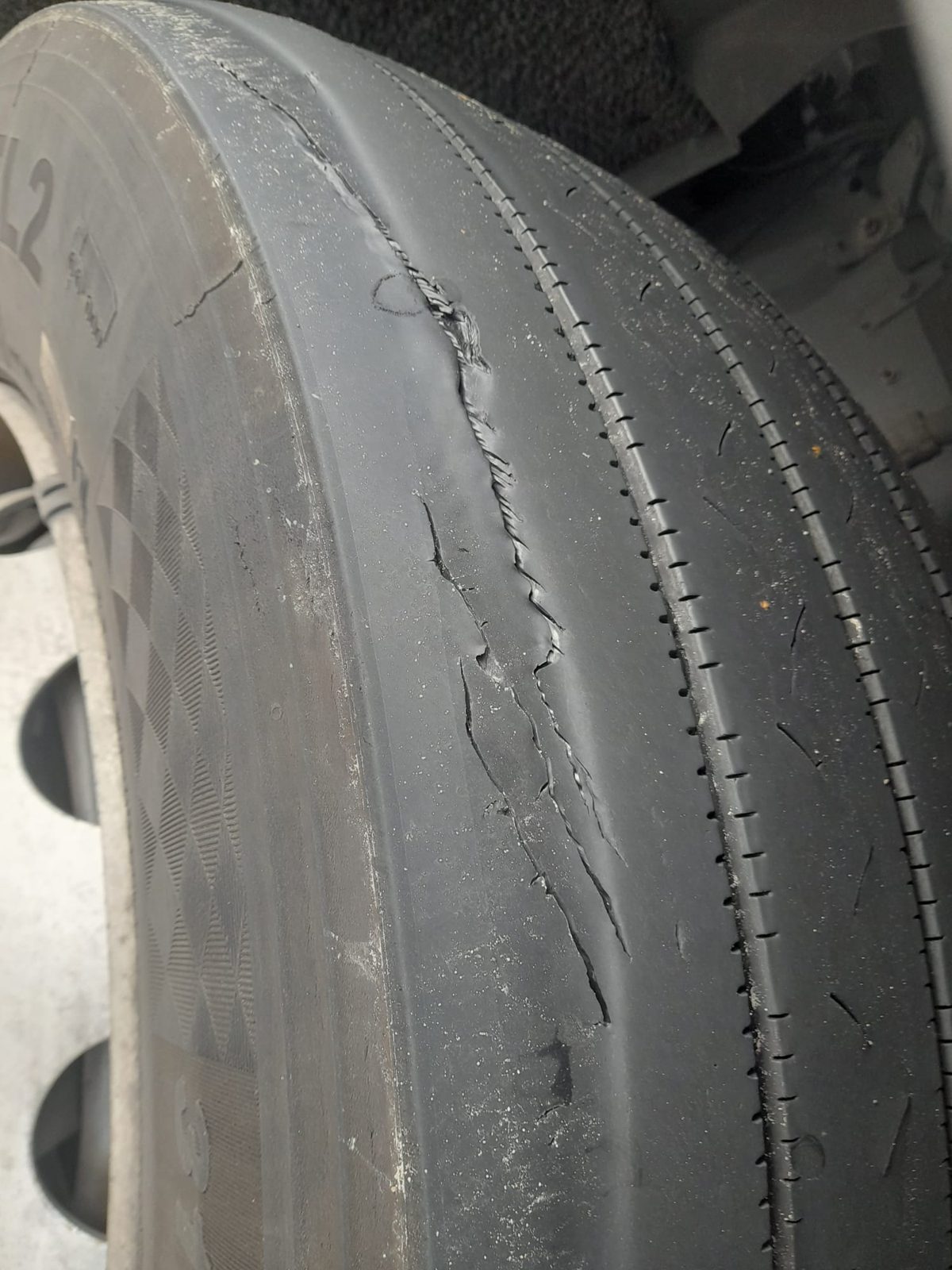
If you only need the short version: our truck tyre service works around the clock across Germany. A driver who spots torn rubber or exposed cord should stop at the next safe place, send us a photo and wait for a crew with the right tyre. Driving on is the expensive option.
A vibration in the wheel, a quick look at the rest area
The driver of a tractor unit heading north on the A7 towards Hannover felt a faint vibration through the steering wheel shortly after Kassel. It was not violent, just a rhythmic shimmy that had not been there an hour earlier. He had enough experience to take it seriously. At about 13:30 he pulled into a rest area in northern Hesse, put the hazards on and walked around the cab with a torch he did not even need on a dry, bright afternoon.
On the front left he found what he had feared. The shoulder of the tyre, that rounded transition between tread and sidewall, was split in several places. In one spot the rubber had torn open deep enough to expose the steel cord of the casing. He took a photo, and at 13:39 the picture landed in our dispatch inbox together with a call to our hotline.
The photo told us most of what we needed. It showed a ribbed steer or all-position pattern, deep cuts at the shoulder, bare cord and a pale rim edge beside it. The size was only partly legible. From the vehicle type and the driver’s description we worked on the basis of a 315/80 R22.5, the most common size on a steer axle of a Euro-spec tractor unit, and confirmed it with him on the phone while he read the sidewall.
What exactly was wrong with the tyre?
The tyre had suffered casing damage, which means the structural layer of steel and fabric under the rubber had been compromised. Casing damage cannot be repaired. A puncture in the tread can often be plugged or patched, but a split shoulder with exposed cord has to be replaced, full stop.
Here is what we saw and what it meant:
- Cracks across the shoulder: the shoulder flexes more than any other part of the tyre. Cracks there spread with every rotation.
- Torn sidewall rubber: once the outer layer is gone, moisture and road salt reach the steel and start corroding it from inside.
- Exposed steel cord: this is the casing itself. The tyre has lost the layer that holds air pressure and carries the load.
- Light vibration: the casing had begun to deform. That deformation produces the shimmy a driver feels in the steering.
On the question of why it happened, we can only be honest about what we know. Neither the driver nor we could point to a single event such as a kerb strike or a tyre hit by debris. The pattern of cracking along the shoulder is typical of a tyre that has run underinflated for some time, or one that has been overloaded or aged beyond its working life. Often it is a combination. The ageing and low pressure never announce themselves until the damage is visible, which is exactly why a regular check matters.
How we organised the help
The call came in at 13:39. By 13:55 a crew was on its way. The sixteen minutes in between are where most of the work happens, even though nobody outside the dispatch room sees it.
- Photo and size check (13:39). The dispatcher confirmed the damage was casing-related, identified the axle (steering, front left) and the size on the sidewall. A damaged steer tyre is treated as urgent because that axle carries the steering and braking forces.
- Location fix. The driver gave the rest area name, direction of travel and the nearest junction. We saved the position and sent him a short message with the arrival procedure.
- Finding the nearest crew with the right tyre. From our partner network we looked for the closest mobile crew with a 315/80 R22.5 premium tyre actually on the van, not just in a warehouse. This step took the longest.
- Price and confirmation. We quoted the full price in advance, net of VAT, and the driver’s dispatcher approved it by phone.
- Dispatch (13:55). The crew left their previous location for the A7.
Our regional partners are independent mobile tyre fitters with a vehicle equipped for heavy wheels, a compressor, a torque wrench and a mobile balancer. We do not name them because the customer deals with us, and we remain responsible for the result. If you want to see the range of jobs we coordinate, our mobile truck service page lists them.
Why you cannot keep driving on cracked rubber
A heavy-goods tyre runs at 8.5 to 9.5 bar, depending on load and axle. At that pressure a steel casing under the tread holds a huge amount of stored energy. If the casing has an open wound, the weakest point can let go without warning.
For a steer axle the consequences are worse than for a trailer. A blowout at the front throws the vehicle to one side. At 80 km/h with a loaded semi that is a few tonnes of momentum going where you did not point it. On the A7, with lorries side by side in both lanes, there is nowhere to go.
Three further reasons not to continue:
- Legal exposure. Section 36 of the StVZO, the German road vehicle licensing regulations, requires tyres to be fit for purpose. A tyre with exposed cord is not. A roadside inspection by BAG or the police will immobilise the vehicle on the spot.
- Damage to the rim. If the tyre loses pressure at speed, the rim runs on the bead and bends. A rim that deforms costs far more than the tyre.
- Insurance. An accident caused by a known, visible tyre defect is the sort of thing an insurer will examine very carefully.
Our guidance to the driver was short. Stay at the rest area, leave the wheel alone, do not try to inflate it, and keep the hazards on until the crew arrives.
The step-by-step repair on the hard standing
The crew reached the rest area at 14:50, 55 minutes after leaving. The A7 on a Monday afternoon is busy around Kassel, and the last stretch of the approach had a traffic-calming queue, which is why we quote 35 to 70 minutes on the motorway rather than a single number.
Step 1: Inspection and pressure check (14:50 to 15:05)
The fitter walked around the whole axle, not just the damaged tyre. He measured the pressure on the opposite steer tyre, inspected the rim edge for dents and hairline cracks, and checked the wheel studs and the hub. Nothing else was damaged. The rim was sound, which was the best news of the afternoon.
Step 2: Securing the working area
The truck was parked on the hard standing of the rest area, not on the hard shoulder. That matters: working on a hard shoulder is the single most dangerous situation for a mobile technician. The crew set wheel chocks on the rear axles, applied the parking brake and put out a warning triangle and cones. Wearing a high-visibility vest is a given.
Step 3: Removing the wheel
The fitter loosened the wheel nuts with the vehicle still on the ground, raised the front axle with a hydraulic trolley jack rated for the axle weight, and removed the wheel. Before the tyre was taken off the rim, the valve core was removed to let the remaining air out safely. He checked the bead seat and cleaned any rust off the rim flange.
Step 4: Fitting the new tyre and balancing
A new 315/80 R22.5 tyre of a premium brand went on the rim with fresh tyre soap and a new valve. After inflation to the working pressure the assembly was balanced on the mobile balancer. For a steer wheel this is not optional: even a 150 g imbalance can cause the same shimmy the driver complained about.
Step 5: Torque, pressure and final check
The wheel went back on the hub. The nuts were tightened in a star pattern with a torque wrench, in two stages, to the manufacturer’s value. For most heavy-goods wheel mounts that value is in the range of 600 to 700 Nm, but it depends on the stud thread and the make of the hub, so the crew always works from the vehicle’s specification. If you want the table, our guide to truck wheel nut torque lists common values. Then the tyre was set to 9.0 bar, the valve cap was fitted, and the crew checked for leaks with soapy water. Re-tightening after a short test run is also standard practice. The driver started up at 15:44.
Full timeline of the call-out
| Time | Phase | Action |
|---|---|---|
| 13:39 | Call | Driver sends photo, dispatcher identifies casing damage, size and axle |
| 13:39–13:55 | Dispatch (16 min) | Nearest partner crew selected, availability of 315/80 R22.5 confirmed |
| 13:55–14:50 | Travel (55 min) | Crew drives to the rest area on the A7 |
| 14:50–15:05 | Inspection and safety (15 min) | Inspection, pressure check, area secured, wheel chocks set |
| 15:05–15:40 | Replacement (35 min) | Wheel removed, new tyre fitted, balanced on site |
| 15:40–15:44 | Final check (4 min) | Nuts torqued in a star pattern, pressure set to 9.0 bar, leak check |
Total time from call to departure: 125 minutes (2 hours 5 minutes).
Anyone who has waited for a tow truck knows that this is a fast result for a motorway call-out on a weekday afternoon. In rain, in the dark or on a Sunday, the dispatch and travel phases are usually longer. We say so in advance rather than promising a figure we cannot keep.
What did the job cost?
The price below is what the customer was quoted and what he paid. All amounts are net, plus VAT.
| Item | Price (EUR) |
|---|---|
| Call-out fee (Anfahrt, A7, daytime) | 240 |
| Tyre 315/80 R22.5, new, premium class | 560 |
| Labour, 1.25 h at €110 per hour | 138 |
| On-site wheel balancing | 35 |
| Disposal of the old tyre | 20 |
| TOTAL | 993 |
What drives the price of a motorway tyre job
- Distance and time of day. Night and weekend call-outs carry a surcharge of 25 to 50 percent on the call-out fee. This job ran in daylight, so there was none.
- Tyre size and brand. A 315/80 R22.5 premium tyre typically costs between €480 and €620 net. A trailer tyre in 385/65 R22.5 is a little cheaper. Budget brands cost less but are not what we suggest for a steer axle.
- Labour. One to one-and-a-half hours at roughly €90 to €140 per hour is typical.
- Balancing and disposal. Small items, but they belong on the invoice because they are part of a correct job.
For a more detailed breakdown by tyre size, see our guide to truck tyre change costs.
Compared with the alternative
A tractor unit with a semi-trailer that stands for a day costs a haulier roughly €800 to €1,200 in lost revenue, driver wages and missed delivery slots. Towing the unit to a workshop would add €850 to €1,600 depending on distance, and then the tyre still has to be bought and fitted. Against that, a mobile job at €993 that is finished in two hours is the cheaper path in almost every case. If the damage turns out to be worse than a tyre, we cover that through our towing service.
Frequently asked questions
Can a cracked truck tyre sidewall be repaired?
No. A cracked sidewall or shoulder, especially with exposed steel cord, cannot be repaired safely. Repairs are only suitable for small punctures in the tread area. Sidewall damage must lead to a replacement, as the flexing zone cannot hold a patch.
How long does a mobile truck tyre change on the motorway take?
On this job the crew spent 54 minutes on site, 35 of them on the actual replacement. From the first call to departure it took 125 minutes. Typical ranges are 1.5 to 3 hours, depending on traffic, weather and time of day.
How much does emergency truck tyre replacement cost in Germany?
A steer-axle tyre in 315/80 R22.5 usually costs between €750 and €1,400 net, including call-out and labour. In this case the total was €993 net. Night work and weekends add to the call-out fee.
Is it safe to drive slowly to the next exit with exposed cord?
No. Even at low speed the casing can fail suddenly, and a steer-axle failure takes away your control. Stop at the nearest safe place such as a rest area or lay-by, and call for a mobile crew instead.
What should I do before the tyre crew arrives?
Park on firm ground, apply the handbrake, switch on the hazards and place the warning triangle. Wear a high-visibility vest if you leave the cab. Photograph the damage and the size marking, then send it to dispatch. Do not attempt to inflate the tyre.
Do you also change trailer tyres?
Yes. We handle steer, drive and trailer axles for lorries, tractor units, trailers and vans. The most frequent sizes are 315/80 R22.5, 385/65 R22.5 and 245/70 R19.5.
Why you should leave this to a professional
Changing a heavy-goods tyre by the roadside looks straightforward to anyone who has done it once. It is not. These are the risks drivers take when they try it themselves or call someone without the right equipment:
- A truck wheel with tyre weighs about 100 kg. Lifting it onto a hub without a wheel dolly is a back injury waiting to happen.
- A standard car jack will not hold a loaded axle. Hydraulic trolley jacks rated for the axle are essential.
- Inflating a tyre to 9 bar without a cage or a long air line can be lethal if the bead lets go.
- Wheel nuts tightened by feel are often too loose or too tight. Over-tightened studs stretch, under-tightened nuts let the wheel work loose.
- A tyre mounted without balancing leads to vibration, uneven wear and stress on the wheel bearings.
- A tyre fitted by an unknown operator may be an old retread or the wrong load index for your axle.
A fitter on a mobile crew does this ten or fifteen times a week. The routine is what makes a 35-minute wheel change possible on a rest area surface in a crosswind.
Typical situations we handle across Germany
Cracked rubber on the A7 is one pattern among many. Our crews are called to the following situations every week:
- Tyre blowouts on steer and drive axles, particularly in summer heat on the A5, A3 and A2.
- Slow punctures from screws and nails, discovered at the morning walk-round.
- Sidewall cuts from kerbs at loading ramps and yard exits.
- Damaged rims after running flat for a stretch.
- Valve failures and loose wheel nuts after a recent wheel change.
- Trailer tyre damage from gravel at motorway rest areas.
- Seasonal changes for fleets, from summer to winter and back.
- Spare wheel changes for vans and light commercial vehicles in 235/65 R16C.
If your situation is not on the list, call anyway. Our truck tyre service page explains what else we handle, from mounting and balancing to emergency call-outs.
Prevention: how to avoid this call-out
Most casing damage is not sudden. It builds up over weeks. A few habits cut the risk sharply:
- Check pressure weekly, cold. Underinflation is the main cause of shoulder cracking. A tyre that loses 1 bar flexes more, runs hotter and wears the shoulder first. Our page on truck tyre pressure shows the target values for common loads.
- Walk around the vehicle before every trip. Look for bulges, cuts, torn rubber, embedded stones and uneven wear. Thirty seconds can save a day.
- Watch the age. Tyres older than about six years deserve extra attention even when the tread depth is fine. The four-digit DOT date code on the sidewall tells you the week and year of manufacture.
- Keep an eye on the minimum tread depth. The legal limit for lorries is 1.6 mm, but for steer tyres most fleets replace them well before reaching that.
- Never mix tyre brands and heights on twin wheels. A pair with different diameters overloads one tyre and wears both prematurely.
- Rotate and inspect on a schedule. A planned tyre check at your depot or yard costs a fraction of an emergency call-out.
- Report any new vibration at once. A shimmy in the steering is the early warning that this driver heeded.
Fleet managers can request a regular inspection programme from us, so the annoying surprises are caught in the yard, not on the autobahn.
Truck tyre maintenance for fleets: brands, sizes and standards
Tyre choice on a fleet is mostly about total cost per kilometre, not the purchase price. Premium makers such as Michelin invest heavily in casing quality, which matters because a good casing can be retreaded once or twice. Continental, Goodyear and Bridgestone follow the same logic with their own premium lines, and each offers dedicated steer, drive and trailer patterns.
Which pattern goes where:
| Axle | Typical pattern | Purpose |
|---|---|---|
| Steer | Ribbed | Precise steering, low rolling resistance |
| Drive | Block or open shoulder | Traction and long wear |
| Trailer | Ribbed or semi-block | Load capacity, even wear |
Sizes are standardised. The common ones on German roads are 315/80 R22.5 for steer and drive axles, 385/65 R22.5 for trailer axles and 245/70 R19.5 for lighter vehicles. The meaning of the digits (width in millimetres, aspect ratio, construction, rim diameter in inches) is defined in the standards published by the ETRTO. The load index and speed rating following the size tell you how much weight each tyre may carry and at which speed. A tyre with a lower load index than the axle needs is a hidden danger and will fail early.
Beyond the tyre itself, inspection bodies such as DEKRA publish guidance on tyre condition and vehicle safety that is worth reading for fleet managers. A pressure monitoring system fitted to the tractor unit and the trailer gives an early warning if pressure drops. Retreaded casings are common on drive and trailer axles, but on the steer axle most operators in Germany prefer new tyres.
If you want a refresher on what the markings mean, our article on what to do after a blowout on the autobahn gives a checklist drivers can keep in the cab.
Why hauliers and drivers choose us
- Available 24 hours a day, 365 days a year across all of Germany, including motorways, rest areas and industrial estates.
- A vetted partner network. Crews are selected for equipment and track record. We stay responsible for the result and the invoice.
- A fixed price before the crew sets off. No surprises on the invoice, and all amounts are shown net.
- Dispatchers who speak your language. Our team handles calls in German, English, Polish and Russian, so a driver from abroad does not need to explain a technical fault in a second language.
- Photo-based diagnosis. A picture of the damage and the sidewall speeds up the parts search and shortens the wait.
- One contact for tyres, repair and towing. If the problem turns out to be more than a tyre, we escalate within the same call.
Summary
| Item | Value |
|---|---|
| Vehicle | Tractor unit, steer axle front left |
| Tyre size | 315/80 R22.5 (working assumption) |
| Location | A7 near Kassel, northern Hesse, direction Hannover |
| Damage | Cracked shoulder and sidewall, exposed steel cord |
| Time to dispatch | 16 minutes |
| Travel time | 55 minutes |
| Time on site | 54 minutes (35 for replacement) |
| Total from call to departure | 125 minutes (2 h 5 min) |
| Cost | €993 net |
| Secondary damage | None, rim intact |
Call us when the tyre says stop
If you see cracks, cuts or bare cord on a tyre, stop, send a photo and call. Our crews cover the whole of Germany, day and night.
Phone: +49 160 5753826
Website: www.lkwhelp24.com
Around the clock, anywhere in Germany
Keywords: truck tyre service | mobile truck tyre service | truck tyre replacement | truck tyre change | truck tyre callout | truck tyre roadside assistance | truck tyre repair | truck tyre breakdown germany | trailer tyre service | truck tyre emergency | A7 Kassel | tyre sidewall damage | steel cord exposed | 315/80 R22.5
Related articles
- Truck Tyre Repair 2026: When It Works and When Only Replacement Will Do
- Tire Blowout on the Autobahn: The Immediate Action Checklist for Truck Drivers
- Truck Tyre Pressure: Correct Values, How to Measure and Mobile Help
- Truck Wheel Nut Torque: Table and Correct Mounting Procedure
- Emergency Tire Service for Trucks: Fast Help Around the Clock