A tractor unit stopped at a rest area on the A9 near Ingolstadt, heading towards Munich, because its tyre pressure warning would not go away. Our truck breakdown service had a mobile team from the partner network on site 55 minutes after the call, read out the control units, checked the sensors and retrained the system. The lorry was back on the autobahn 2 hours 15 minutes after the first phone call, for a net total of 540 EUR (excl. VAT).
The driver did the sensible thing. A yellow tyre symbol with an exclamation mark is easy to ignore for a few hours, but he did not trust a warning on a unit with roughly 746,800 km on the clock, so he pulled off at the next parking area instead of carrying on to the delivery. This article walks through the whole job: what the display showed, how the help was organised, what was checked, what it cost and what fleets can learn from it.
What happened on the A9 near Ingolstadt?
A foreign-registered artic with a Romanian-language dashboard stopped at a rest area on the A9 near Ingolstadt, direction Munich, after the tyre pressure warning lamp came on and stayed on. The driver rang our 24/7 line at 10:00 on a mild, dry morning. He was not stranded in the sense of a blowout or a smoking engine. He simply had a tractor unit that was telling him something was wrong with its tyre monitoring, and he could not tell what.
The dispatcher asked the questions that matter in this situation. Does the lorry pull to one side? Is any tyre visibly low? Is the lamp steady or flashing? Has anything changed since the last stop? The driver had walked round the unit and could see no flat tyre, no bulge and no hissing valve. The tyres looked normal, but the lamp stayed on.
That combination is the classic reason to call a mobile truck mechanic in Germany instead of guessing. When the wheels look fine and the warning persists, the fault is either a real slow pressure loss that nobody can see, or an electronic problem in the sensors, the receiver or the control unit that evaluates them. Both need a diagnostic tool and a pressure gauge, and neither is a job for a driver with a hand-held gauge and a mobile phone.
The unit and the symptoms
The vehicle was a modern tractor unit from a foreign haulier, running without a trailer problem and without any reported vibration. We deliberately do not name the make, because the facts of this job do not depend on it: the dashboard had a tyre pressure monitoring system (TPM, called RDKS in German), and its fault memory held entries.
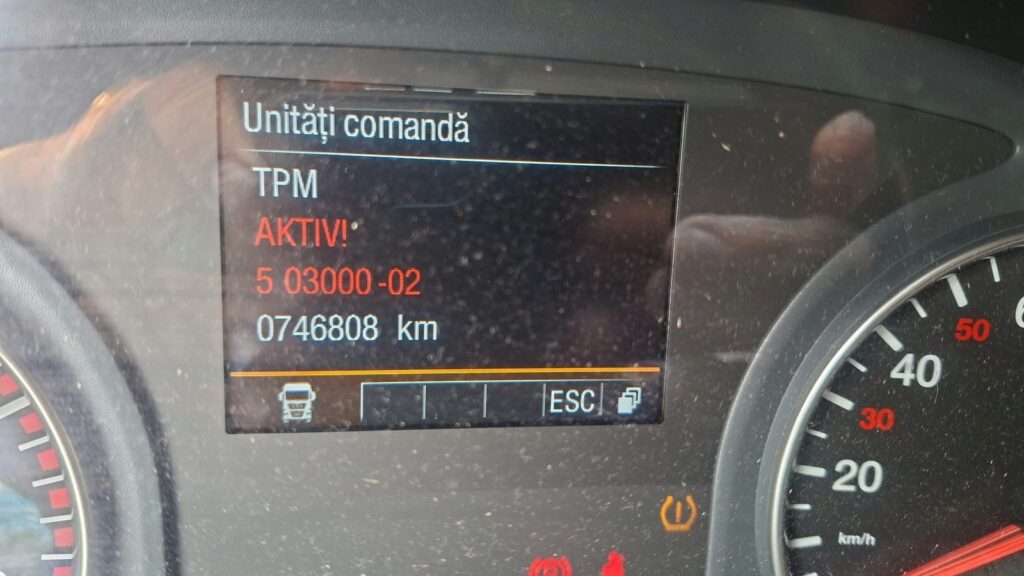
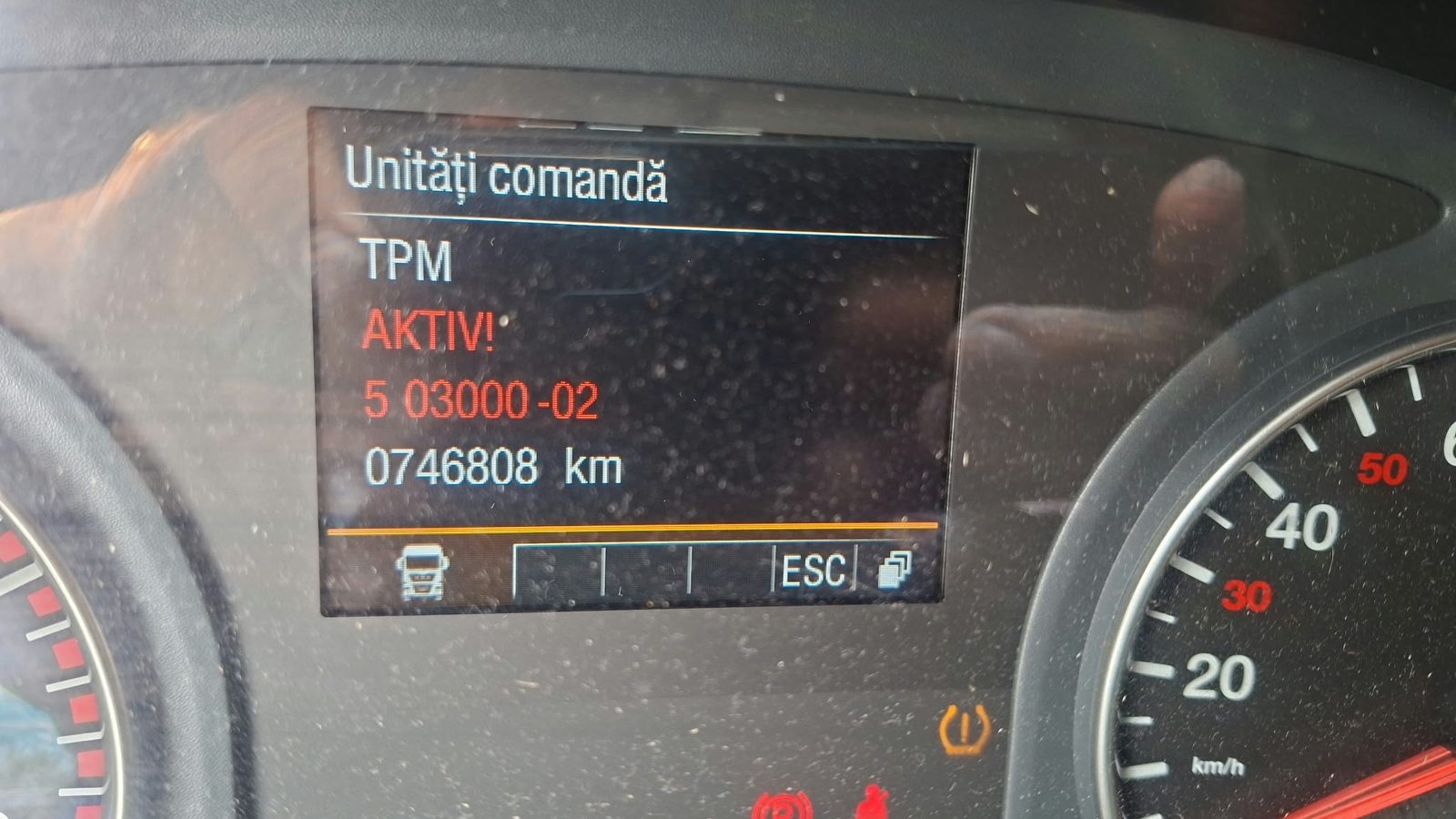
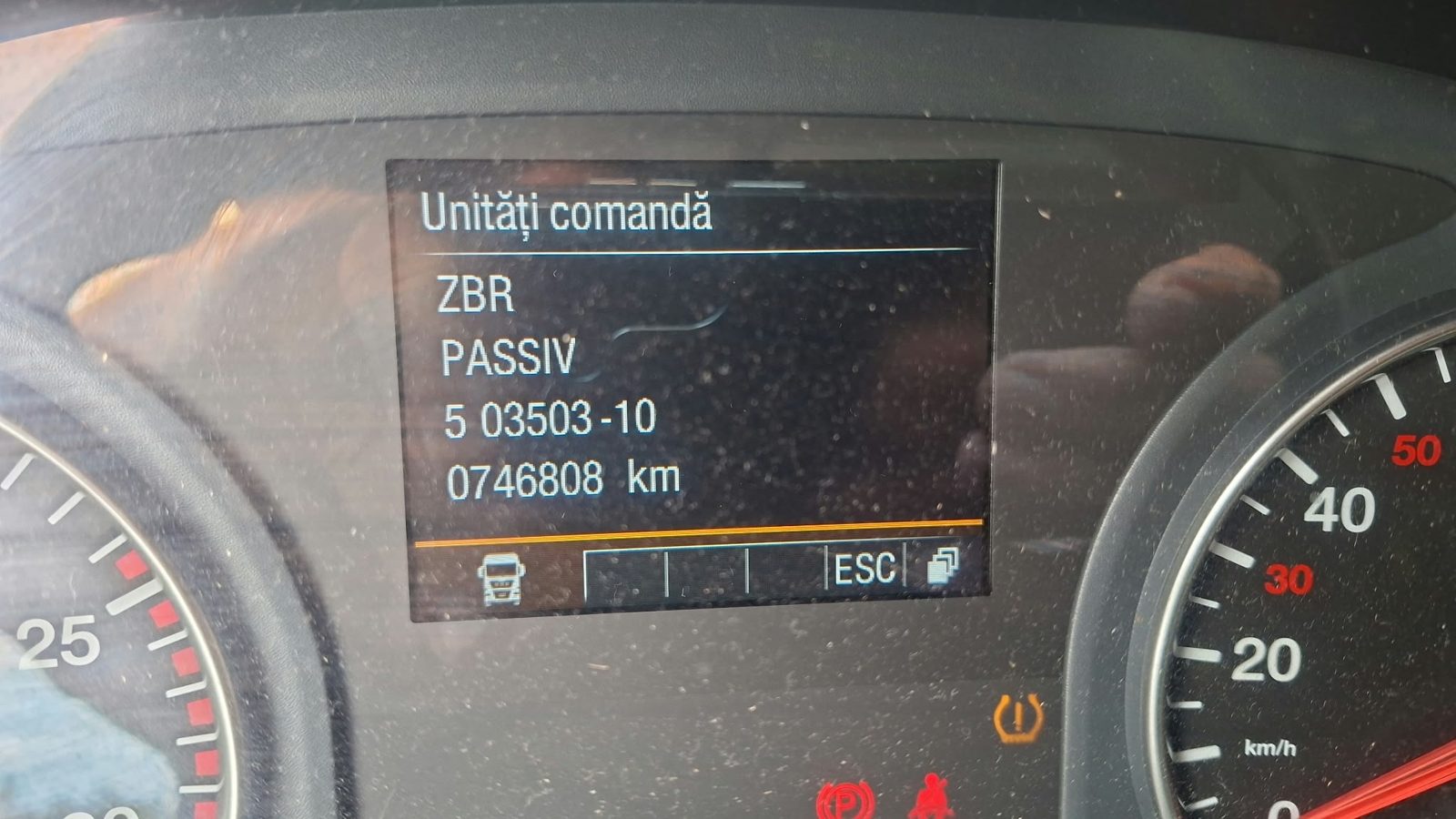
When the driver scrolled the display menu to the control units page (labelled in Romanian), two entries stood out:
- TPM: status ACTIVE, shown in red, fault code 5 03000-02.
- ZBR: status PASSIVE, fault code 5 03503-10.
The odometer showed 746,808 km on both screens. The yellow tyre pressure lamp lit on both pictures, and the red parking brake and seat belt indicators were showing as well, which is normal on a parked vehicle with the engine in a particular state. The driver photographed both screens, which gave our dispatcher and the technician exactly what they needed before anyone had driven a metre.
How did we organise the help?
Dispatch took 15 minutes: our team found a mobile crew in the regional partner network, confirmed it had a diagnostic interface and pressure equipment on board, and agreed the price with the driver before the van left. The crew was on the rest area at 10:55, 40 minutes after setting off.
The sequence behind the scenes is the same on every job, and it is worth spelling out because it is what keeps the price honest:
- Take the call and qualify the fault. We ask about symptoms, location, direction, fuel level, cargo and whether the lorry can still be driven safely. We never send a crew blind.
- Collect the evidence. Photos of the warning lamps and the diagnostic screens went to the dispatcher straight away. That is how the two fault codes were known before the technician arrived.
- Pick the right crew. A pure puncture needs a tyre fitter with a van full of casings. An electronic warning needs somebody with a diagnostic tool, sensor knowledge and a calibrated pressure gauge. We sent the second profile, with tyre equipment as well.
- Agree the price in advance. The driver heard the call-out fee, the diagnostic fee and the hourly labour rate before approving the job. Everything is quoted net, excluding VAT.
- Follow the crew and keep the haulier informed. The driver and his dispatcher at home both knew the arrival time and the plan.
Our multilingual dispatch matters here too. The driver spoke limited German, the dashboard was in Romanian, and the technician worked in German. The dispatcher bridged all three. A fault code read aloud in the wrong language is how a wrong part gets ordered.
If you want to understand the general logic behind this, our page on mobile truck service in Germany explains what a mobile crew carries and which jobs it can finish on the spot.
Why can a tyre pressure warning not be ignored?
A tyre pressure warning on a truck must be treated as a real fault until a gauge proves otherwise, because truck tyres run at 8.5 to 9.5 bar and lose their safety margin quickly when pressure drops. A tyre that is 1.5 bar low can look perfectly normal from the cab and still overheat within a few hundred kilometres.
Here is what is at stake:
- Heat. An under-inflated tyre flexes more, builds heat in the sidewall and can fail suddenly. Most blowouts we attend on the autobahn started as a slow pressure loss that nobody noticed.
- Load per axle. A tractor unit’s drive axle carries heavy loads, and the trailer’s axles are no lighter. If one tyre of a twin pair loses pressure, its partner carries the extra weight and wears or heats faster.
- Rims and carcass. Driving on a soft tyre damages the carcass, and once the inner structure is destroyed the casing cannot be retreaded. In worse cases the rim is affected too.
- Roadside inspection. The tyre rules in section 36 of the StVZO require tyres that are suitable and roadworthy for the vehicle, and an officer who finds a visibly soft tyre on a loaded lorry will not be impressed by “the lamp came on this morning”.
- Time. Truck drivers work against tachograph limits. Every hour lost to an unplanned stop eats driving time that cannot be recovered the same day.
A frequent question is whether the system might simply be wrong. Sometimes it is. Sensors have batteries, receivers lose their pairing after a wheel change, and control units occasionally log a stored fault that is no longer active. But that is an answer you get after measuring, not before. Our rule at the roadside is simple: check each tyre with a gauge first, read the fault memory second, and only then decide whether it is a pressure problem or an electronic one.
More background on correct values is in our guide to truck tyre pressure.
What does a TPM fault code actually tell you?
A TPM fault code tells you which part of the monitoring chain has reported a problem, not necessarily which tyre is low. The system is usually made of wheel sensors, a receiver or antenna, and one or more control units that compare the readings with set thresholds and warn the driver.
TPM (tyre pressure monitoring) is the system that measures pressure, and often temperature, at each wheel position and passes the values to the dashboard. The German abbreviation is RDKS. A control unit (Steuergerät) is the on-board computer that handles a function such as braking, gearbox, or in this case, tyre monitoring. A fault memory is the log in which a control unit stores events with a code and a status, such as active or passive.
In this job the two codes meant the following:
| Entry | Status | Code | Practical meaning |
|---|---|---|---|
| TPM | ACTIVE | 5 03000-02 | The tyre monitoring system currently reports a fault. The warning lamp is on for a reason that exists right now. |
| ZBR | PASSIVE | 5 03503-10 | The other unit has a stored entry that is not currently active. It may be linked, or it may be an old entry. |
We read the codes as pointers, not as a diagnosis. An active entry plus a passive entry on a second unit tells the technician where to look first and what to confirm. Code numbers are manufacturer-specific, so we never guess a cause from a number alone. We checked the physical tyres, the sensors and the system response, and the repair followed from that.
One honest caveat: a stored passive code does not always mean there is a defective part. Some entries are written during a power dip, after a battery disconnection or while sensors reconnect. The technician’s job is to separate real faults from historical noise.
How did the technician work through the fault, step by step?
The crew solved the problem in five steps: look, secure, diagnose, correct and test. The whole on-site work took 80 minutes between arrival and the end of the test run.
Step 1: Inspect and secure the position
The van parked behind the tractor unit on the rest area. The technician put on a warning vest, placed the warning triangle where required and chocked the wheels. A rest area is safer than the hard shoulder, but trucks still move around it all the time, so the crew worked with the van between the lorry and the slip road where possible.
Step 2: Check the pressure on every wheel
Before touching the diagnostic tool, the technician walked the unit and measured each tyre with a calibrated gauge. This takes a few minutes but sets the baseline: if one tyre is low, the warning is real; if all are within spec, the fault is electronic. He also checked valve caps and valves for leaks, looked for stones and nails in the tread, and compared the twin tyres for uneven wear.
Step 3: Read the control units
The diagnostic read-out took 25 minutes in total, starting at 11:20 after the first inspection. The technician connected the tool, confirmed the active TPM entry, the passive ZBR entry and the mileage, and noted the exact codes. He then looked at live data from the sensors and checked whether every wheel position was reporting.
Step 4: Check the sensors, reset and retrain
This part took 40 minutes, finishing at 12:00. The crew checked the TPM sensors, replaced small parts such as valve caps and seals where needed, brought the pressures to the specified values, cleared the stored faults and ran the learning procedure so that the system recognised every wheel position again. We do not claim a dramatic component failure here. The record shows a checked system, corrected pressure values and a relearn that completed.
Step 5: Test drive and final check
At 12:15 the technician took a short test run with the driver. The TPM entry did not return, the lamp stayed off and the pressures held. He then rechecked the wheel nut condition and the valve seats. For the record, whenever a wheel has been off the hub we torque the nuts in a star pattern; here no wheel had to come off, so that step was a visual check only.
The driver signed off, thanked the crew and left. The unit had been parked for 135 minutes from the first call.
What does the timeline look like from call to departure?
The job took 135 minutes from the driver’s call to departure, of which the crew spent only 40 minutes travelling and 105 minutes on dispatch plus work. The table shows every phase.
| Time | Phase | Action |
|---|---|---|
| 10:00 | Call | The driver reports the TPM warning; the dispatcher asks for mileage and the fault screen |
| 10:15 | Dispatch | A mobile crew from the partner network is found and the price is agreed (15 min) |
| 10:55 | Arrival | The crew reaches the rest area (40 min travel) |
| 11:20 | Diagnosis | Control units read out, codes 5 03000-02 (TPM) and 5 03503-10 (ZBR PASSIVE) logged, pressures checked (25 min) |
| 12:00 | Repair | TPM sensors checked, system reset and relearned (40 min) |
| 12:15 | Test and departure | Test run, no fault returns (total 135 min = 2h 15min) |
Two points are worth stressing. First, 135 minutes sits at the faster end of what is realistic for a rest-area job on the A9. Second, it was a morning in dry weather. In rain, heavy traffic or at night, expect longer arrival times, and our dispatcher will tell you honestly if that is the case.
What does a truck breakdown service like this cost?
This job cost 540 EUR net (excluding VAT), made up of the call-out fee, the diagnostic work, one hour of labour and small materials. The prices below are the actual amounts for this case.
| Item | Price (EUR) |
|---|---|
| Call-out (Anfahrt) | 240 |
| Diagnostics of electronics and control units | 150 |
| Labour, 1 hour (pressure check, TPM sensors, reset and relearn) | 110 |
| Small materials (valve caps, seals) | 40 |
| TOTAL | 540 |
All figures are net, plus VAT where applicable.
What drives the price up or down?
Three factors move the total more than anything else:
- Distance and timing. The call-out fee covers the crew’s drive and is higher at night and at weekends, typically with a surcharge of 25 to 50 percent. This was a weekday morning, so no surcharge applied.
- Scope of work. Reading a fault memory and resetting a system is cheaper than replacing a sensor or a tyre. If a sensor had been dead, we would have quoted the part separately before ordering it.
- Parts. A valve cap costs next to nothing, a tyre casing costs hundreds. A transparent quote lists them separately.
Compared with the alternative
A tractor unit that sits for a day costs a haulier roughly 800 to 1,200 EUR in lost revenue, wages and missed slots. Set against that, a 540 EUR repair finished before lunch is the cheaper option by a clear margin. The other cost is the one nobody budgets: if the lamp had been a real slow leak, driving on could have ended in a blowout and a recovery bill many times higher. Our article on truck tyre repair explains where the line between repair and replacement lies.
Which questions do drivers ask about this kind of breakdown?
How long does it take to fix a TPM fault on a truck?
On this job, 135 minutes from the call to departure, with 80 minutes of actual work. A simple reset can take less; if sensors or tyres need replacing, plan for more. Arrival time on a German autobahn is usually between 35 and 70 minutes.
Can I keep driving with the tyre pressure warning on?
Only if you have measured every tyre with a gauge and found them within specification. If you cannot measure, stop at the next safe parking area. Truck tyres run at 8.5 to 9.5 bar, and a hidden pressure loss can lead to a blowout within a few hundred kilometres.
Who pays for the diagnostic check?
The vehicle owner or haulier pays the call-out and the work, unless a warranty or a service contract covers it. We quote everything in advance, net of VAT, so the driver or dispatcher can approve the job before the crew leaves. Insurers decide separately whether to reimburse costs.
Do you only help trucks, or also vans and trailers?
We help tractor units, rigid lorries, trailers and vans. The price list differs by vehicle class, and a van job is usually cheaper than a tractor unit job. Tell the dispatcher what you drive and what you see on the display.
What should I send to the dispatcher?
Your exact location (autobahn, direction, nearest junction), the vehicle type, what the display says and a photo of any warning screen. A photo of the fault codes saves 10 to 15 minutes of questions and lets us pick the right crew.
Will the fault come back?
In this job it did not return during the test run. If a sensor battery is nearly empty, a recurrence can happen weeks later, which is why we recommend a workshop check at the next planned service. We never promise that an electronic warning is gone for good.
Why do you need a professional for this kind of fault?
You need a professional because the repair involves diagnostic access, calibrated measurement and a correct relearn procedure, and mistakes can leave the system unreliable or the warning permanently on. A driver with a gauge can find a flat tyre. A driver cannot normally read a control unit.
Common DIY mistakes we see:
- Inflating all tyres to the maximum value “to be safe”, which damages the casing and spoils the handling.
- Disconnecting the battery to clear the lamp, which wipes useful information from the fault memory and sometimes triggers new faults.
- Replacing a sensor without registering it, so the system reports a missing wheel.
- Ignoring the passive entries and missing a link between two units.
- Driving on to the next workshop with an unknown pressure loss.
- Skipping the test run after a reset, so the problem is only discovered on the next motorway stretch.
A technician carries the diagnostic interface for the make, a reference pressure table, replacement valves and the know-how to tell a real problem from a historical entry. That is what the diagnostic fee pays for.
Which breakdowns do we attend across Germany?
We attend a broad range of breakdowns at rest areas, truck stops, yards and on the hard shoulder, and the pattern is rarely a single dramatic failure. The most frequent calls from the past months include:
- Tyre blowouts and slow punctures on steer, drive and trailer axles.
- Dashboard warnings: tyre pressure, AdBlue, engine protection, brake and air system faults.
- Battery and starting problems, including 24 V jump starts.
- Air leaks, brake valves and trailer connection faults.
- Cooling and hydraulic leaks.
- Clutch, gearbox and propshaft problems.
- Pre-trip and post-accident safety checks.
- Recovery and towing when the vehicle cannot be repaired on site.
If you want to see how a similar warning was handled on another route, read about a dashboard warning light on the A93 near Weiden, where mobile diagnostics got a tractor unit moving again in under two hours. When a fault cannot be fixed on the spot, our truck service network can take over in a workshop.
How can drivers and fleets prevent TPM warnings and flat tyres?
Prevention comes down to regular measurement, tidy records and a short routine at every stop. None of it is complicated, but fleets that do it have far fewer roadside calls.
For drivers:
- Check tyre pressure cold, with your own gauge, at least once a week and before long trips.
- Walk round the unit at every stop and look at the tread, sidewalls, valves and wheel nuts.
- Do not ignore a lamp that comes on and goes off again. Note the date, the place and the load.
- Photograph any unusual display and keep the picture for the workshop.
- Report sensor warnings to the fleet manager the same day.
For fleet managers:
- Keep a log of tyre pressures and sensor warnings per vehicle and per wheel position.
- Replace sensors in sets or according to the supplier’s recommended interval, since their batteries age together.
- Schedule a pressure and sensor check at every service.
- Train drivers on what the warning means and who to call.
- Keep the dispatcher’s number and the vehicle’s details in the cab.
Independent inspectors such as DEKRA and testing bodies publish guidance on roadworthiness checks, and it is worth a look when you write your internal checklist.
What should you know about truck tyres and fleet maintenance?
Good tyre management saves more money than almost any other maintenance habit in a fleet. Tyres are among the largest running costs after fuel and wages, and the way they are inflated, matched and rotated decides how many kilometres they deliver.
The common sizes we handle are 315/80 R22.5 on steer and drive axles, 385/65 R22.5 on trailers, 245/70 R19.5 on lighter rigid trucks and 235/65 R16C on vans. ETRTO publishes the standards behind these size markings and the permitted rim and load combinations. If you need a refresher on reading the sidewall, our guide to how to read truck tyre markings covers size, load index and DOT code.
Brands and what to look for
The premium manufacturers such as Michelin, Continental, Goodyear and Bridgestone offer casings that can be retreaded, which lowers the cost per kilometre if the casing is looked after. That is only possible if the tyre has not been run underinflated. A single stretch driven on a soft tyre can destroy the casing, so pressure monitoring does pay for itself.
When selecting tyres for a fleet, consider:
- the axle position (steer, drive, trailer) and the load per wheel;
- the typical route: long-haul motorway, regional distribution or construction;
- the load index and speed rating on the sidewall;
- the retread policy;
- whether the vehicle needs winter or all-weather markings.
Why pressure monitoring is more than a convenience
A working TPM system gives the driver early information about slow leaks and temperature rise. It does not replace the gauge, and it does not replace the walk-round. It does however catch the problem that happens at kilometre 400 of a 600 km run, when the driver has no time to look. A fleet that acts on every warning has fewer blowouts and fewer unplanned recoveries.
Why do drivers and fleets choose lkwhelp24?
Drivers and fleets call us because we answer around the clock, send an appropriate crew and tell them the price before the van leaves. The rest is detail, but the detail matters.
- 24/7 availability across Germany, including nights, weekends and public holidays.
- A vetted partner network of mobile crews with the right equipment for tyres, electronics and recovery.
- Price transparency. Call-out, diagnostics, labour and materials are listed separately and quoted net.
- A multilingual dispatch team that talks to drivers in their own language and to the technician in German.
- Photo-based triage. Pictures of the display or the damage help us choose the right team the first time.
- Documentation. After the job you get a clear invoice and a summary of what was found and done.
Need a human straight away? Our contact page lists all the ways to reach the dispatch team, and the phone line is always the fastest.
Summary
- Vehicle: tractor unit of a foreign haulier, about 746,800 km, tyre pressure lamp on, TPM fault code 5 03000-02 active, ZBR code 5 03503-10 passive.
- Location: rest area on the A9 near Ingolstadt, direction Munich.
- Response: 55 minutes from call to arrival (15 minutes dispatch, 40 minutes travel).
- Work: 25 minutes diagnosis, 40 minutes sensor check, reset and relearn, then a test run.
- Total time: 135 minutes, 2 hours 15 minutes, from the call to departure.
- Cost: 540 EUR net, excluding VAT.
- Secondary damage: none, because the driver stopped as soon as the warning appeared and the tyres were never run flat.
- Lesson: a persistent tyre pressure warning deserves a gauge and a diagnostic read-out, not a guess.
Stuck with a warning lamp or a flat tyre? Call now
If a warning lamp will not go out, a tyre looks soft or your lorry will not move, call our dispatcher and describe what you see. We will find the nearest suitable crew and give you the price before anybody sets off.
Phone: +49 160 5753826
Website: www.lkwhelp24.com
Open around the clock, anywhere in Germany.
Keywords: truck breakdown service | truck service germany | roadside assistance germany | truck mobile service | mobile service truck | truck repair | mobile truck maintenance | truck assistance | emergency roadside | tyre pressure warning truck | TPM fault | truck breakdown
Related articles
- Dashboard Warning Light on the A93 near Weiden: Mobile Engine Diagnostics
- Truck Repair on the Road: What Can Be Fixed Right on the Spot
- AdBlue Warning with a Countdown on the A2 near Helmstedt
- Tyre Check After Standstill: DAF Tractor Unit at the A81 Heilbronn Truck Stop
- Mobile Truck Mechanic in Germany: How to Call for Help
