Skip to content
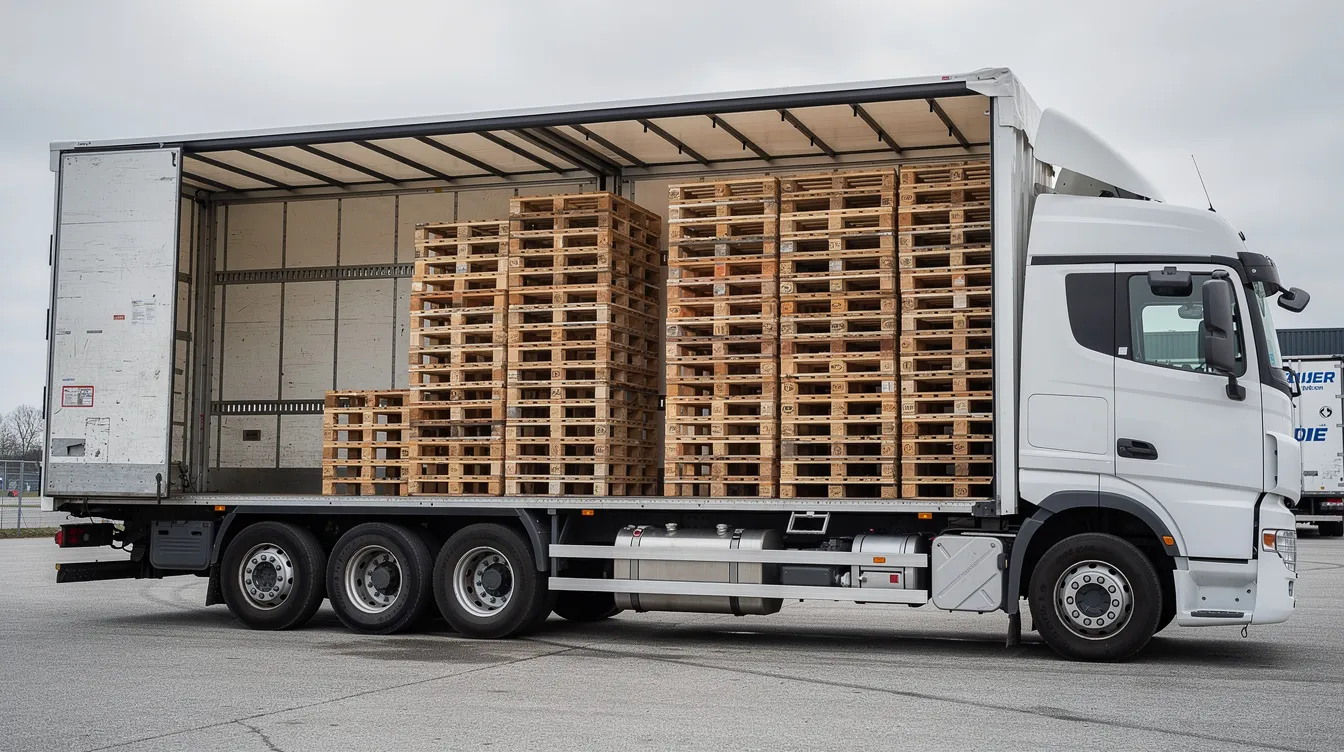
The number of pallets that fit in a truck varies between 12 and 36 depending on vehicle type. A 7.5 t rigid truck typically holds 12 to 15 pallets, while a standard 40-tonne articulated lorry with a 13.6 m cargo floor can accommodate up to 33–34 Euro pallets or around 25 industrial pallets. The exact figure depends on three factors: pallet dimensions, truck dimensions and the arrangement chosen (crosswise, lengthwise or stacked if height permits).
Precise planning of pallet capacity has a direct impact on transport costs, load utilisation and CO₂ emissions. Studies show that optimal loading can reduce CO₂ output by 20 to 30 per cent — simply by avoiding empty runs and under-loaded transports. This article provides all the information you need on common pallet types, the most important truck types, step-by-step calculation examples, a practical summary table and answers to frequently asked questions about pallet transport.
Common Pallet Sizes in Freight Transport
Choosing the right pallet size forms the foundation of every load-space calculation. Standard dimensions enable efficient logistics and greatly simplify planning for goods transport.
Euro pallet (EPAL): The Euro pallet measuring 1,200 × 800 mm (height 144 mm) is the standard in European freight transport. Standardised under DIN EN 13698-1, it has a static load capacity of up to 4,000 kg and a dynamic load capacity of 1,000 to 1,500 kg. Its width of 800 mm makes it possible to position three pallets side by side on a standard cargo floor.
Industrial pallet: At 1,200 × 1,000 × 144 mm, the industrial pallet is larger and is used mainly in machinery and plant engineering. However, the extra width means only two pallets can be placed crosswise next to each other on a truck loading floor, which reduces the number of pallet spaces per vehicle.
Other common formats:
- Half pallet: 800 × 600 mm – ideal for smaller quantities and point-of-sale goods
- Display pallet: 600 × 400 mm – optimised for retail floor space
- Disposable pallets: variable dimensions, usually pressed wood, for single-use dispatch
A practical advantage: many special pallets are based on the Euro pallet grid dimension (multiples of 400 mm). This facilitates compatibility in the truck and minimises load gaps when transporting different product types.
How to Calculate Pallet Spaces in a Truck
Calculating Euro pallet spaces follows a simple principle: loading floor dimensions (length × width) combined with pallet dimensions and orientation give the number of spaces. These basics are essential knowledge for anyone working in logistics.
The standard width of truck loading floors is virtually universally 2.45 metres (2,450 mm). This width allows either two industrial pallets placed crosswise (1,000 mm each) or three Euro pallets placed lengthwise (800 mm each) side by side.
The calculation formula is:
(Loading floor length in mm ÷ pallet length or width in mm) × pallets per row = number of pallets
Example 1: 7.5 t rigid truck
A typical 7.5 t rigid truck has a loading floor of approximately 6.00 × 2.45 m (6,000 × 2,450 mm).
- Industrial pallets (1,200 × 1,000 mm): 6,000 ÷ 1,200 = 5 rows × 2 pallets crosswise = 10 pallets (in practice often 12 with optimised longitudinal rows)
- Euro pallets (1,200 × 800 mm): 6,000 ÷ 1,200 = 5 rows × 3 pallets = 15 pallets
Example 2: 40-tonne articulated lorry
The standard articulated lorry has a loading floor of approximately 13,600 × 2,450 mm.
- Euro pallets: 13,600 ÷ 1,200 ≈ 11 rows × 3 pallets = 33 pallets (with optimised arrangement up to 34 with an additional crosswise row)
- Industrial pallets: 13,600 ÷ 1,200 ≈ 11 rows × 2 pallets = 22 to 25 pallets
Note that the theoretical number of spaces often drops by 1 to 2 pallets in practice. Front wall reinforcements, load-securing elements or door-closing mechanisms take up valuable space. For more complex loading with mixed pallet dimensions or part loads, digital pallet calculators and simulation tools are recommended — they can reduce utilisation losses to below 5 per cent.
Overview: Pallet Spaces for Different Truck Types
For day-to-day planning, this overview provides a quick comparison of the most common truck sizes and their pallet capacities. Values apply to standard bodywork without tail lifts or on-board handling equipment.
Truck type | Interior dimensions (L × W × H) | Euro pallet spaces | Industrial pallets | Payload |
|---|---|---|---|---|
Rigid 7.5 t | 6.00 × 2.45 × 2.40 m | 15 | 12 | approx. 2.8 t |
Rigid 12 t | 7.20 × 2.45 × 2.70 m | 17–18 | 14 | approx. 6 t |
Articulated lorry 40 t | 13.60 × 2.45 × 2.50 m | 33–34 | 25 | approx. 24 t |
Swap-body train | 2 × 7.30 × 2.45 × 2.40 m | 36–40 (total) | 28 | approx. 24 t |
Megatrailer | 13.60 × 2.45 × 3.00 m | 33–34 (possibly double when stacked) | 25 | approx. 24 t |
The figures for load metres and floor area vary depending on the vehicle specification. When planning, always obtain exact dimensions from the haulier.
An important note: in addition to the number of spaces, the permissible payload also limits the actual pallets that can be transported. For a 40-tonner with 24 t payload and heavy pallets weighing 1.5 t each, capacity drops to just 16 pallets — regardless of the available space in the loading area.
Optimal Weight Distribution in the Truck
The question of how many pallets fit in a truck is only half the answer. Equally important is where the load is positioned — both for safety and for legal compliance in HGV transport.
The maximum gross weight of 40 t permitted in Germany (governed by the StVZO) and axle loads (e.g. 11.5 t front axle, 18 t tandem axle) must under no circumstances be exceeded. This rule applies to every deployment in road traffic.
Practical weight distribution:
- Heavy pallets belong over the axles and close to the centre of the vehicle
- Lighter goods are positioned towards the top and rear
- Around 60 per cent of the load should be in the front section of the loading area
Consequences of incorrect loading:
- Reduced braking effectiveness (up to 15% longer braking distance)
- Unstable handling in bends and evasive manoeuvres
- Increased tyre wear
- Potential damage to the chassis
- Fines of up to €500 per violation
Key regulations: StVZO (permissible axle loads and gross weights), UVV (accident prevention regulations for loading), VDI Guideline 2700 (the central regulation on load securing and weight distribution). If in doubt, use a load distribution plan from the vehicle manufacturer or haulier. Modern trucks also have sensors for real-time axle load monitoring. If a breakdown occurs from overloading, LKWHelp24 provides truck towing service in Germany 24/7.
How to Load a Truck with Pallets Correctly
The journey from warehouse goods to secured pallets in the truck follows a proven procedure. This step-by-step guide covers the most important factors for safe freight.
Warehouse preparation: Pallets are first packed stably — ideally using the cross-stacking method with offset layers. Cartons should lie flush on the pallet; overhangs of more than 10 cm must be avoided. Stack height is determined by the interior height of the truck and the load-bearing capacity of the lower layers.
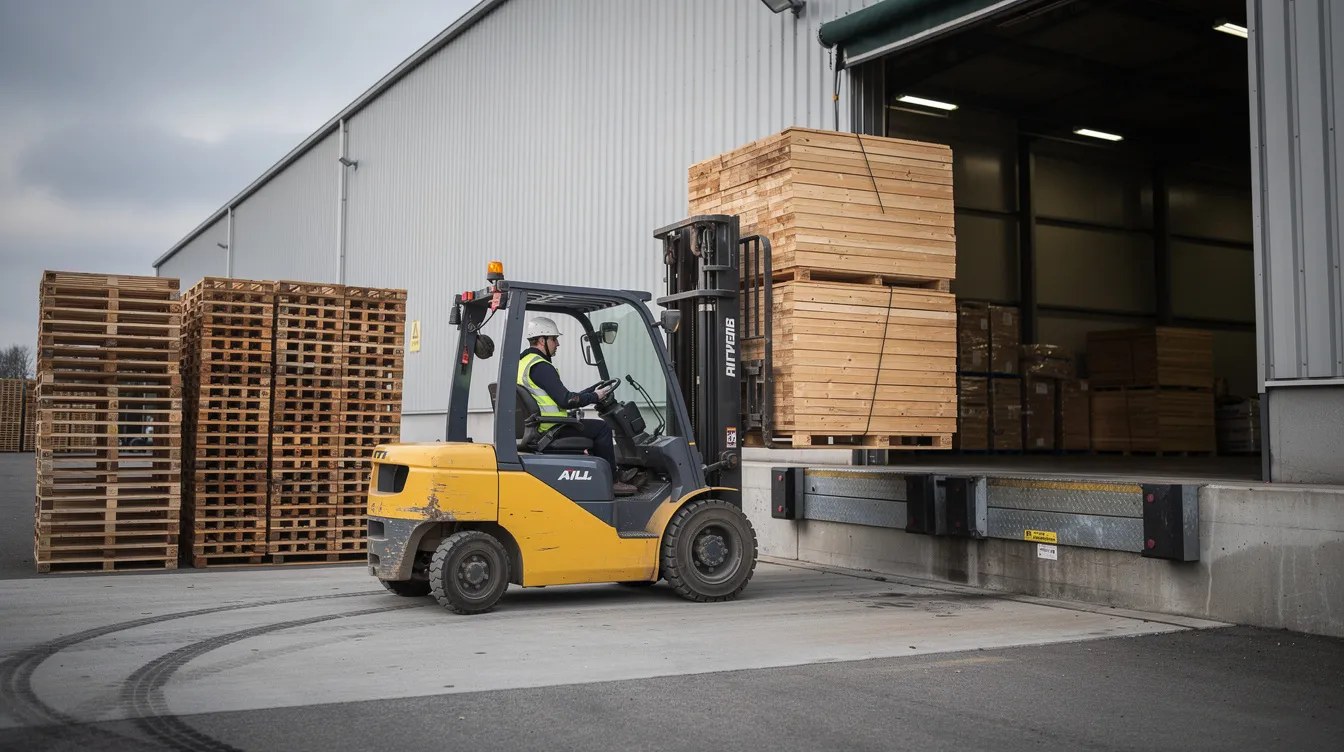
Transport to the ramp: Depending on weight and infrastructure, various handling equipment is used: forklift trucks (up to 3 t lift capacity), electric pallet stackers, hand pallet trucks for lighter pallets.
Loading sequence: The arrangement in the loading area follows the tour and unloading plan. Pallets for the last stop are loaded first (right at the front); goods for early stops go to the rear. Heavy pallets go to the bottom and over the axles; fragile products are placed in the protected interior zone.
Load securing:
- Anti-slip mats: coefficient of friction at least 0.5
- Lashing straps: at least 2 t pre-tensioning force per pallet
- Stanchions and load bars: prevent longitudinal shifting
- Nets: secure stacked or unstable loads
- Form-locking loading: keep load gaps below 100 mm or close them with filler material
FAQ: Frequently Asked Questions About the Number of Pallets in a Truck
How many pallets fit in a 7.5 t truck?
A 7.5 t rigid truck with standard bodywork (approx. 6.00 × 2.45 m loading floor) typically holds 12 industrial pallets or 15 Euro pallets. The exact number varies depending on the bodywork and whether load-handling equipment such as a tail lift is fitted.
How many pallets fit in a 40-tonne lorry?
A standard articulated lorry with a 13.6 m trailer holds approximately 33 to 34 Euro pallets or around 25 industrial pallets. The actual number depends on whether weight and load distribution remain within permitted limits — for heavy goods, the payload of approximately 24 t may be the limiting factor.
How do I calculate pallet spaces myself?
The basic formula is: loading length (mm) ÷ pallet length (mm) × pallets per row = total number. For a 40-tonner with Euro pallets: 13,600 ÷ 1,200 × 3 ≈ 34 pallets. For more complex scenarios with mixed dimensions, online pallet calculators are recommended.
Can I combine pallets of different sizes?
Yes, provided the pallets match the Euro pallet grid dimension (multiples of 400 mm). Half pallets, for example, can efficiently fill gaps. The important thing is to draw up a loading plan in advance to avoid utilisation losses of 10 to 20 per cent.
What role does stack height play?
With sufficient interior height — as in megatrailers with 3 m — pallets can be stacked. Prerequisites: the goods and pallets are designed for this (static load over 6,000 kg), and load securing is adapted accordingly. For more than two layers, the risk of instability rises sharply.
How does pallet planning influence cost optimisation?
Precise space planning significantly improves efficiency. According to industry studies, 80 per cent of all full truck loads (FTL) run at less than 90 per cent utilisation. Every additional pallet per journey saves transport costs and reduces the ecological footprint of goods transport. If your load is particularly heavy or oversized, our truck service in Germany 24/7 and mobile truck service can help with on-site support.
With these fundamentals and the overview table, you can quickly determine pallet capacity for any common truck type. For everyday use, keep the table to hand and use digital planning tools for complex loading scenarios. This ensures every transport is optimally utilised — to the benefit of your costs and the environment.