 Skip to content
 Current Prices 2026 and Complete Guide for Drivers and Transport Companies
A breakdown or accident involving an HGV can happen to any truck driver at any time — whether you’re an experienced professional or an occasional driver. In emergency situations, it’s crucial to stay calm and know the right procedure to ensure the safety of everyone involved. The subject of HGV towing encompasses many legal and technical aspects that are particularly relevant for truck drivers. It’s advisable to always contact a specialized HGV towing service if your truck breaks down or needs to be towed, to receive professional assistance. Professional truck towing services in Germany available 24/7 are available 24 hour a day, 365 days a year, ensuring help is always accessible.
Breaking down with an HGV or car on the road is always stressful — especially for foreign drivers who don’t speak German and aren’t familiar with local regulations. This article covers towing procedures and legal requirements for both HGVs and cars, as both can face breakdowns and require assistance. One of the most important questions in such a situation is: What does towing cost? This article explains all the pricing aspects of HGV breakdown assistance in Germany, provides current prices for 2026, and offers practical tips on how to avoid unnecessary costs and organize help quickly.
Emergency roadside assistance services are available 24/7 throughout Germany.
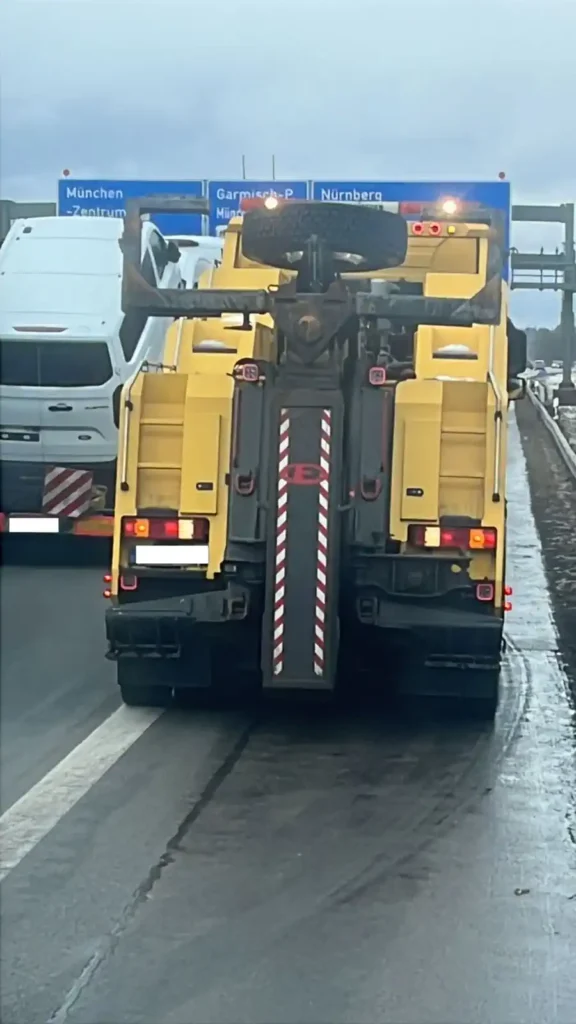
What Does HGV Towing Cost Depend On?
The costs of towing an HGV in Germany consist of various factors such as distance, time, service quality, and service provider policies. Every breakdown is unique — the final amount can vary considerably depending on the specific circumstances. Understanding these various factors will help you estimate potential costs better and make the right decision quickly when an emergency occurs. The reliability of the towing service is also crucial, as dependable and professional assistance ensures your vehicle is handled safely and efficiently. Additionally, the current workload of towing services can impact estimated arrival times and may influence the overall cost, especially during peak periods or high demand.
Beyond the actual costs, the legal requirements for towing a motor vehicle also play an important role. The Road Traffic Act (Straßenverkehrsordnung) regulates vehicle towing under Section 15a StVO. According to § 15a StVO, towing a motor vehicle is only permitted in case of a breakdown to remove the vehicle from the motorway or a hazardous location. It’s also important to note that, according to the law, towing is primarily permitted for the tractor unit, not for the loaded trailer. Key factors for a reliable towing service include proper licensing, insurance, highly trained professionals, well-maintained equipment, and a strong local reputation supported by positive online reviews.
Vehicle Type and Gross Vehicle Weight
One of the most important factors is the type and permissible gross vehicle weight of your HGV. Truck towing services are specifically designed to handle various types of trucks and heavy loads, requiring specialized equipment and expertise. Light commercial vehicles up to 3.5 tonnes can be transported with a standard tow truck, which significantly reduces costs. However, towing HGVs requires specialized towing vehicles that have sufficient pulling power, hydraulic lifting arms, and specialized equipment. Heavy-duty tow trucks are equipped with hydraulic jacks, booms, and winches for effective towing of trucks and heavy loads. Towing also requires special couplings and connectors that securely hold the two vehicles together, especially for trucks. Heavy HGVs, articulated lorries, and combinations require specialist vehicles with appropriate load capacity — the heavier the vehicle, the more expensive the required equipment and thus the operation. For vehicles over 7.5 tonnes and articulated lorries, heavy towing equipment is required, which involves significantly higher hourly rates. Special designs such as lowboy trailers or specialized machinery occasionally require individual solutions.
Various methods are used when towing HGVs and cars: tow rope, tow bar, and tow axle. While a tow rope is mostly used for short-term and safe towing maneuvers with cars, a rigid tow bar is recommended for HGVs to reduce the risk of jackknifing. The tow axle is used particularly for longer distances or special situations to move the HGV safely. The HGV is connected to the recovery vehicle via a special crossbeam on the tow bar or using a wheel lift. The towing method depends largely on the manufacturer of the truck model and its individual systems.
When towing an HGV, the propeller shaft may need to be disengaged to avoid damage to the drivetrain. Additionally, the pneumatic brake system of the towing vehicle should be connected to the towed HGV to ensure braking capability. The ignition of the towed HGV must be switched on so the steering wheel lock is released. The driver of the broken-down HGV must be prepared for the loss of power steering assistance and account for the extended braking distance due to the vehicle’s weight. Furthermore, the driver of the towing vehicle must hold a driving license with Category E endorsement. Engine problems, such as failure to start or breakdowns on the road, are a common reason for requiring truck towing services.
A professional HGV towing service has the necessary equipment and expertise to carry out the towing process safely and without damage. Trucks must also be properly equipped according to German laws, including warning triangles, first aid kits, fire extinguishers, and winter tires, to ensure safety and compliance during towing and roadside assistance.
Distance to the Nearest Workshop or Parking Space
The distance over which the HGV must be transported directly affects the costs. Most towing services charge by the hour — from departure until return to base. The farther the breakdown location is from the base or specialist workshop, the more time is required and the higher the bill will be. Customers can specify their desired location for the vehicle to be towed, and towing services in Germany can transport vehicles to any destination of the client’s choice, such as a repair shop, parking lot, or other placement. On the motorway, the nearest authorized workshop for a rare HGV brand can sometimes be far away, resulting in significantly longer and more expensive transportation.
Time of Day and Day of Week
The timing of the call-out is a crucial cost factor and can double the price. Standard rates generally apply Monday to Friday between 8:00 AM and 6:00 PM. Evening, night, weekend, and public holiday call-outs are charged with substantial surcharges of 50 to 100% on top of the base rate. Since Germany has around 20 statutory public holidays per year (including regional holidays), you should always check the public holiday calendar for the relevant federal state.
Location and Road Conditions
The exact location of the breakdown significantly affects costs. A breakdown on the motorway or highway requires strict safety precautions, which increases the time required and thus the costs. Winter conditions — snowfall or black ice — and other challenging road conditions such as severe weather or difficult terrain extend the call-out duration further. If the HGV is in a tunnel or on a bridge, special safety protocols apply, which increase both time and price. Breakdowns can occur both in the city and on the highway, each presenting unique challenges for towing services due to traffic density, regulations, and access.
A safe and suitable parking space is particularly important for parking the HGV after a breakdown or while waiting for the towing service. Parking lots are common locations for breakdowns and towing operations, so identifying the vehicle’s position in environments like parking lots helps ensure prompt and efficient service. This facilitates the towing or repair process and contributes to road safety. Vehicles involved in accidents may require secure storage facilities to preserve evidence and prevent further damage.
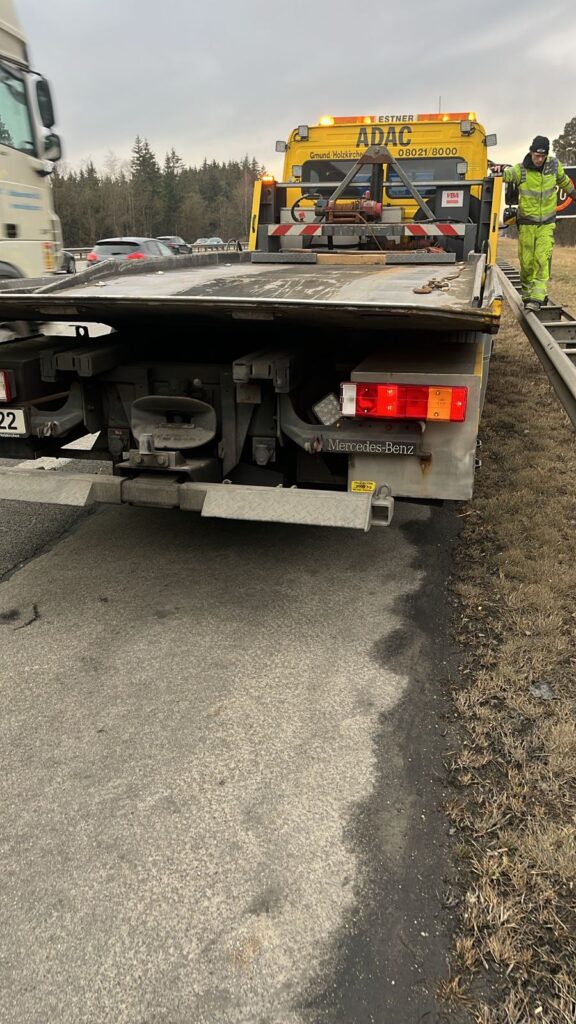
What Does Towing at Night and on Weekends Cost?
Breakdowns don’t keep business hours — often help is needed precisely when regular rates no longer apply. A dependable truck roadside assistance service in Germany that operates around the clock, including weekends and holidays, must provide emergency assistance whenever it is needed. This round-the-clock service is especially important for breakdowns that occur outside regular business hours, ensuring help is accessible at any time of day or night. Some towing services offer a fixed price for certain services to make costs transparent and predictable for customers. The following overview shows how prices change depending on the call-out time.
Base Hourly Rate and Surcharges
The standard hourly rate for towing heavy HGVs during the day ranges from €350 to €450. From 6:00 PM onwards, the rate rises to €450–550 per hour; between 10:00 PM and 6:00 AM (night), it rises to €550–700 per hour. On weekends and public holidays, rates of €550–750 per hour are typical. For light commercial vehicles (up to 3.5 tonnes), the rates are correspondingly lower.
Call-out Time | Light Commercial Vehicle (up to 3.5 t) | Heavy HGV (over 7.5 t) |
|---|---|---|
Weekdays (8:00–18:00) | €200–300/hour | €350–450/hour |
Evening (18:00–22:00) | €280–400/hour | €450–550/hour |
Night (22:00–6:00) | €350–450/hour | €550–700/hour |
Weekends & Public Holidays | €350–500/hour | €550–750/hour |
Indicative values for 2026. Actual prices may vary depending on region and provider. |
Additional Costs Outside Business Hours
In addition to increased hourly rates, extra costs often occur at night and weekends. Since many workshops are closed, the HGV must be parked in a guarded parking space — this costs between €30 and €100 per day depending on region and vehicle size. There may also be costs for transporting the driver, and for refrigerated transport, expenses for emergency cooling or transferring cargo to another vehicle.
Who Pays — Driver or Company?
This question frequently leads to misunderstandings between drivers and employers. German law is clear on this point. Many towing companies in Germany specialize in towing heavy HGVs and buses and offer corresponding services. A professional trucks towing service relies on a well-trained team to assess incidents, provide accurate estimates, and execute towing operations efficiently, ensuring smooth coordination and expert handling of complex situations.
The Transport Company Bears Responsibility
According to German employment law and standard employment contracts in the industry, the employer — the transport company or fleet operator — bears responsibility for the vehicle’s technical condition and all associated costs. All towing, repair, and ancillary costs must be borne by the company, not by the driver. Asking a driver to pay towing costs out of their own pocket violates employment law.
Importance of a Fixed Point of Contact
In case of a breakdown, the driver must immediately contact the dispatcher or the company to coordinate the next steps. The company is obligated to give instructions and organize help — including the towing service. If the company doesn’t respond promptly, professional breakdown assistance services like AutoHelp UG can step in, taking over the entire coordination and helping with cost documentation.
Role of Insurance and Breakdown Assistance
Many transport companies have insurance or a breakdown assistance contract that covers towing costs up to a certain limit. The driver should know whether such a contract exists and how it’s used. Important: Insurance benefits are often limited by distance, frequency of use, or category of breakdown — the small print should therefore be familiar before an emergency occurs.
Why Can Costs Double?
Many drivers and companies experience unpleasant surprises when the final bill is significantly higher than expected. Towing services are either organized with in-house staff or through reliable partners to ensure a quick and efficient solution. By negotiating with the towing company, you can save up to 50% of towing costs. The following factors can lead to a significant increase in costs:
Urgency and Emergency Situations
An emergency call-out — particularly outside business hours — may result in an emergency surcharge. In such situations, a breakdown service can be contacted via an emergency hotline for immediate assistance. Drivers can also contact emergency services directly or use emergency pillars on the autobahn to request professional help and ensure safety. 24/7 truck towing services are available throughout Germany to provide assistance in emergencies, especially for heavy-duty trucks. If the tow truck is required to arrive on-site within 30 to 60 minutes, this is treated as an urgent case and charged at a higher rate. The quick response time of the towing service is crucial to keep the vehicle’s downtime as short as possible for transport companies. Regular waiting time is usually 2 to 3 hours. If the HGV blocks a lane on the motorway, quick action is safety-critical — and correspondingly expensive.
Specialized Equipment and Vehicles
Some breakdowns require special equipment. A professional recovery service will dispatch specialized equipment such as flatbeds, wheel-lifts, or heavy-duty wreckers depending on the situation to ensure safe and efficient vehicle transport. If the HGV has overturned or gone into a ditch, a crane is needed — this adds €500 to €2,000 to the price depending on call-out duration and difficulty. For hazardous goods transport or special vehicles, additional permits and accompanying vehicles may be required.
Hidden Fees and Unscrupulous Operators
Warning: There are unscrupulous operators on the market who exploit drivers’ difficult situations and demand inflated prices. Typical hidden costs include: call-out fee, surcharge for bad weather conditions, waiting fee, and surcharge for foreign language documents.
To avoid this: Use only vetted service providers and have all conditions and the total price confirmed in writing before work begins.
What Documents Are Required for HGV Towing?
Without the correct documents, there can be delays and problems with insurance processing. All required documents should always be at hand to ensure a smooth towing process for your HGV. Foreign drivers should always have the following documents readily available:
- Driving license of the appropriate category (C, CE, or D) — original or certified copy
- Registration certificates for tractor unit and trailer (vehicle registration certificate/registration certificate Part I and II)
- Tachograph with driver card and current data — to provide evidence of driving and rest times
- Freight documents (CMR consignment note, where applicable) — to identify cargo and route
- Insurance policy or insurer details — for potential cost reimbursement
- Employer and dispatcher contact details — for quick coordination
After the call-out, the driver should receive a detailed invoice showing all services provided, times, and provider details. A breakdown report documenting the vehicle’s technical condition at the time of removal is also recommended. All documentation should be submitted to the company’s accounting department.
How Quickly Does an HGV Tow Truck Arrive in Germany?
Arrival time is particularly critical on the motorway or at hazardous locations. It depends on location, time of day, required vehicle type, and service availability. Local companies are often preferred for their faster response times and better knowledge of the area. With more than 1000 tow trucks available throughout Germany, you can be confident that your vehicle is in good hands and will receive quick assistance. A well-organized network of towing services enables particularly fast response times, as coordination and bundling of partners ensures rapid on-site assistance.
Typical Waiting Times
During normal business hours on weekdays, the waiting time for an HGV tow truck is around 45 minutes to 2 hours depending on region and availability. In large industrial centers such as North Rhine-Westphalia, Bavaria, or Baden-Württemberg, waiting times are usually shorter. In remote areas — particularly in eastern Germany or the Alpine region — waiting times can extend to 3 to 4 hours.
Motorway Breakdown: Special Considerations
On the motorway, the situation is particularly critical due to high accident risk. If the HGV blocks a lane, priority response is given — the tow truck usually arrives within 30 to 60 minutes. If the vehicle is on the hard shoulder, normal waiting times apply. Important: The driver must immediately leave the cab, place the warning triangle, and wait for help behind the safety barrier at a safe distance. For towing operations where the trailer poses a hazard, the police must be informed to ensure safety during towing.
Advantages of a Professional Breakdown Assistance Dispatcher
A professional breakdown assistance dispatcher such as AutoHelp UG has a dense network of partners throughout Germany and can quickly coordinate the nearest available, suitable tow truck. This is particularly helpful for foreign drivers who don’t speak German: the dispatcher handles all negotiations. Moreover, the dispatcher can assess whether a tow truck is really necessary or whether a mobile mechanic can resolve the breakdown on-site.
How Can You Avoid Inflated Towing Costs?
Inflated prices are a widespread problem — especially for foreign drivers. However, there are proven methods to protect yourself.
Use Only Vetted Providers
The best protection is to have a reliable contact beforehand. Professional companies such as AutoHelp UG work exclusively with vetted partners, have transparent pricing structures, and provide complete cost documentation. Searching independently for a tow truck online or through notices on parking lots carries considerable risk of encountering an unscrupulous operator.
Get the Price Confirmed in Writing Beforehand
Before agreeing to a towing operation, always request a cost estimate and have it confirmed in writing — via SMS, email, or messenger. Reputable providers have no problem with this. If a provider refuses to quote a price or says “we’ll see,” that’s a warning sign.
Check the Final Invoice Carefully
Examine all line items on the final invoice carefully. Does the stated working time match the actual call-out? Are all surcharges justified and explained? Professional companies explain every invoice item. If there are any unclear points, you can also contact the breakdown service that arranged the towing.
Can It Be Done Without a Tow Truck — Repair on Site?
Not every breakdown requires transportation away. Many problems can be solved by a mobile truck service in Germany right at the roadside — and this saves considerable time and money.
Typical breakdowns that can be fixed on-site include battery jump-starts, tire changes, minor electrical repairs, refueling (including fuel delivery, fuel system problems, and incorrect fuel filling), and unlocking doors.
Before towing, it is necessary to remove any attached equipment from the truck to prevent damage during transportation.
Typical Breakdowns That Can Be Fixed On-Site
- Tire change or tire repair — one of the most common breakdown assistance services
- Refueling with empty tank — mobile refueling is considerably cheaper than towing
- Jump-start for flat battery — standard service for mobile mechanics
- Minor electrical repairs — fuse replacement, connection restoration
- Pneumatic system repair — fixing leaks, fitting replacement, and where necessary, support from a specialized HGV workshop for trailer and tarpaulin repair
Professional breakdown assistance services such as AutoHelp UG or a specialized 24/7 HGV breakdown service in Germany can assess the situation over the phone and determine whether a mobile mechanic is sufficient or whether a tow truck is required. This saves the company costs and reduces the HGV’s downtime on the road.
FAQ — HGV Towing in Germany
- Driving licence
- Registration certificate Part I
- Driver card (tachograph)
- CMR consignment note (if applicable)
- Transport company contact details
