Skip to content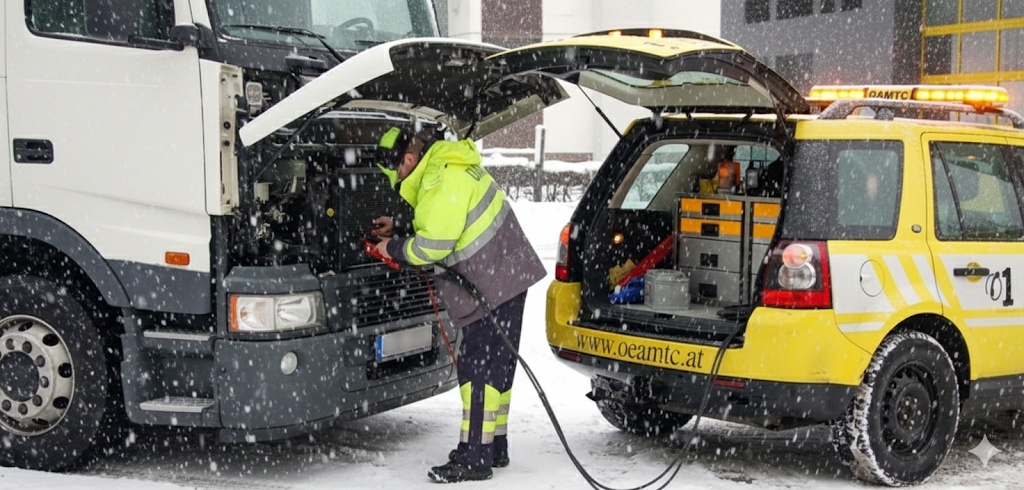
Winter, freezing cold, and the engine won’t start? A familiar situation. Many people rush to get a “jump start” from another vehicle, but a single mistake with the cables can lead to expensive repairs to the electronics. Warning: an incorrectly performed jump start carries risks for both the vehicle and your health. When in doubt, always seek professional help or call a towing service to avoid unexpected costs and damage. Jump-starting is a practical way to start a vehicle with a dead battery, but it must be done with care.
Important Jump-Start Rules: How to Jump-Start a Car Correctly
Both vehicles should be parked on level ground and secured before starting the jump-start procedure. Drivers should always check the car battery for visible damage, such as cracks, leaks, or corrosion, before proceeding. If the battery is cracked, leaking, or shows visible damage, do not attempt to jump-start it — instead call professional help or a breakdown service. Roadside assistance is available in many cases even for non-members, although a fee may apply. Professional helpers ensure a safe jump-start and minimize the risk of further damage.
This is especially relevant for modern vehicles equipped with sensors and control units. The donor vehicle must have a fully charged battery with the same voltage as the dead battery, usually 12 volts.
Jump-starting a car can be dangerous if done incorrectly, and an improper procedure can lead to costly repairs or even an explosion. Drivers should always put safety first and call a breakdown service if they are unsure of the steps.
Below is a step-by-step guide to safely using jumper cables.

Quick guide to jump-starting a car:
To jump-start a vehicle, you will need jumper cables (also called booster cables) and a second vehicle with a running, fully charged battery of the same voltage (usually 12 volts). Before starting, read the owner’s manual for both vehicles — especially for hybrid and electric vehicles, as they often cannot be used as “donors.”
Jumper cables are a simple tool for starting a vehicle with a dead battery. They have four fully insulated crocodile clips — two red and two black. The red clips (red cable, red jumper cable, red clamp, red terminal end) connect to the positive terminals, while the black clips (black cable, black jumper cable, black clamp) connect to the negative terminal of the running battery and to a grounding point (an unpainted metal surface) on the vehicle with the dead battery. Hold the jumper cable only by the insulated plastic handles and wear safety goggles for protection. The jumper cable’s cross-section should be at least 16 mm², and 25 mm² is recommended for vehicles with larger engines.
Carry out safety checks: inspect both batteries for visible damage, leaks, or cracks, and do not attempt a jump-start if any are found. Batteries emit flammable gases — avoid open flames and sparks. Never attempt to jump-start a frozen battery, as it may explode. If you have a jump starter or a portable booster, you can use it as an alternative to cables. Connect the positive cable to the positive terminal, and the negative cable to a good grounding point (unpainted metal surface). Keep portable batteries charged and do not store them at extreme temperatures.
The correct sequence (memorize it!):
CONNECTING:
- Make sure both vehicles are parked, switched off, in neutral or park, and the parking brake is engaged.
- Connect the red jumper cable (red clamp) to the positive terminal of the running battery, then connect the other end of the red cable to the positive terminal of the dead battery.
- Connect the black jumper cable (black clamp) to the negative terminal of the running battery, then connect the other end of the black cable to an unpainted metal surface (grounding point) on the engine block or chassis of the vehicle with the dead battery — never connect it directly to the negative terminal of the dead battery to avoid sparking.
STARTING:
- Start the engine of the vehicle with the working battery and let it run.
- Try to start the vehicle with the dead battery (no more than 10 seconds per attempt). If the engine doesn’t start, wait a few minutes before the next attempt and avoid cranking the starter for long periods.
- If the engine starts, turn on the heater and rear window heater in the assisted vehicle to smooth out voltage spikes.
- Let the engine run for at least 30 minutes to charge the battery, or fully charge it with a charger.
DISCONNECTING:
- Disconnect the black jumper cable (black clamp) from the grounding point (unpainted metal surface) on the revived vehicle first, then from the running battery — always in the reverse order of how they were connected.
- Remove the red jumper cable (red clamp) from the positive terminal of the revived vehicle, then from the running battery.
Incorrect or improper connection of the jumper cables can lead to costly repairs or damage to the vehicle’s electrical components. Jump-starting is only a temporary solution for a weak or old battery; repair or replacement may be required. Regular maintenance and battery checks help identify problems early and avoid breakdowns. Batteries in modern vehicles can wear out faster due to higher power demands, so deep discharge should be avoided to preserve battery health. If the vehicle with the dead battery doesn’t start after several attempts, call a breakdown service or professional help.
What NOT to do when providing roadside assistance:
- Never let the positive and negative clamps touch each other.
- Don’t draw power for a jump-start from a hybrid or electric vehicle if this is prohibited by the manual.
- Don’t crank the starter for longer than 10 seconds.
- If the vehicle with the dead battery doesn’t start right away, wait a few minutes before the next attempt. Avoid repeated or lengthy attempts, as this can increase repair costs and cause additional damage.
- Don’t turn off the donor vehicle immediately after a successful jump-start.
- Note: check the terms and services of your breakdown assistance provider in advance to avoid unexpected costs.
After a successful jump-start: contact ADAC
The battery needs to be fully recharged. Drive the vehicle normally for at least 30 minutes to charge the battery, and avoid using unnecessary power consumers (music, seat heating). For a full recharge, using a stationary charger is recommended.
Jump-starting is only a temporary solution if your car battery is weak or old; the problem may recur, and the battery may need to be repaired or replaced. Avoid deeply discharging the battery to preserve its performance.
Not confident, or afraid of damaging the vehicle? It’s better to call in professionals or experienced helpers — it will save your nerves, time, and repair budget.
Car battery maintenance to prevent breakdowns
Keeping a battery in excellent condition is the best way to avoid the inconvenience of a dead battery and the stress of an emergency jump-start. Whether you run a private vehicle or a fleet of trucks, regular battery maintenance can save time and money and prevent unexpected breakdowns. Here are some important tips:
- Regularly check the battery terminals for corrosion. Clean them as needed to ensure a reliable connection for your vehicle’s electrical components.
- Make sure the battery is securely mounted in the engine compartment to prevent vibrations that could cause internal damage and shorten its lifespan.
- Protect the battery from extreme temperatures. Both excessive heat and cold can affect battery performance, so park in sheltered locations whenever possible.
- Don’t let the battery become fully discharged. Deep discharge can significantly shorten battery life, especially in modern vehicles, hybrids, and electric cars. Always follow the manufacturer’s recommendations for charging and maintenance.
- Invest in a quality trickle charger or battery maintainer to keep the battery fully charged during long periods of standing — ideal for commercial vehicles or trucks that may sit idle for extended periods.
- Watch for early signs of battery failure, such as sluggish engine starts or dim headlights. If you notice this, have the battery checked by a professional before it fails completely.
- Keep the vehicle’s electrical components, such as the alternator and starter, in good condition to avoid unnecessary strain on the battery.
- Keep a set of quality jumper cables or a portable booster in the vehicle, along with clear instructions, to be prepared for emergencies.
- If you’re unsure about the jump-start or battery maintenance process, don’t hesitate to call breakdown assistance or consult a professional. LKW Help 24 offers round-the-clock breakdown assistance for commercial vehicles and heavy truck towing throughout Germany, ensuring you’re never left stranded.
- Always check the owner’s manual for specific battery care and jump-start instructions tailored to your vehicle, especially if it’s a hybrid or electric car.
- When working with the battery, wear protective gloves and safety goggles, and remove metal jewelry that could cause an accidental short circuit. Make sure the work area is well ventilated, and stay away from open flames or sparks.
Overview: roadside assistance options, membership, cost, and digital services
An overview of the main roadside assistance options and services shows that automobile clubs, insurance companies, and car manufacturers offer various ways to get quick support in the event of a breakdown, failure, or accident. As a member of an automobile club, you enjoy exclusive services such as towing, accident assistance, on-site mechanic visits, and often family discounts. Club membership fees and rates vary depending on the scope of services and can range from 45 to 139 euros per year. Premium membership offers a broader range of services but requires higher fees. Many clubs offer various rate plans with different terms, and in the event of breakdowns or accidents at home or abroad, they often cover the cost of transport to the nearest workshop — usually up to a certain limit, however.
Car manufacturers often provide a mobility guarantee for new vehicles, which includes breakdown assistance, towing, and sometimes a replacement vehicle during repairs. This mobility guarantee is usually free for the first two years after purchase, though the contractual right to these services exists only within the respective terms and conditions. Alternatively, your comprehensive insurance policy may offer similar services; the cost of this is usually between 5 and 40 euros per year in addition to the insurance premium.
Roadside assistance can now be conveniently requested via an app. Many providers offer apps for Android and iOS, which let you report a breakdown directly from your smartphone, track the status, and use the geolocation feature to send the exact location of the incident to helpers. These digital services ensure accessibility and efficient assistance — even the loading of information is optimized so you don’t have to wait long in an emergency.
The cost of roadside assistance without membership must be paid out of pocket and depends on factors such as travel distance, time of day, and scope of assistance. For minor breakdowns, such as a flat tire, a mobile mechanic can often solve the problem on the spot. In more complex cases, such as a vehicle failure, an accident, or towing (for example, after a rollover or if the vehicle is no longer drivable), additional services such as vehicle custody and towing come into play. The cost of towing usually starts from 100–200 euros, depending on the region and the situation.
Roadside assistance is relevant not only for private individuals, but also for families, truck drivers, and others who depend on their mobility. Many clubs offer special family rates so that traveling children are also covered. Membership terms determine in detail which services are covered and who they apply to.
Frequently asked questions (FAQ) cover topics such as: what services are included in the fee? How do you call for help via the app? What’s the difference between clubs, rate plans, and insurance? The answers depend on the specific provider, the chosen rate plan, and membership status. It’s recommended to familiarize yourself in advance with the terms, contact options, and availability of services so that you can act quickly and wisely in an emergency. A little preparation — such as saving the service number or installing the app — can make a decisive difference in a critical situation.
This overview should help you understand the key differences and selection criteria between automobile clubs, insurance companies, mobility guarantees, digital services, and the role of car manufacturers in providing roadside assistance, so that you are optimally protected in the event of a breakdown, accident, or vehicle failure.
Roadside assistance for electric vehicles and other vehicles
Roadside assistance for electric vehicles and other vehicles is becoming increasingly important in Germany as more and more drivers rely on modern drive technologies. In the event of a breakdown or accident, it’s crucial to get help quickly and safely — especially when it comes to an electric vehicle. This is where ADAC breakdown assistance comes in: it offers its members, especially premium status holders, an extensive service that goes far beyond a classic “jump-start.”
An important difference in breakdown assistance for electric vehicles is the towing process. Many electric cars can’t simply be towed; they must be professionally loaded onto a platform to avoid damaging the drivetrain. ADAC’s so-called “yellow angels” are specially trained to choose the right approach for both electric and hybrid vehicles. This ensures that your vehicle is handled safely at the breakdown site and reliably delivered to the nearest workshop.
ADAC‘s breakdown assistance services are multifaceted: from on-site repairs and towing to arranging a replacement vehicle — depending on your membership, especially with the premium package, you enjoy an especially broad range of services. Premium members even enjoy worldwide coverage and full reimbursement of costs, such as for towing or hotel accommodation, if continuing your journey isn’t possible.
Besides ADAC, there are also alternative providers, such as other automobile clubs or insurance companies, offering assistance for electric vehicles and classic cars. However, the scope of services and cost can vary greatly depending on the provider and the chosen membership. It’s therefore worth comparing different offers and tailoring them to your individual needs as a driver.
Anyone deciding to join an automobile club should pay attention to the scope of breakdown assistance, cost coverage, and availability in the desired location. Especially for electric vehicles, it’s important that the assistance service has the necessary expertise and appropriate equipment. This way, you’ll be optimally covered in the event of a breakdown or accident and can count on fast, professional help — whether you’re in Berlin, on the autobahn, or abroad.
Overall, breakdown assistance for electric vehicles and other vehicles today offers numerous options to stay mobile in an emergency. Stay informed in good time about the various providers, rates, and services so that you can count on a reliable partner when needed.